
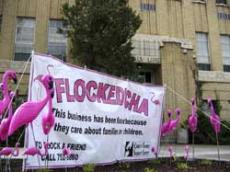
Flocked flamingos raising awareness of abuse problem
A flock of flamingos landed on the lawn in front of the Family Life Building Tuesday morning to raise awareness for child abuse prevention.
The Child and Family Support Center placed the flamingos there because of a donation made to the center.
A sign surrounded by flamingos that said “‘Flocked’cha: This business has been flocked because they care about families and children” was placed so people will ask about it and find out about the center and be more aware of the problem.
The center has four flocks of 25 flamingos. When someone makes a minimum donation of $10 to the center, they will flock someone’s house with the flamingos – either the person who donated or a friend who they wanted to flock, Wright said.
Another way to get involved is to buy a paper flamingo at one of four grocery stores in the valley. They are a dollar and are located at both Lee’s locations, Albertson’s and Macey’s.
The need for awareness is a bigger problem than most people realize, Deborah Ascione, a family, consumer and human development principal lecturer said.
Sixty percent of victims of abuse or neglect are under the age of 10, with those from birth to five years being the largest group, according to the Utah Department of Child and Family Services.
This is why the need for the Child and Family Support Center is so great. The agency is non-profit and the services they provide are free to the public. They operate mainly on grants and donations, said Ascione, who has been a member of the Child and Family Support Center Board since 1995.
The agency is there to strengthen families and protect children, said Stacey Wright, the children’s service coordinator.
It is a shelter for children who are removed from their parents because of abuse or neglect, Wright said, but they also have a crisis nursery for parents who need a break from their kids.
Another service they offer is a respite nursery. Parents will give them a reason why they need a break from their kids and they will set up a time every week when they can leave their kids at the center for two to three hours, Wright said. This is a time when the parents can spend some time together or, if they are single, have some time alone.
With the respite program, Wright said they try to set goals with the families and make sure they are trying to find other support systems..
“We are meant to be a temporary service until parents can find another source,” Wright said. “If they have a doctor appointment, we don’t want the kids to be left at home alone, so they can come here.”
Kayleen Streator, the nursery services coordinator, said the main focus of the nursery is to give parents a place to bring their kids when they are stressed out. It is a good service for parents with ongoing stress, including parents going through a divorce or families with disabled children.
The center will determine what kind of difficulty they are having and if respite is right for them, Streator said. It’s a place where they can bring their children that is safe.
The center has a crisis nursery for an urgent situation where the parents need to drop their kids off. The center will take the child if they have room, or if it is an actual emergency, such as if the parent needs to go to the hospital, then they will make room.
All of these services are free and meant to protect the children.
It’s important for parents to use the services if they are in the situation where they might abuse their children, but Wright said it isn’t just for them.
“One of the misconceptions about us is that we only serve families that meet a certain income level or if they beat their kids,” Wright said. “There aren’t any limitations about who can use our services.”
Wright said they teach life skills that everyone needs to learn.
Many people need the services offered at the center. Wright said children don’t have to have a serious anger problem or be social misfits to come to the classes.
The center offers free therapy to victims of abuse, which is offered to those who can’t afford it otherwise, Wright said.
The center is open 24 hours a day so they can receive calls in the middle of the night about a child that has been removed from the home. The child can come be safe, get a hot meal and be supervised until arrangements can be made – usually until their parents sort their issues out, Ascione said.
When a child is removed from their home, they can live in the shelter for up to two weeks. It is usually until they are placed – either back in their home or in a foster home, Wright said.
Some people bring their children there for years and others for month, Wright said. It really depends on their situation.
The center offers several classes for parents and children.
The different classes range from anger management classes for parents to sibling rivalry classes for children who are taking out their anger about their parent situation on their siblings, Ascione said.
There are parenting classes, which are designed to teach parents more positive discipline strategies. Ascione said they are supposed to help the parents to get their children to cooperate without using physical abuse.
The classes last for eight weeks and are held twice a week. The parenting class is taught four times a year, Wright said.
The Outreach Program is a program where someone actually goes into the home and helps the family set goals and they will keep working with them for free.
Children’s classes are taught to kids ages 5-15 and they include anger management and social skills. They teach them about making friends, bullies, cooperation, communication and self-esteem.
They also teach sex abuse prevention classes, called “Good-Touch/Bad-Touch.” Those are taught to children from third to sixth grade. Wright said it is important for the children to learn the information because one in three girls and one in five boys will be sexually abused by the time they are 18 years old, according to Prevention and Motivation Programs.
The center can handle up to four children per one adult they have on staff. On a normal day, Streator said they will have four to six kids at a time. She also said there tends to be more in the evening and during holiday seasons.
She said the number of kids varies a lot, since sometimes there won’t be any kids and sometimes there might be eight.
For parents to bring in their kids, they have to call in and have it approved, Streator said. The center has to know the situation – what the problem is – and then they will try to find other resources like family members. Streator said they like to be a last resort.
To avoid letting parents use the service as free babysitting, they will restrict the amount of time the child can remain at the center. She said if the child was there a full day, they won’t allow the parent to leave them there again for a while.
“If the parents are trying to get a free babysitter, we will tell them that we have to keep it open for families in crisis,” Streator said. “We get with them and point out other resources.”
Streator said they keep the services free so parents who can’t afford it but need the help can still get it.
“We want them to ask for help,” Streator said.
Because April is National Child Abuse Prevention Month, there are events going on, including the first-ever Blue Ribbon Banquet. The fundraiser will be held at Hamilton’s restaurant April 25. There will be a silent and a live auction where local businesses and individuals have donated several things to auction off.
Streator said students who want to help can volunteer at the center. They can go hang out with the kids or there are lots of projects they can do.
“People have this idea that they aren’t normal because of their backgrounds, but they are normal and they still need to be loved and played with,” Streator said.
Some volunteers just come in and sit on the couch. She said volunteers should come play with them. They just had an unfortunate thing in their lives, but they are still normal children.
For students looking for volunteer hours, it’s a great place, Streator said. They are open from 9 a.m.-9 p.m. She said groups and individuals are welcome.
For information or questions about the center or to volunteer, call 752-8880 or go to the center located at 380 W. 1400 North in Logan.
To get flocked or to flock a friend with the flamingos, a minimum donation of $10 can be made to the center.
-hollyadams@cc.usu.edu