
Flying Saucers
views and flat parking lots sits the nine holes that make up the Utah State disc golf course.
The course was designed by enthusiasts, but its layout has become one of convenience.
“They put [the holes] wherever it’s easiest to mow,” avid frisbee golfer Nate Brookston said.
Disc golf or “frolf” as it is known around the world, has been around since 1976 when the first disc catcher was made.
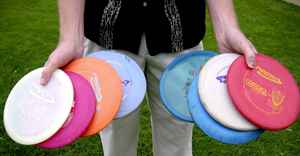
A metal basket with chains hanging down from the top like a maypole serves as the hole. Flying discs, are used and are made especially for disc golf. They are smaller and more dense than frisbees and come in a multitude of styles, which depend on their intended mode of use.
Two main distinctions can be made between the types of discs: driver and approach.
Driver discs come in light and heavy varieties, depending on preference and weather. Heavier discs are better used when the wind is stronger. Some driver discs also have rims made to roll better when the disc hits the ground.
To throw the discs, you should usually have two fingers under the rim with the thumb on the outside as you throw it – like you would a frisbee, Brookston said. There aren’t any rules to throwing, he said, as long as you don’t cross the hole’s marker before you release or cross where your disc had landed from the throw before.
If you were me and had just thrown the disc, it probably just hit a tree or went into the street or parking lot. While you are responsible for any damage caused, its pretty tough to do so with a disc.
If your throw did make it into the parking lot, it’s a one-stroke penalty and you throw from where the disc crossed into the out of bounds. Other than the parking lot, anything man-made – including the volleyball courts – are out of bounds, but if any part of the disc isn’t touching the man-made surface, you’re safe.
Also, if the disc is caught in a tree or any other tall object above 2 meters, it is out of bounds.
Eventually, you will make it close to the hole. Within 10 feet of the hole, you must throw without any forward momentum, so just plant both your feet and toss.
The second type of disc is used when you are up close. The approach discs are called putters from their “ball golf” counterparts.
A myriad of different techniques can be used to put the disc in the hole. You can float it in, you can toss it like a saucer or you can try to tomahawk it into the hole – whichever way you feel is the best to get it in. Again, the only throwing rule is don’t cross the edge of where your disc landed.
Brookston said the biggest tip is to throw as flat as possible to ensure a good throw.
Discs can be rented from the Student Living Center or can be bought at the Outdoor Recreation Center or other sport equipment retailers.
There is a map of the course on the south-facing wall of Wasatch Hall and you can get a scorecard and course map at the disc golf Web site at www.usu.edu/discgolf.
-krn@cc.usu.edu