
Former Aggie netters make move to coaching
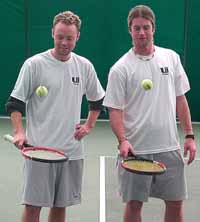
Steve Peterson and Andy Madersbacher attend the Utah State men’s tennis team practices and matches. They attend the women’s team practices and matches. They both are even returning to the team after being members last year.
Despite their dedication to the team, though, neither Madersbacher nor Peterson will have the opportunity to play in a match this season.
No, it isn’t because they aren’t good enough — they both played in most of the team’s matches last year. It isn’t even because they are hurt, although both have had to deal with injuries.
It is because both have made the transition to coaching.
“Last year toward the end of the season I started working with the women a little bit even though I was still playing. I loved it,” Peterson said. “I told [Head Coach] Chris [Wright] after the season that I wanted to help out. He normally only has one assistant but he told me he’d make room.”
Although Madersbacher and Peterson completed their college eligibility last season, after three years and one year of playing, respectively, both still had schooling to finish.
With the departure of former assistant coach Jevin West, who left to finish post-graduate work, the team had an opening for an assistant.
Wright said Madersbacher talked to him last year about the position and was given the job to allow him to finish up his
schooling.
“I thought it looked really fun and I wanted to keep in touch with tennis,” Madersbacher said.
The position also reimburses Madersbacher, allowing him to afford to finish going to school, he said.
Unlike Madersbacher, who is paid, Peterson is volunteering his time as an
assistant.
Originally an attempt was made to get Peterson more eligibility to play, but when that didn’t happen, Wright said Peterson approached him last spring about helping out with the team.
“We’re glad to have him help,” Wright said. “He’s been very generous in coming out and putting in time for us.”
The factor that made the transition from player to coach easiest was that both men were respected as players, Wright said.
Neither Peterson nor Madersbacher said they have had too many problems with the transition and have actually found it beneficial to already know the players on the level they do.
“Some of them are my close friends that I’ve just known for years and they know me so well,” Peterson said. “Sometimes when I have to maybe get a little tougher on some of them, it’s hard for both of us because I don’t want to be doing that and they’re like ‘this is Steve, this isn’t my coach,’ so it’s a little challenging, but I think I’ve earned the respect of the players.”
Madersbacher said, “I know many of them and how they are. It may be easier for me than for [Coach Wright] to understand them and talk to them. They’ll listen to me.”
Players on both the men’s and women’s teams also said they didn’t find the transition too much of a challenge, mainly because of the respect the players have for the two assistants.
“I think that when they’re giving me advice I really listen because I know that they were just barely there,” said women’s team member Holly Anderson.
Senior Jordan Butler said he likes having Peterson as a coach, especially because the two were friends before Peterson came to Utah State. It was Butler who originally convinced him to come to USU to play tennis, Peterson said.
Peterson had originally played at Weber State University before taking a couple of years off.
“It’s fun. I like it. He knows my game real well because he’s seen me play for a long time,” Butler said. “He knows what I need to do and has got some good insight.”
With their tennis knowledge from years of playing, in addition to their time at USU, both Peterson and Madersbacher have made an impact as coaches.
Peterson said he is able to contribute work ethic while Madersbacher said he has been able to help with the mental game.
“I wasn’t the most gifted player on any of the teams I’ve been on, but I think I worked as hard as anyone,” Peterson said.
Madersbacher said he had difficulty with his mental game and that has now allowed him to help other players.
“I had a hard time mentally,” he said. “Now I can show them what I did that was probably wrong.”
The fact that both know so much about the team may be one of the biggest benefits, though.
“They’ve seen teams that we play. They know our games,” Butler said. “They know our strength and our weaknesses, what we need to work on and get better at. It’s not an outsider looking in, it’s an insider who already knows.”
Madersbacher, who is finishing his degree in business administration, is looking to attend graduate school to earn his MBA. He said his preference is to remain at Utah State where he can continue coaching during his schooling.
As for his plans with tennis, Madersbacher, who is from Kramsach, Austria, said he grew up playing tennis and will most likely continue, although he probably will not continue coaching after finishing school.
He said he would like to do something with his degree, either in the United States or Austria.
Peterson, on the other hand, said he would like to continue coaching after he finishes his degree in sales communication.
“I would like to stay in coaching, but I need to make some money, too,” he said.
Most likely, Peterson said he will get a job in sales, but try to keep coaching at the college level on the side.
“At the college level it’s just so much more fun,” he said. “They want to be here and they’re all good. You don’t have to tell them that much. It’s more working with mental aspects and a little bit of strategy.”
In the meantime, both will continue to be valuable parts of the USU teams.
“We’re good friends with them and they’re great at coaching,” said women’s team member Carolyn Larsen. “I don’t think we could work without them this year.”
–slbk5@cc.usu.edu