
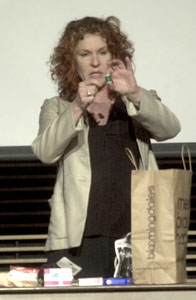
From white-out to medicine
What do cell phones, Jell-O, Scotch Gard, Barbie and brown paper bags all have in common?
To the surprise of many Utah State University students who attended Ethlie Ann Vare’s lecture Wednesday afternoon, these products were all the genius creations of female inventors.
In honor of National Women’s History Month, the USU Women’s Center and Associated Students of USU invited the California TV-show writer and author to speak about female inventors whose inventions affect the lives of millions of people everyday.
“Inventions by women have been saving my life since I was born,” Vare said.
Vare said she first became interested in female inventors in the 1980s while she was working as a rock ‘n’ roll journalist.
She learned that Michael Nesmith of the Monkees was the son of millionaire Betty Nesmith, inventor of Liquid Paper.
Vare became curious about female inventors and, with the help of fellow-editor Greg Ptacek, began researching the subject.
Vare said she began considering the multitude of inventions potentially created by women, “I bet there’s all kinds of things that were invented by women and I’ve never heard of them.”
However, after finding “not one mention of one woman inventor” in books written about inventors, Vare and Ptacek began their own investigation.
According to Vare, the U.S. Patent Office reported that only 14 percent of all patents were filed by women, not including patents listed under company names, foreign names and single initials.
Vare reasoned that of the five million patents on file, 750,000 were filed by women, and she hadn’t heard of one of them.
“History seems to remember some and not others,” Vare said in her lecture. “Inventions by women, for some reason, have slipped through the cracks of history. Individual women have been individually robbed of credit continually in the last century and earlier.”
After further investigation, Vare said she discovered a slew of female inventors and their inventions – a list long enough to fill an entire book. Vare and Ptacek wrote “Mothers of Invention,” in 1989, which won the American Library Association Award that year.
This was the first book ever written solely about female inventors, she said.
Additional books have since been written by Vare and Ptacek, including “Patently Female” and an entire textbook on female inventors.
Vare mentioned inventors such as Hedy Lamarr, whose technology designed for submarine communication led to the invention of cellular phones. Madam C.J. Walker became the first black millionaire in the United States at age 25 after she developed hair products for black people and sold them door-to-door.
Mary Anderson of Alabama invented the first windshield wipers for automobiles. Gertrude Belle Elion, the first woman in the Inventors’ Hall of Fame, discovered the cure for leukemia, gout and a medication to suppress herpes.
Rick Meyer, a civil engineer graduate student, attended the lecture and said he was most impressed to learn that an 8-year-old girl was the inventor of a bacon rack.
This young girl, now 14, is supporting her family with millions of dollars she has earned from the invention, Vare said.
“I’d never really thought about the perception of women as inventors,” Meyer said. “There’s really a lot out there who have contributed to our society.”
Michelle Stites, a junior majoring in communicative disorders said she enjoyed the story of Hannah Slater, the inventor of sewing thread.
Hannah Slater was not listed initially by name as the inventor, but rather as Mrs. Samuel Slater.
The name was later clarified when Vare received a letter from an ancestor of Slater, graciously exposing her identity.
Vare’s use of visual aids during the lecture helped the audience get a better perception of who these women inventors were.
Shallie Ehlers, a junior majoring in dietetics, said the pictures of the women helped put a face to a name.
“When you can put a face to the inventor it makes it so much more important,” she said.
Vare quoted Rosalyn Yalow, winner of the 1977 Noble Prize for the invention of radioimmunoassay, to emphasize the importance of women becoming inventors. Yalow said in her acceptance speech, “The world cannot afford the loss of the talents of half its people if we are to solve the many problems which beset us.”
Vare concluded by encouraging women, half of the world’s population, to learn to think in a new way. She said women are inventors all the time, and it is up to this generation of inventors to rewrite the history books.
-jhrash@cc.usu.edu
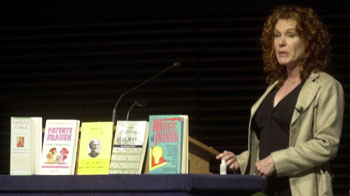
Writer Ethlie Ann Vare stands with two of her books, “Patently Female” and “Mothers of Invention” with the German, Korean and Japanese translations of the latter. (Photo by Michael Sharp)