

Future foresters confront uncertainty
Imagine you’re a college senior who just landed your dream job working for the U.S. Forest Service — a career that won’t necessarily make you a lot of money but is fueled by a passion for the natural world and protecting our federal land. Then you receive an email terminating you.
On Feb. 14, thousands of federal employees received that email. As part of an initiative by President Donald Trump’s administration to shrink the size of the federal workforce, probationary federal employees were terminated from their jobs across different agencies.
This initiative affected the whole nation and directly impacted students on Utah State University’s campus.
“Just seeing all these jobs go away and science being defunded — I guess I don’t really know what I’m doing with my life at the moment,” said Anna Hansen, sophomore in USU’s forest ecology and management program. “I had these goals to do, and now I’m not really sure if that’s going to work out.”
Federal probationary employees are people who have been in their role for under three years and can be let go at any time. These jobs, after their probationary period, can turn into a lifelong career.
“Those types of employees were targeted by the administration to be let go because it was easy,” said Ellen Orlemann, junior in USU’s forestry program.
Orlemann was someone who received a termination email. She was hired out of high school in the Cedar City Ranger District and worked out of Filmore for the last two summers.
While the termination was “blindsiding” for Orlemann, she said it wasn’t as devastating to her as others she knows — people who moved across the country for a job they have now been let go from.
These federal employees who manage the federal lands do everything from maintaining hiking trails and manning entrance stations to wildfire prevention. Temporary or newer employees are a large portion of that workforce.
“The American public doesn’t realize how much these government employees who have been cut — how much they do for public land,” Orlemann said. “Without all these lower-grade employees, the nation would not function and will not function. People don’t see that until it’s gone.”
Federal and state land is protected land for wildlife, plants and people. According to Utah.gov, 71% of the land in Utah is managed by either a federal or state agency, an amount of land bigger than the entire state of Arkansas.
“Especially with the urban population along the Wasatch Front, people need that escape — that release. That has to be protected,” said Darren McAvoy, wildland resource professor at USU. “If you just let it go by itself, it’s a little bit more inclined to have troubles with fire, insects or disease. Long-term prudent forest management can help minimize the disturbances that happen on our forest land.”
Utah’s Forest Service and Bureau of Land Management primarily manage wildlands containing woody species in Utah, but it’s about more than just the trees. Taking care of the forests is important, as most of the water in Utah comes from forested land. The better the care, the higher the potential for water quality and quantity.
Another important aspect of the Forest Service is fighting wildfires. Hansen, who has a job this summer in wildland firefighting, didn’t lose her job.
“Cutting everything else is crazy, but then firefighting is even crazier,” Hansen said. “I feel like they stopped the hiring of a lot of wildland firefighters with the hiring freeze, so it’s kind of made the summer of wildland firefighting feel a bit more scary because there’s going to be less people to help, and with climate change, the fires are only getting worse.”
These positions help preserve and protect the land. The people who work in these fields typically do it because of a passion, not money.
“I’ve always really cared about conservation science and protecting the planet, and to see that other people don’t care and the government doesn’t care is kind of a depressing feeling,” Hansen said.
The Quinney College of Natural Resources at Utah State has several different majors for students to turn their passion for the outdoors into careers. In years past, there were more forestry jobs than USU students to fill them, and the Forest Service paid a lot of attention to QNCR graduates.
With the changes and terminations, the outlook for this year’s graduates could be very different and affect those still in college who are considering pursuing this career.
“There’s still a need for foresters long-term in the country,” McAvoy said. “I still believe that job prospects are probably better now than they have been anytime during my 40-year career, despite the challenges with the uncertainty from the federal government.”
Since the layoffs, some jobs have been brought back, but there is still uncertainty in the future of both forestry and other land management agencies.
The lack of jobs is not the only reason Hansen is concerned.
“The Earth is so beautiful, and it’s our home. We all live on it as one community of humans and whatnot, and it provides for us,” Hansen said. “It’s just sad to see that people don’t appreciate that.”
Even with the current uncertainty, McAvoy said he is still encouraging students to pursue these careers.
“Even if you’re not pursuing a career in forestry or land management, the work that these people do affects you,”
McAvoy said. “Any trail that you use, picnic area you enjoy or fire that could be near your house is managed by someone working in these federal or state agencies.”
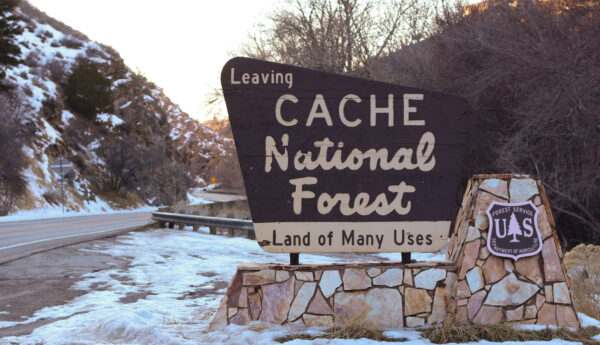
The Cache National Forest sign up Logan Canyon as seen on Feb. 26, 2025.
Great article! Unfortunately, my last name is actually spelled “Orlemann.”