
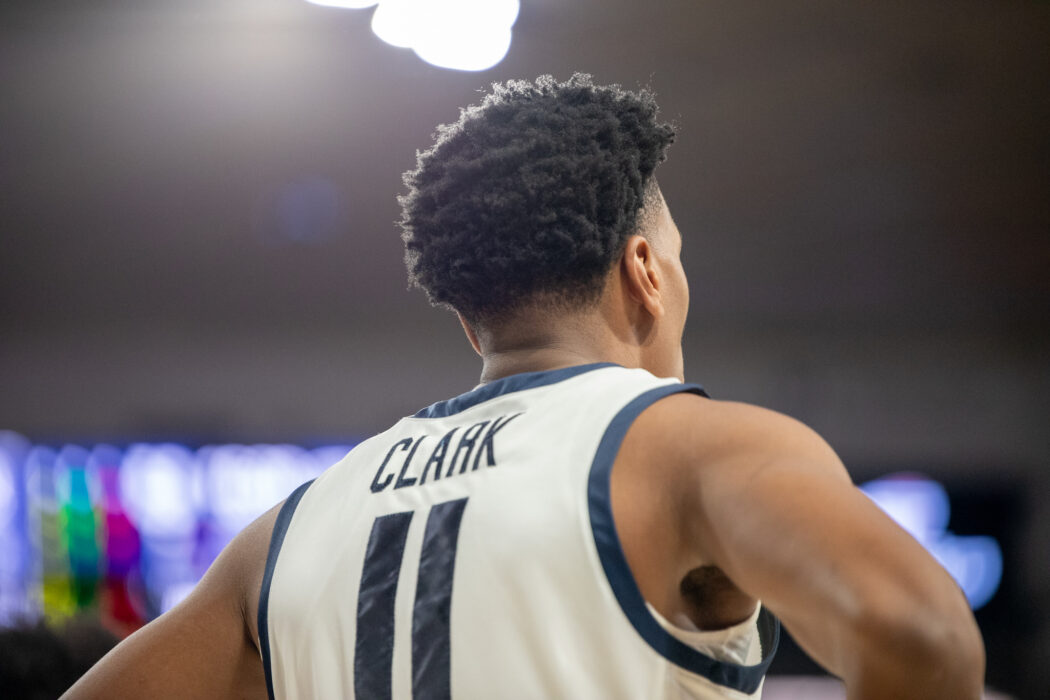
Garry Clark’s patient, persistent path to Utah State
On most days around Logan, Garry Clark blends in easily. He’s usually quiet. Laid back. Often on his phone — not scrolling social media but playing chess.
“Yeah, if anybody sees me around town on my phone, I’m probably playing chess,” Clark said with a smile.
It’s fitting. Clark’s basketball career has unfolded less like a straight-line sprint and more like a long, patient march — full of adjustments, sacrifices and moves made with the future in mind. Now, in his final year of college basketball, those years of preparation have brought him to Utah State.
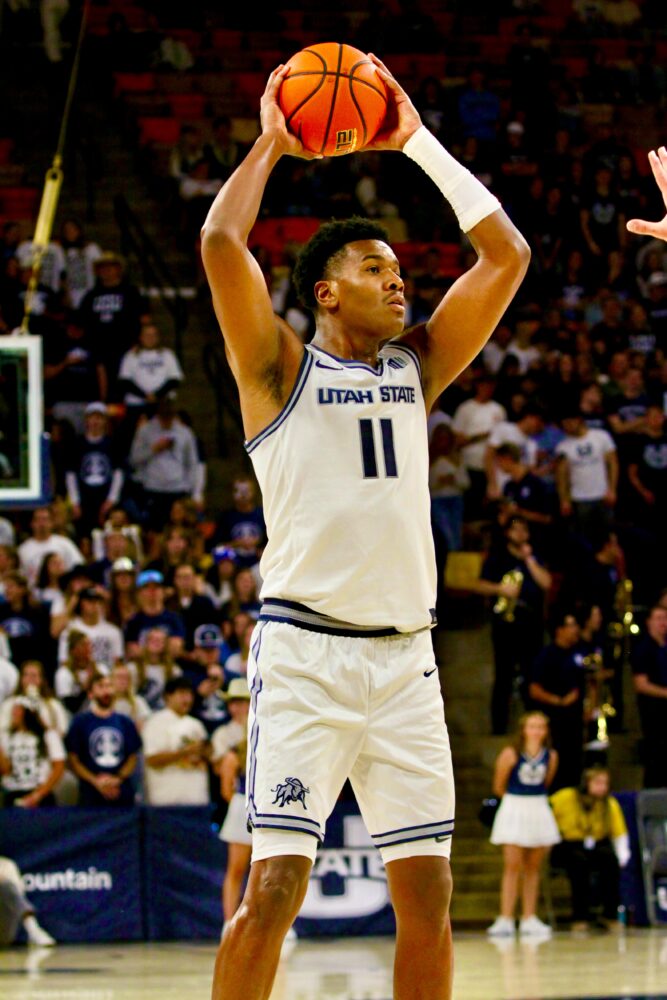
Garry Clark prepares to pass the ball during the season opener against Westminster on Nov. 3rd. Photo by Hadley Sintay.
For Clark, the transition to Utah State has been about more than basketball. After spending the previous two seasons at Texas A&M-Corpus Christi, where he was the top scorer in front of modest crowds, stepping into the Dee Glen Smith Spectrum felt different immediately.
“They’ve opened me here with open arms, and it’s been some of the best moments of my life,” Clark said. “Basketball-wise, I’m playing in the most packed arenas every night, and here in Logan is special. My last two years, I hadn’t had that, so being able to get here and experience that my last year in college basketball means a lot.”
The Spectrum atmosphere was one of the first things that caught Clark’s attention during the transfer process. When Utah State coaches reached out last summer, Clark did his homework. He watched games and noticed the crowds. He listened closely when head coach Jerrod Calhoun laid out what the program stood for.
“It was just something that’s hard to turn down, especially coming from the conference I was in,” he said. “Just seeing the building packed like that and everybody screaming — that is something that drew my attention immediately.”
His sister Lauren Young noticed it too. A few visits to Logan were enough to convince her Utah State was different.
“The games, the crowd, everything is fantastic,” Young said. “From the slow pace of life to the mountains, it’s completely different from Corpus Christi.”
Clark’s path to Utah State wasn’t simple. In fact, it rarely has been.
Out of high school, Clark didn’t have Division I offers waiting. A COVID-altered senior year added even more uncertainty, forcing him into a year of prep basketball before he eventually landed at the junior college level. From there, he worked his way up to Corpus Christi and finally to the Mountain West.
“If I can do it, anybody can do it,” Clark said. “I didn’t have any special advantages. I’m not the most athletic player or anything, but if you have the motivation and the determination, you can do it.”
For Young, watching that journey unfold was equal parts pride and patience. Being 13 years older than her brother, she often filled a parental role growing up, emphasizing academics, discipline and consistency just as much as basketball.
“Stopping or quitting was never an option for him,” Young said. “If something got in the way, he figured out how to get around it or go through it.”
Those lessons carried into Clark’s college career, where he’s had to constantly adjust to new roles. On certain teams, he’s been the go-to scorer. On others, he’s been a role player fighting for minutes. Each stop required honesty — with coaches, teammates and himself.
“Every situation is different,” Clark said. “You have to be open-minded. Even here, where I’m more of a role player, just being able to accept that and grow in that position has helped me grow as a man.”
That adaptability has made him a natural fit in Calhoun’s system, which values depth, flexibility and matchup-based rotations.
“Garry Clark is kind of a sneaky type of guy,” Calhoun said. “He’s very, very strong. He’s stronger than he looks.”
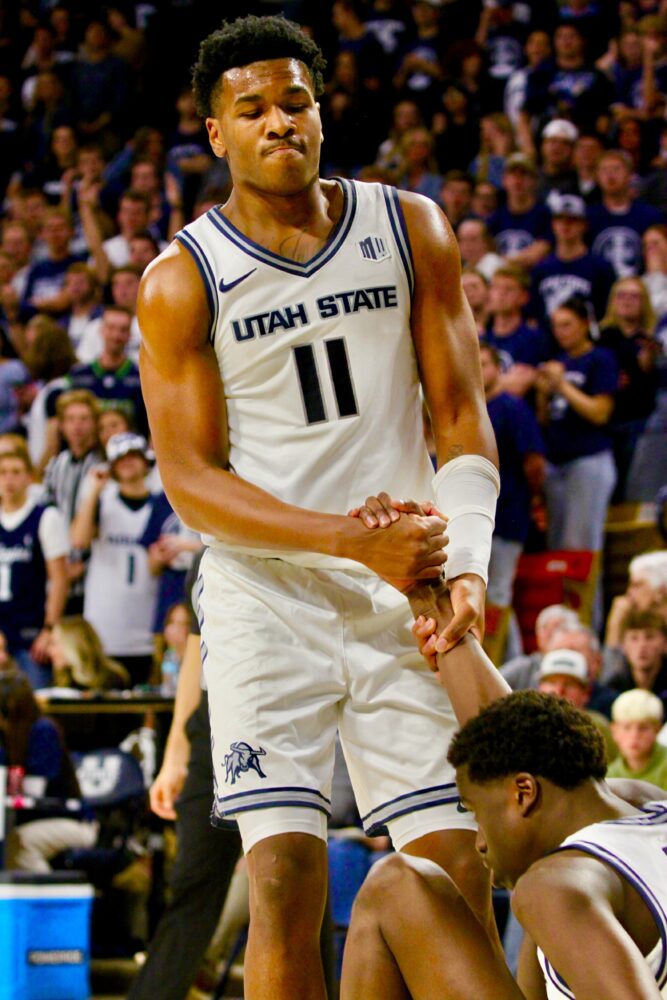
Garry Clark helps up Adlan Elamin during the season opener against Westminster on Nov. 3rd. Photo by Hadley Sintay.
Clark wasted little time making an impression this season. Coming off the bench, he provided physicality, scoring and rebounding, quickly earning national attention as one of the Mountain West’s most effective reserve bigs. Through 10 nonconference games, he averaged 10.5 points and 7.8 rebounds per game.
“The start I got off to was very important for me this year, and it’s momentum that I’m trying to keep rolling to finish off the season,” Clark said.
Utah State guard MJ Collins Jr. has seen Clark’s impact firsthand.
“Garry is a powerhouse down low,” Collins Jr. said. “It gives everybody else open threes. We feel like we have two of the best bigs in the conference in [Karson Templin] and Garry.”
But conference play has brought new challenges. The Mountain West is deep, physical and loaded with size, and the 6-foot-9 Clark often finds himself battling bigger bodies. Foul trouble has limited his minutes at times, something Calhoun has openly acknowledged.
“Garry’s used to staying on the block, playing against kids his size,” Calhoun said. “He’s got to be a little creative. But the thing that I love about Garry is he’s really learning the game and expanding his game, and he really loves it.”
Clark has taken that challenge head-on, breaking down film with his father and focusing on defensive discipline.
“I’ve got to quit playing with my hands,” Clark said. “I’m undersized, so I can’t out-physical a lot of guys. I’ve got to move my feet more.”
Young has noticed the same thing from afar.
“It’s containing that excitement,” she said. “We don’t make those silly fouls and can stay on the floor longer.”
Off the court, Clark’s story took an unexpected turn when his sister wrote a children’s book about his journey. “And Then There Was Garry” was born from Young’s work as a teacher in St. Louis, along with her desire to give kids a real example of persistence.
“Garry was the motivation for that book,” Young said. “I wanted other children to see that if you work hard and stick the course, you can achieve great things.”
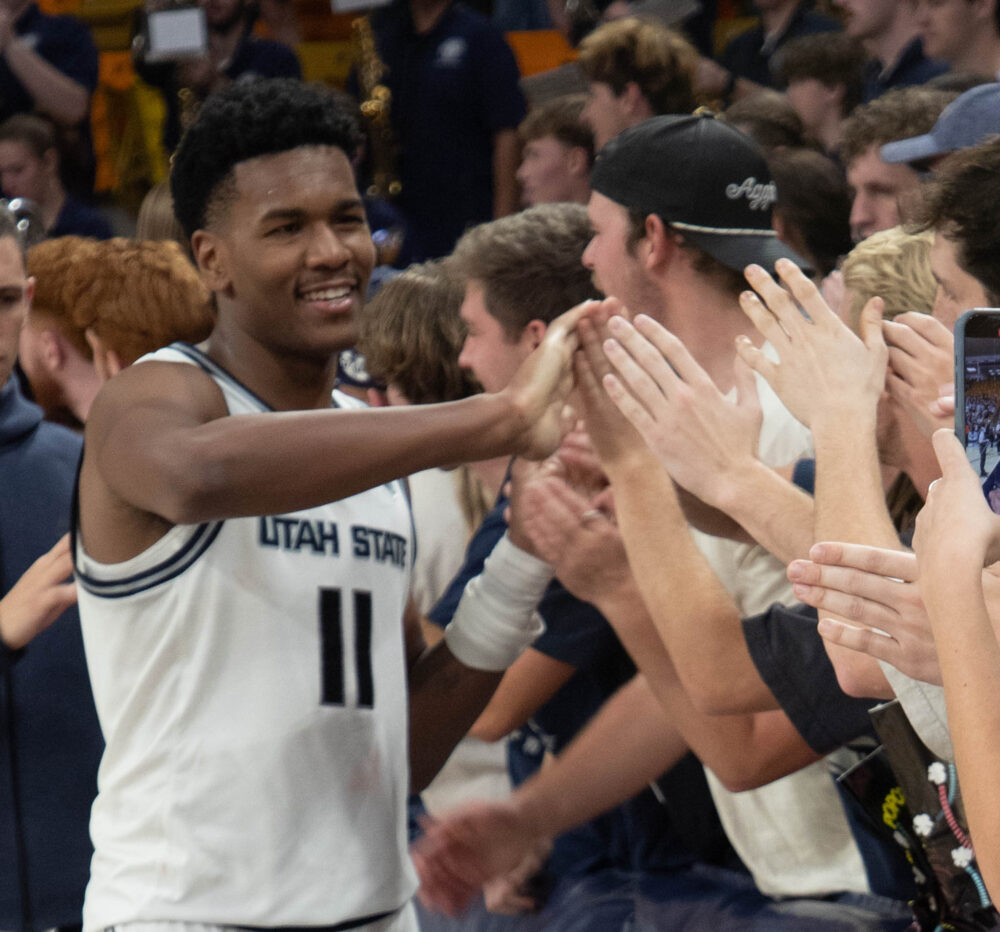
Garry Clark, 11, high-fives fans courtside after the win over UTEP on Nov. 15 at the Spectrum. Photo by: Alyssa Cook
Clark contributed with plenty of ideas and feedback, watching his life turn into illustrated pages. The message is simple: Success doesn’t have to be immediate to be real.
“That’s really what we were trying to show,” Clark said. “Anything is possible.”
Utah State’s season hasn’t been perfect, and Clark is quick to say that’s the point.
“You really find out who you are when you go through adversity,” he said. “Nothing is going to be given to us.”
Still, moments like his key minutes in a comeback win over Colorado State and a productive 13-point, 5-rebound performance in 16 minutes against Wyoming remind Clark why the grind matters.
“It’s been hard for me to accept not being able to help the team as much in certain games, so just me staying levelheaded and being able to help my team get a win means a lot,” he said.
As his college career winds down, Clark isn’t looking too far ahead. He wants to stay in the game in whatever form that takes and for as long as possible.
For now, though, he’s content in Logan, playing in front of packed crowds while continuing to learn, adjust and think a few moves ahead — just like a chess match.
You must be logged in to post a comment.
There are no comments
Add yours