
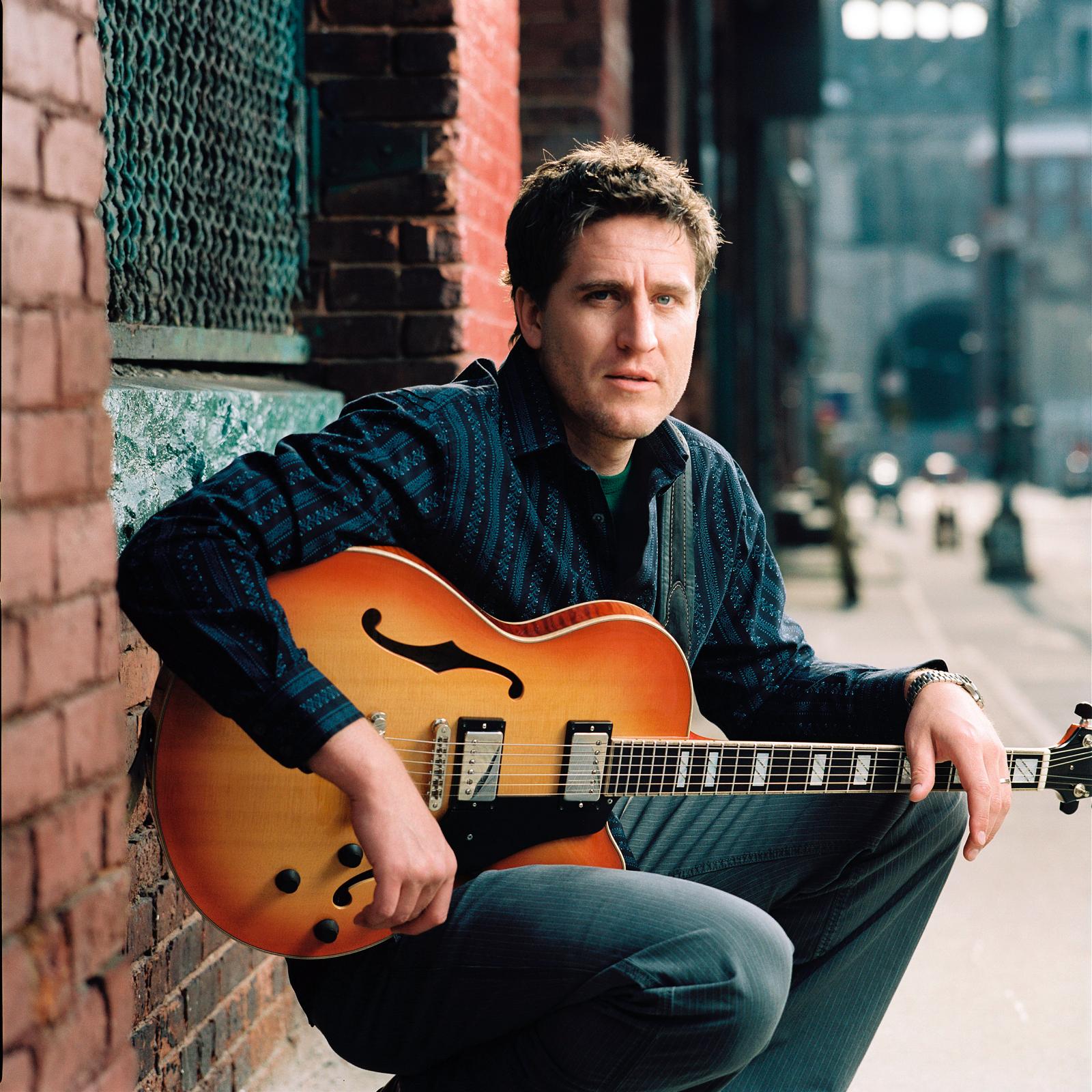
Guitar professor learns while teaching
Corey Christiansen, an instructor of guitar performance and jazz studies, leaned back in his chair in an office buried in the University Reserves building, his stature framed by the cozy clutter of sheet music and books plastering the wall behind him.
“Utah State asked me to be a visiting professor for a few years, so here I am,” Christiansen said.
He was following in the footsteps of his father, Mike, who also teaches at USU.
Christiansen was raised in Smithfield and said he is happy to be back in Cache Valley, teaching at the school where he earned his undergraduate degree in guitar performance.
“He was a student when I first started teaching here,” said professor Todd Fallis, who teaches low brass and jazz studies. “He’s one of the best guitar students this program has ever seen.”
Christiansen attended graduate school at South Florida University and soon landed a job as senior editor at Mel Bay, a sheet music publisher. He said he traveled the country and the world, gaining the necessary experience to become a great guitarist.
“He has a much bigger picture because he has seen what it’s like to be a musician in almost every way that you are a musician, whether it is teaching young kids or teaching college students or performing here in the U.S. or in Japan,” Fallis said.
Christiansen said the travel has been one of the best parts of his experience.
“It’s great to travel,” Christiansen said. “I am really fortunate in that I get to go out and play music with some of the best musicians in the world.”
Through his tours overseas, Christiansen had the opportunity to see cultures radically different than those in the U.S. and gave him a new perspective on the world and on music.
“I’ve been very lucky. I’ve been all over the world and worked with musicians from all different backgrounds and countries and financial circumstances,” Christiansen said. “Some were from situations that weren’t very desirable but they seemed to make the happiest music. The fact that I have been able to travel and see different cultures have been the most beneficial experiences that I’ve had.”
This global perspective has given him the tools to be an effective teacher, said Nick Manning, junior majoring in guitar performance.
“He is a good professor and mentor because of his world experience,” Manning said. “He has traveled all over the world playing the kind of music that we are trying to learn to play.”
Christiansen believes teaching is a learning experience in itself.
“One of the great things about teaching is you really have to know something to teach it,” he said. “Every time I am showing a student how to do something, it is reinforcing that concept, principle or technique in my own playing.”
He said he strives to be the professor who doesn’t merely teach but who has the experiences to support his methods.
“I have tried to be the teacher that does all the things that I tell my students they should be doing,” Christiansen said. “One of the benefits of going out performing and recording is I can tell my students this is how it really is when you are a professional musician. It’s not something I’ve read about. It’s not something I heard someone talk about, I’ve done it.”
His students often watch him perform, hoping to learn something from the “cool cat.”
“He’s wild and knows how to deliver,” Manning said. “There is always a good pacing, variety and contrast. There’s always energy, but he knows how to build from a subtle energy to a roaring climax. Through his performances, I have learned that I need to pace myself and let silence abound.”
“The best part about performing is making the music itself,” Christiansen said. “I like being a part of the music in the moment.”
In the practice room, Christiansen hopes his students see him as dedicated and honest.
“I don’t mind it if they think I am a little bit tough,” he said. “I think especially in music, the business is tough and you need teachers that are no-nonsense. I just don’t believe in telling somebody they sound good when they don’t sound good then when they do sound good, it’s hard for them to trust me.”
In lessons, classes and ensembles, students know who is in charge, Fallis said.
“Although the students know that he is the teacher and they’re the student, they have a great personal relationship,” Fallis said. “Everyone feels like they are on the same plane.”
Christiansen said he hopes his students will learn from his successes and go on to make their own name in the music business.
“In order to succeed a musician needs three things,” Fallis said. “Practice, make connections, and through those connections and hard work, get the gigs that will expand the whole world of playing.”
This was the method Christiansen followed to success and said he encourages his students to do the same.
“Practice, practice,” Christiansen said. “Keep practicing and get many different sources to draw from because the more you draw from other people the more original you are going to be. Being an original is a good thing as long as you’re not just an original to be an original. I think you need to some kind of influence that has stood the test of time.”
For the faculty and students at USU, Christiansen’s influence has stood the test of time, Fallis said.
“He could be anywhere,” Fallis said. “I hope he sticks around here. He’s the real deal.”
-brianne.palmer@aggiemail.usu.edu