
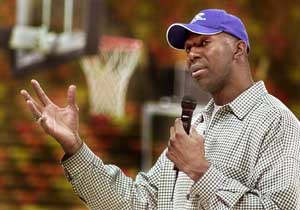
Hard work pays off for former Jazz man
You name it, Thurl Bailey has done it.
The former Utah Jazz forward left his 16-year basketball career to follow his passion of being an inspirational speaker and entertainer.
Last Thursday, the Spectrum became his most recent outlet for preaching to high school students and the community about believing in yourself and never giving up.
“It would be presumptuous to say that you guys should know who I am,” Bailey said to a group of about 50 people. “I had a 16-year professional basketball career and I’ll tell you it was the most awesome thing that could ever happen to me in my whole life. I realized the dream of playing professional basketball.”
It didn’t come easy, though, as he recounted his story to the group.
When Bailey was about 12 or 13 he was watching basketball on TV with his dad when he noticed a particular player. It was Julius “Dr. J.” Erving playing for the Philadelphia 76ers.
“I remember he was like the Michael Jordan of that time,” he said. “I was mesmerized by how this guy was playing. I knew that day that I wanted to be like Dr. J. I wanted to play in the NBA.”
There was a problem, though.
Bailey wasn’t a born basketball star. And the only way to get better was to practice and play on an organized team.
His family was poor so his dad created a make-shift court in the drive way with a trash can as the hoop and a round object that somewhat resembled a basketball. It was the best they could do at the time.
The Baileys would spend time outside together learning different aspects of the game. His dad taught him how to do a hook shot, and his mom was a master of granny free throws.
All this time Dr. J. was still in the back of his mind. Bailey would pretend he was his idol and drive to the hoop to attempt the game-winning shot.
But playing organized basketball was more of a challenge.
As a 6-foot-7 eighth-grader, Bailey tried out for the basketball team.
He was cut.
“I was so disappointed because I felt like it was a step back for me,” he said. “It was the end of my goal.”
Bailey said he specifically remembers the coach coming to him after tryouts and telling him he was wasting his time.
The man looked the scared teenager in the eyes and said he wasn’t cut out to play basketball – he didn’t have what it takes.
After not making the team again the following year, Bailey began to doubt himself. He spent the summer down in the dumps but perked up when he heard there was a new basketball coach at the school.
Two inches taller and with a little more confidence, Bailey tried out again.
He was nervous because he associated trying out for the team with being cut. He wanted to experience the joy of making the squad.
He gazed at the list of names who made the team, and the very first one was himself – because of alphabetical order of course.
But he had made the team nonetheless.
His job was simple. He was to start the game, get the jump ball, and on the next possession the coach would take him out of the game.
Bailey didn’t care. It was a great accomplishment just to be part of the organization.
“I remember the coach coming over to me, looking me in the eyes, and saying that if I wanted to dedicate myself there would be opportunities,” Bailey said. “He said if I was willing to dedicate myself there could be college scholarships.”
And a free ride through college was something important to Bailey because he probably wouldn’t have the chance to go without it.
He continued to work on his game throughout high school and eventually received a letter from the University of Maryland during his senior year.
The Terrapins wanted him to play collegiate basketball for them.
But so did a couple of hundred other schools around the country.
Bailey had a choice and he picked North Carolina State, which was coached by Jimmy Valvano.
In his senior season with the Wolfpack the team did the unthinkable. A squad that had barely qualified to make the NCAA Tournament upset the No. 1 ranked University of Houston 54-52 to win the national championship.
After a successful college career, the next logical step was the NBA.
Imagine sitting in Madison Square Garden waiting for someone else to make a decision that will affect the rest of your life.
Bailey patiently waited through the first six picks of the first round of the 1983 NBA draft. Then came his turn.
“I realized that that was it,” he said. “It was a dream. This is what dreams are made of.”
After the Utah Jazz selected him as the seventh pick in the first round, a team representative greeted him and suddenly two things ran through Bailey’s mind – how an amazing dream was coming true and the question of where exactly Utah is.
During one of his first professional basketball games, Bailey was sitting on the bench watching the game. Frank Layden, Utah’s then-head coach, summoned the rookie to check into the game.
“I was so nervous,” he said. “I had to go to the bathroom.”
As he was hunched over near the scores table he felt a tap on his shoulder. Bailey turned around and, lo and behold, Dr. J. was standing behind him.
The NBA veteran congratulated Bailey on a great college season and wished him good luck in his career.
When both men checked into the game, Bailey stood still and looked around for a minute. All of his teammates were guarding other players and Dr. J. was left alone.
“It was one of the greatest moments of my life,” Bailey said. “I was out there on the same court with the guy I had been watching on TV. … He worked for everything he got that night. I held him. I held Dr. J to 47 points.”
So he was a little nervous.
In his prime during the late 1980s, Bailey averaged almost 20 points per game for the Jazz.
He was traded to the Minnesota Timberwolves for a few seasons in the early ’90s, but finished his NBA career in Utah during the 1998-99 season.
Since then, the 6-foot-11 celebrity has released three albums, the most recent being 2002’s “I’m Not the Same.”
Between being a singer/song writer, actor and public speaker, Bailey is also a broadcast analyst for the Utah Jazz and the University of Utah.
He has also won various awards for his leadership and contributions to the community.
Bailey currently lives in Salt Lake City with his wife, Sindi, and his two youngest children, BreElle and Brendan.
-juag@cc.usu.edu