
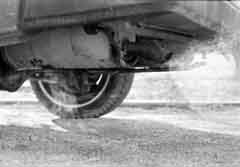
Health Department takes action against Cache Valley pollution
Cache Valley’s pollution in both 2001 and 2002 exceeded federal standards, prompting officials to take measures to curb pollution rates this year.
Particles 2.5 microns or smaller (PM 2.5) have been measured in Cache Valley for the past three years. The tiny particles are so small, people’s respiratory defenses can’t keep them out. They can end up deeply imbedded in the lungs. Children, the elderly and people with respiratory problems are most likely to be affected.
“I have asthma, and on days with more smog, I am short of breath by the time I walk home,” said USU student Malisa Dalpias.
Over time, PM 2.5 may cause death. The federal limit is 65 micrograms per cubic meter. In 2001, Cache Valley hit 88 micrograms per cubic meter, and in 2002, rates reached 137.
If federal standards are exceeded three years in a row, the federal Environmental Protection Agency will impose restrictions to decrease pollution.
“This year is kind of a pivotal point,” said Mike Weibel, spokesman for the Bear River Health Department. “So far, Cache Valley hasn’t had any yellow or red days this winter, but it only takes one day with levels over 65.”
Vehicles account for 80 percent or more of PM 2.5, wood burning for as much as 12 percent. The Bear River Board of Health approved mandatory winter burn restrictions in December. They went into effect Jan. 1. The program uses red, yellow and green lights to control burning and has been used along the Wasatch Front for several years. A green light means wood burning in stoves and fireplaces is acceptable, yellow allows burning only if necessary, and red prohibits any burning.
The Health Department launched the Air Pollution Hotline last week, so Cache County residents can report violators of red lights, or vehicles with excessive smoke. Letters will be sent to the owners of vehicles reported. People who fail to do something about the problem may be cited with a class-C misdemeanor. The Air Pollution Hotline is 792-6611. To report a vehicle with excessive smoke, callers should note the vehicle’s license plate number, description — color, make and model — and the time and place it was observed.
Mayor Doug Thompson said these new measures are just the first of many steps necessary.
“The problem is us. As a result, we are the ones [who need to] take care of it,” he said.
Long-term solutions alone won’t solve the problem. Unless people are willing to take emergency, drastic actions on red burn days, the EPA will step in and be involved in creating Cache County policy, he said.
High PM 2.5 levels are episodic and typically last from four to five days, so people need to plan ahead. For the mayor, that means riding the bus to work, conducting business over the phone and bringing lunch to work on red light days.
“We’ve all got to make those kinds of personal plans,” Thompson said.
Ron Bushman, transit manager of the Logan Transit District, said Logan has a better bus system than most cities its size.
“Get on the buses. Don’t drive your cars, and we’ll [solve] the pollution problem,” he said.
Thompson said, “If you’re driving diesel, drive a car. If you drive a car, carpool and if you’re carpooling, ride the bus. People should also try to consolidate their errands and avoid drive-up windows or other situations the car is idling.”
The bus information number is 752-BUSS (752-2877).
–katrich@cc.usu.edu