
Here’s How: Step-by-step sports; Winging it, How to run Aggie basketball’s Motion Wing play
It has happened a thousand times up in the Spectrum: the Aggies have the ball on offense and it is whipping around like a hummingbird, almost quicker than the eye can follow.
The other team is running itself silly, but are one or two ball movements behind. Suddenly, a pass is heading toward a blue and white jersey that is completely unguarded for a wide-open basket. The USU coaching staff has done it again. They’ve befuddled some frustrated opponent into guarding four Aggies with all five of their players.
Utah State is ranked third in the nation in both field-goal percentage and 3-point shooting, as of this writing. They shoot the ball 50.1 percent from the field and 41.9 percent from three. They are also sixth in assists, at 18 per game. Jaycee Carroll is third in the nation in 3-point percentage with 47.6 percent and Nate Harris is eighth in field-goal shooting with 62 percent.
Assistant Coach Don Verlin, an eight-year veteran of Aggie basketball, explained how to run “Motion Wing” from the Aggie playbook. It is set plays like this one that allow the Aggies to get a lot of open looks at the basket.
The biggest key to the play, Verlin said, is that the Aggies have the option to take an open shot at any point.
“Anytime we have a shot, we take it. Nate could post up [in figure 4] and we could throw it there. That’s just part of playing basketball,” Verlin said.
“Motion Wing” has three looks at the basket, he said. With so many permutations and variations to the play, it’s little wonder the Aggies’ offense looks unstoppable when it’s executed correctly.
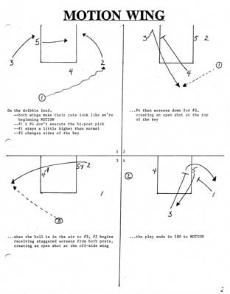
Here is the play broken down step-by-step. Each numbered step corresponds with a numbered picture.
1. “Our normal set we start out in is what’s called a ‘one-two-two.’ Both wings make their cuts to look like they’re beginning a motion. They both act like they’re starting to run under. Nate breaks up, and him and the point guard execute the high-post pick. One stays a little higher than normal and Five changes sides of the key,” Verlin said.
ex. The power forward, usually Nate Harris, sets a pick for the point guard up high. Both wings fake toward the baseline while the point comes off Nate’s screen and the center moves to the other side of the key.
2. “Four screens down for Three while one has the ball, and One passes Three the basketball to create an open shot at the top of the key. So we’ll take that shot if we can get it, but we don’t get it very often,” Verlin said.
ex. Nate runs down and across the key to set a screen for Three (sometimes Durrall Peterson), who catches the ball at the top of the key and takes the shot if it’s there.
3. “Four and Five are now in position on the low blocks. When the ball is in the air to Three, they set what are called baseline screens. Two runs the baseline and receives staggered screens from both posts. He flies through there and Three’s job is to create an open shot for him on the wing,” he said.
ex. Nate and Cass both set screens down low and Jaycee runs along the baseline while the ball is passing from the point guard to Durrall. Jaycee comes into position in the corner and Durrall makes the read to either take the shot or pass it to Jaycee for a 3-pointer.
4. “As soon as he throws it, there he is going to screen down for Five, and we do what we call ‘Iso to Motion.’ Five gets it, turns, and we’re into what we call our Motion play. That’s a set play that goes to our freelance Motio,n where we move and cut and play basketball,” Verlin said.
ex. Normally, by now they have scored and are running to get back on defense. If everything was guarded, Durrall will drop down and set a screen for Cass to come up, turn and catch the ball and they are into their freelance Motion, which is basically running around trying to create something.
-graham@cc.usu.edu