Here’s How: Step-by-step sports
The team lines up with 10 guys at the line of scrimmage and the lone punter 15 yards behind them.
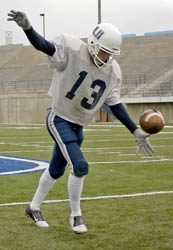
Utah State punter Justin Hamblin and long snapper Jeff King make up the the Aggies’ punting unit. And when the Ags are in a tough situation, that’s who they call on.
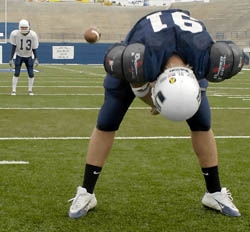
To punt correctly, the first thing that should happen is the 15-yard snap.
“It’s like throwing a pass upside-down with your head between your legs,” said King.
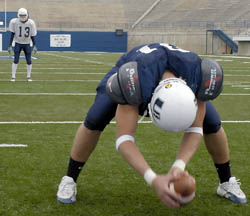
King said that to perform the snap correctly, you should have your feet further than shoulder-width apart, your “butt down and your mind clear and concentrated.”
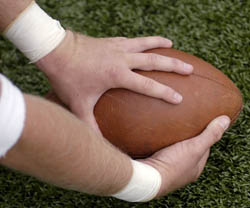
The long snapper then grips the ball with both hands. One hand actually throws the ball, while the other is used as the guide hand.
The ball is then hurled between the long snapper’s legs to the punter in a tight spiral fashion, preferably hitting the punter about waist-high.
In a game situation, time is of the essence. The punter needs to be ready before the ball is snapped. Stance is key.
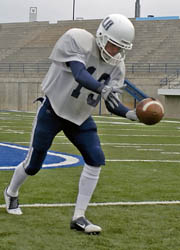
Hamblin, a left-footer, stands with his right foot forward ready to receive the snap.
“You want to catch the ball out in front of you,” Hamblin said.
Upon receiving the ball, the punter usually has to rotate the ball so that the laces are up, while simultaneously taking a couple quick steps forward.
It’s important, Hamblin says, to make sure the ball doesn’t move up or down while the punter is stepping forward.
Keeping the ball steady helps ensure a good, flat drop. The drop must be flat so as to ensure clean contact with the foot.
As the punter begins to swing the leg forward into the ball, the toe should be pointed down like a ballerina as the foot makes contact.
According to Hamblin, a good contact point is about four inches higher than the knee would be when standing upright.
The leg swing should be smooth and swift, straight through the center of the ball, with the momentum carrying the body forward and upward in the direction of the punt.
If the ball is dropped properly and contact made cleanly, the ball will spiral through the air as if thrown. As it travels through air, the ball should also gradually turn over.
The “turn over,” as it’s known in punt lingo, combined with the tight, spiraling action, help the ball cut through the air better.
This will add yards to your distance and seconds to your hang time.
According to Hamblin, a good punt will go about 40 yards past the line of scrimmage and will stay in the air for about four seconds.
Punting is best done using soccer shoes or any flexible footwear with a flat, smooth upper.
Shoes designed specifically for kicking footballs are also available, but are hard to find.
-jhislop@cc.usu.edu