
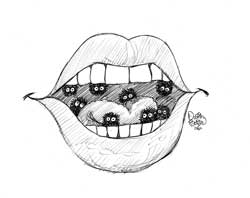
Hidden Dangers Mono can be hard to detect and harder to over come
The doorstep scene last night may have bigger repercussions than you might think.
It’s “kissing disease” season, said Dr. Jim Davis, director of the Student Health and Wellness Center. Infectious Mononucleosis, more commonly known as mono, is extremely contagious through human saliva, and coincides with flu season.
Davis said diagnosing mono is not as easy as one might assume and students can get a mono test from the doctor, but the test is unreliable.
“When it says ‘yes’ is means ‘yes.’ If it says ‘no,’ it means ‘maybe,'” Davis said.
Most students think if the test comes up negative, they are home free.
“Wrong – thank you for playing,” Davis said. “It means I don’t have anti-mono antibodies; it doesn’t mean you don’t have [mono].”
Davis said mono is caused by the Epstein Barr virus. There is a test for the virus, he said, but it’s more expensive and takes more time, though it can be used when someone needs a definitive answer quickly. Davis said the diagnosis is partly clinical and partly laboratory.
“Mono testing is not a science, you just have to have a strong inclination to keep testing,” Davis said.
Davis said there were 23 diagnosed cases on campus last semester, one of which was suffered by Tim Macnar.
A junior majoring in psychology, Macnar was diagnosed with mono about a year ago, which he contracted from his girlfriend whom he married a year later. Both students ended up sick for almost a full month.
“She got diagnosed about a week after we started dating. She got really sick; she was going to the doctor and everything. She was bed-ridden for a week or so,” Macnar said, “I was just tired all the time; I just always wanted to sleep. I didn’t really get sick, but I just was always tired.”
According to the National Center for Infectious Diseases Web site, the EPV virus occurs worldwide, and a majority of people become infected with EBV sometime during their lives.
In the United States, the Web site states, “as many as 95 percent of adults between 35 and 40 years of age have been infected. Infants become susceptible to EBV as soon as maternal antibody protection (present at birth) disappears. Many children become infected with EBV, and these infections usually cause no symptoms or are indistinguishable from the other mild, brief illnesses of childhood.”
However, when adolescents or young adults get infected with EBV, it causes mono almost 50 percent of the time.
Davis said the symptoms of mono can be easily confused with a common flu, but the difference is they don’t go away after just a few days.
According to “FDA Consumer” magazine, mono strikes as many as two out of every 1,000 teens and 20-somethings, especially those in high school, college and the military.
Davis said mono is a viral infection that takes a few weeks to fully develop and then once it surfaces, it can leave you bed-ridden and suffering from chronic fatigue for weeks or sometimes even months.
Davis said students have three options when it comes to school. They can either take incompletes and redo the semester or tough it out. Davis said they don’t write post-opt notes, but they will write notes upon diagnosis or before the fact.
He said the only thing that cures mono is “just time.”
“The body’s immune system is the only thing that cures your body. There is no antibody or chemical,” Davis said.
Macnar said his wife toughed out the semester and passed all her classes.
“She got behind in some classes and when she started feeling better, she played catch-up,” Macnar said. “She’s a smart young lady.”
Davis said the biggest problem with being active while infected with mono is the potential damage done to the spleen.
“The spleen is enlarged as a big, juicy, blood-filled organ and gets fragile, like a ripe tomato. If you get a bump to your spleen, it can cause it to split, just like a tomato, so spleens are a concern during mono,” Davis said. “We watch people very carefully.”
Davis said you can never be sure how long you will be out or how mono will affect you. “People who are otherwise healthy who eat well, drink fluids and get rest – do all the things students don’t do – tend to get better quickly. We are cautious with people who have spleen enlargements on athletic teams and they don’t like it, but they get better quicker,” he said.
Macnar said he was exhausted for about a month and his wife was out of it for three weeks.
“For me, [the hardest part was] just being tired all the time and I couldn’t study and stuff. It’s hard to not feel good and miss out on stuff,” Macnar said.
“It was kind of nice having a break, but not when you don’t feel good. It’s not really a break, you just get behind in school,” he said.
Jim Davis said when mono sets in, the extreme fatigue that takes over your body is both mental and physical, so even laying in bed and studying to stay caught up isn’t really an option.
Because mono is extremely contagious, avoiding it may sometimes be difficult and symptoms may not appear for weeks after the actual virus is passed.
According to the National Center for Infectious Diseases, the symptoms of mono usually resolve in a couple of months, but EBV remains dormant in a few cells in the throat and blood for the rest of the person’s life. Periodically, the virus can reactivate and is commonly found in saliva.
This reactivation usually occurs without symptoms of illness, however Davis said it is possible for someone to acquire mono twice, but the best possible solution is to “get it and get it bad” so your body can create antibodies on it’s own to combat it.
The NCID states there are no known associations between the mono virus and problems during pregnancy.
-etippetts@cc.usu.edu