

House Bill 449 gives Utah State a direct path to pay athletes
When Utah legislators approved House Bill 449 earlier this year, a first-of-its-kind law allowing universities to directly pay student-athletes, they set in motion an experiment in the country’s rapidly changing college sports economy.
Under the new framework, universities like Utah State University can now directly pay athletes for the use of their name, image and likeness, or NIL. It’s a sweeping shift from the booster-driven collectives that have defined the NIL era since 2021 — and it’s forcing schools, teams and lawmakers alike to reimagine what “amateurism” means in 2025.
“Ultimately, the reason why I ran … HB 449 was to ensure that our Utah universities were in the best place to compete compared to any other university,” said Rep. Jordan Teuscher, sponsor of HB 449, in an interview with The Utah Statesman. “We weren’t trying to necessarily push the needle and be on the cutting edge of anything. But we wanted to make sure that if other states … were moving in a certain direction, that our universities could follow suit and make sure that they could compete at the highest levels.”
Teuscher explained his legislative efforts began with HB 202 in March 2024, a precursor to HB 449.
“It became really the wild, wild west,” he said. “Collectives were springing up. Universities weren’t really sure what to do. They were afraid that they were going to violate NCAA policies because the NCAA hadn’t updated their policies based on these new conditions. Some of our mid-size universities like Utah State or Weber State or Utah Tech … were really afraid of taking action and being able to take advantage of some of the NIL opportunities … because they just didn’t have the resources to go and fight those fights like some of the bigger universities.”
For Utah State, the timing feels critical. Aggie athletics are in an age of strong coach hires, facility upgrades and unprecedented success across many sports, but with fewer resources than Utah’s flagship programs, USU has leaned heavily on its collective — the Blue A Collective — to help athletes navigate NIL deals.
However, with HB 449 enabling universities to pay athletes directly, the role of collectives going forward is unclear.
Few people understand that uncertainty better than Dalton Forsythe, former director of the Blue A Collective and a former USU student-athlete. Forsythe confirmed he has arranged several meetings with the university’s new athletic director Cam Walker as Utah State Athletics works to implement the bill.
Before the bill, the collective operated independently outside the university. Looking ahead, the collective will likely narrow its scope while still supporting Utah State athletes. Forsythe said the collective will focus on supplementing the school’s efforts, particularly for smaller sports or international athletes who need flexibility in compliance and recruiting.
“We can help negotiate NIL deals and keep teams intact where the athletic department doesn’t necessarily have the revenue to do it themselves,” Forsythe said.
Although the bill effectively eliminates the role Forsythe once held in fundraising for the school, he does not oppose the changes.
“In my experience, one of the biggest complaints people had when it came to collectives in general is where we were independent,” he said. “[HB 449] also requires state institutions to go through an audit every five years on their NIL funds. So, there’s some trade-offs, but it gives athletes protection and oversight.”
Forsythe also acknowledged Utah State faces structural disadvantages compared with BYU and Utah in revenue and NIL resources. While HB 449 levels the playing field against states without similar laws, it won’t make Utah State immediately competitive with its wealthier in-state rivals.
“Internally, everyone shares the same revenue cap, but we can’t even generate enough to hit ours. BYU and Utah are far surpassing theirs,” he said.
Still, Forsythe sees opportunity for the university to engage donors more effectively, noting the law allows contributions to flow directly to sport-specific or general NIL funds, giving fans a more tangible connection to the teams.
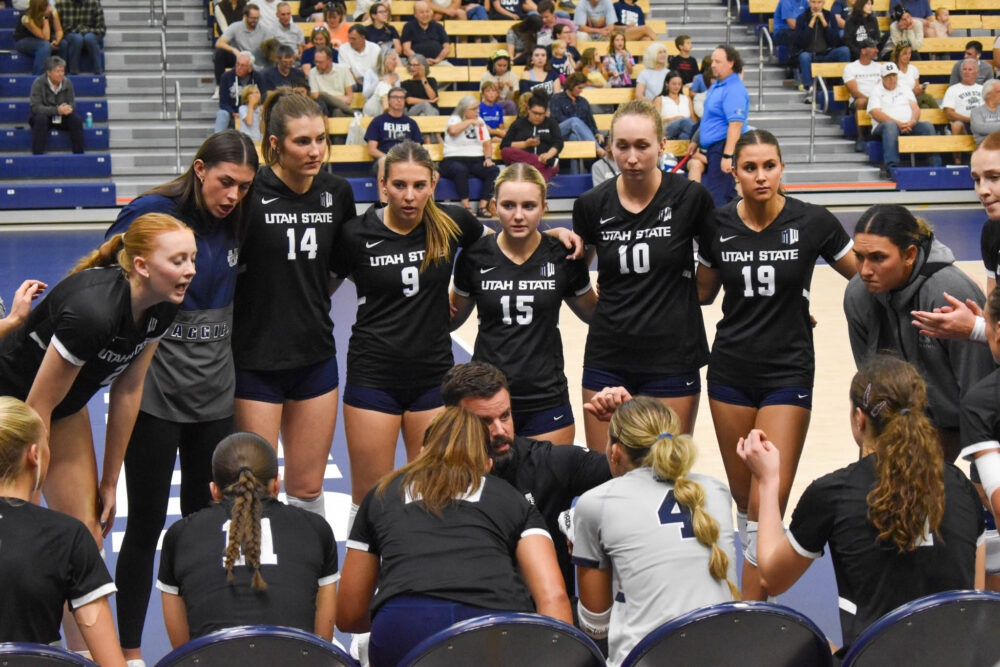
Team huddle during volleyball game against SJSU (photo by: Alyssa Cook)
Despite all the changes, Forsythe is confident the collective will remain relevant.
“We’re in a good place to start,” Forsythe said. “The short-term plan is to work closely with the school and fundraise for recruiting and retention funds. Long term, we’ll focus on revenue-generating NIL deals for programs that need it most.”
Jason Winfree, an economics professor at the University of Idaho and a leading researcher on sports economics, suggested Utah’s new NIL model could have implications beyond the state. Having advised as amicus curiae in multiple Supreme Court cases on sports economics, Winfree sees potential benefits for mid-major schools.
“Most people have this sense that player pay … is going to help the big schools because they have more money,” he said. “That’s true to some extent, but the bigger schools were already getting the better athletes through better coaches, facilities and recruiting. But you have to think about this in terms of what paying the players accomplishes for small schools. They’re not going to get the best athletes, but maybe they’ll get more really good athletes to give them a better chance to compete.”
Regarding the role of collectives like Utah State’s Blue A, Winfree believes they can still be influential by coordinating closely with universities.
“To the extent that you want to build a more successful athletic program, you should be working with those groups to get funds to where they go most efficiently,” he said. “If the collective can find the right mechanism to go through the university’s fundraising system, it shouldn’t be a problem.”
Winfree emphasized economic incentives will continue to drive university behavior.
“Universities are masters at moving money around,” he said. “If athletic teams generate revenue through ticket sales, merchandise or increased enrollment, they will find a pot of money to fund NIL.”
He also stressed that fans and donors shouldn’t be overly pessimistic of the current changes.
“Universities and athletic departments are in the business of trying to create the best teams they can,” Winfree said. “Making this more formalized through the university shouldn’t be dramatically negative.”
Looking forward, Winfree remains optimistic about the long-term evolution of NIL.
“The health of college athletics is always going to depend on demand,” he said. “NIL policies push more revenue to players at the expense of coaches and facilities, but budgets can be reallocated. I’m not at all concerned about the economic viability of college sports as long as people want to watch it.”
While HB 449 centers on direct payments to student-athletes, its companion measure HB 479 included provisions addressing “abusive coaching practices.”
The law requires universities to establish policies for responding to complaints by early November and defines abuse as harmful or offensive physical contact, sexual misconduct or harassment, inappropriate sexual language or conduct a reasonable person would find psychologically abusive.
According to Teuscher, that section of the bill fell under the focus of HB 479 sponsor Rep. Sahara Hayes, though he remains supportive of the overall aim to enhance athlete welfare.
“The idea is that athletes have protections beyond just financial ones,” Teuscher said.
The legislation came after reports of emotional and verbal abuse in multiple university programs, including the University of Utah gymnastics team.
“This is an issue that has affected more than one of our universities in recent years,” Hayes said during a committee hearing.
After months of shaping this landmark NIL law, Teuscher reflected on its broader impact
“College athletics will be permanently changed,” he said. “Student-athletes for decades weren’t fairly compensated, and now they’re finally getting protections. At the same time, it’s shifting how programs operate, especially in high-revenue sports, and it affects Olympic sports too.”
Teuscher reassured Utah State fans, donors and athletes the legislature is vigilant.
“We want to ensure athletes can compete in Utah, that our programs are the best in the country and that our state benefits from it,” Teuscher said. “We’re not going to let Utah take a back seat.”
As HB 449 takes effect this year, Utah State will be watching closely, navigating its identity in a new era of college athletics — one in which the lines between education, employment and enterprise are more blurred than ever.