

How music therapy students at USU combine art and science for mental health
By Avery Truman | Utah State University
This story is jointly published as part of the Utah College Media Collaborative, a cross-campus project bringing together emerging journalists from Southern Utah University, the University of Utah, Utah State University and Utah Tech University. The collaborative is an Amplify Utah project with support from PBS Utah and POV.
LOGAN – Carlin Troska was 17 when she found herself in a psychiatric hospital. She wasn’t disheartened to be there — she was inspired. The soft, calming music that flooded the room was Troska’s first encounter with music therapy, a discipline she’s since devoted her studies and career to.
When the music therapist started playing, Troska said it was a bittersweet moment that drew her to learn more.
“I kind of saw someone in front of me, and I was like, ‘okay, this is what my future could be.’” Troska, now a senior in Utah State University’s music therapy program, said. “I saw for myself, in the eyes of a patient, how powerful it was.”
Combining art and science
In her arc from patient to practitioner, Troska said she found a passion for bringing together two fields that, to an outside perspective, might seem opposite.
“When art and science go together — when people of those disciplines work together — it makes a product that is so much stronger,” Troska said.
Students in Utah State University’s music therapy program do just that by using their voices and instruments to improve the mental health of others. From hospital bedside visits to group sessions and even kindergarten classrooms, music therapy has proven versatile.
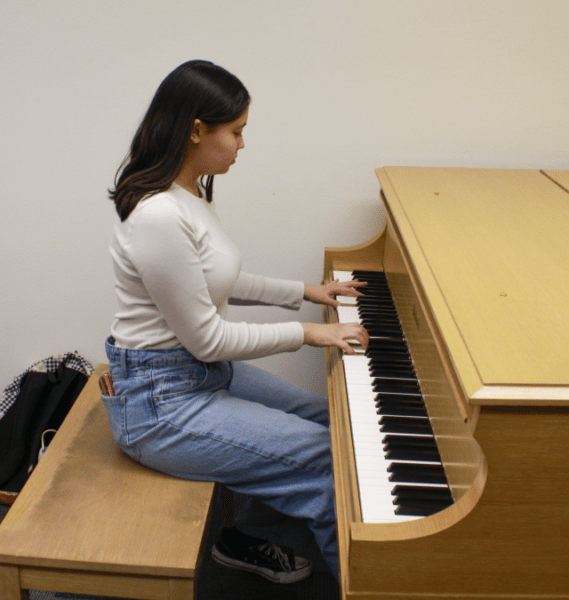
Carlin Troska plays the piano in Utah State University’s Music Therapy Clinic on Feb. 11, 2026. (Avery Truman)
“Its hard in a talk-therapy setting sometimes to share, but music can really help serve as a container and something that can make someone feel a little bit more comfortable with expressing how they’re feeling,” Troska said. “Sometimes, it’s not with words. Sometimes, it’s with how they play.”
During a session, the music therapist may play or sing songs, teach music as a coping strategy or experiment with lyrics adapted to the patient. A patient may simply listen to the music or contribute as an active participant by playing an instrument.
The music therapy program landed in USU’s College of Arts and Sciences after the university restructured, placing arts, sciences and humanities under one umbrella.
Many of Troska’s friends didn’t understand the choice to combine the colleges, but for someone who studies both, Troska said the decision made sense to her.
“It doesn’t have to be science or art,” Troska said. “They can very much go together, and that’s when music therapy really is. Music therapy is a scientific field, but it’s also a creative field.”
The role of music in therapy
Clarissa Zollinger, a senior in the program, has loved music since childhood. When she was 3 years old, she asked her parents for violin lessons and started her classical training at age 5. Now, Zollinger plays the violin, guitar and piano.
She is currently completing her practicum requirement while working with music therapists in Cache Valley.
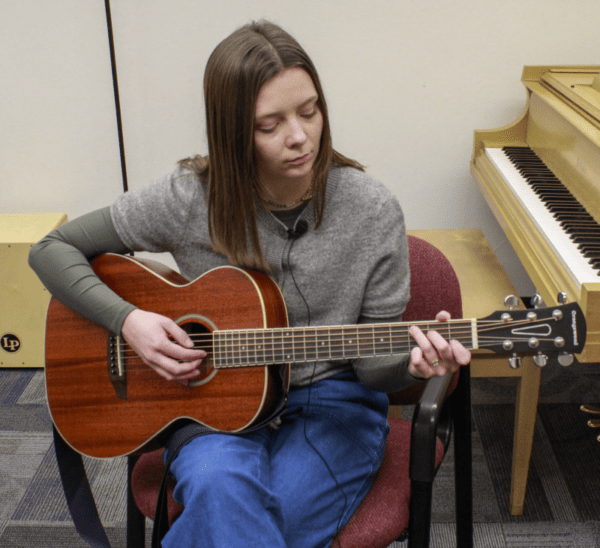
Clarissa Zollinger plays guitar in Utah State University’s Music Therapy Clinic on Feb. 9, 2026. (Avery Truman)
“This semester, I’m with a behavioral health group in Logan, and it’s been really cool to see how music therapy works with adolescents with various mental health diagnoses,” Zollinger said. “It’s a cool way to create interventions around their interests and the things that will help them have that release and build their own self-esteem.”
Throughout a session, participants might work on writing lyrics to tie music to their own personal circumstances, learn to play an instrument or participate in guided breathing meditation.
The session ends with box-breathing techniques and a “goodbye song,” giving participants a stairway to wind down after an energetic session.
Zollinger said music therapy can positively influence people at all stages of life, from adults with disabilities who use music to express themselves to preschoolers who learn valuable lessons from songs that teach skills like sharing.
“Music just plays such an essential role in so many lives …,” Zollinger said. “It’s such a valuable tool to be able to bring into the community — of providing [a] higher quality of life for those who are in hospice … to be able to bring something so beautiful into their lives as they’re transitioning to the end of life, I think is so impactful.”
Creating peace in a hospital
Mallory McAlister, music therapy student association president, didn’t come from a musical family, but pursued theatre and piano regardless. She learned about USU’s program from a missionary in her hometown in northern California, and moved to study music therapy.
“Everyone uses music kind of as a coping mechanism,” McAlister said. “I see that with my own people, I have in my life. A lot of people who come into the program say that that’s a big reason why they did — was because music was that for them.”
McAlister said when working in a hospital, a music therapist’s goal is to improve quality of life, increase relaxation and reduce agitation.
“Seeing the real-life application of what we’re learning, and seeing how it can positively affect people, is crazy,” McAlister said. “Being in a hospital room and seeing a kid who you thought was going to be paralyzed the rest of his life, move his arm — things like that just really get you.”
Anna Small, music therapy student association treasurer, said that because music is part of daily life, it can provide comfort and normalcy when faced with life-threatening or challenging situations, such as a visit to Primary Children’s Hospital.
“Being in a hospital is not very fun for some young, very energetic kiddos,” Small said. “Bringing that piece of familiarity to them in their hospital room can really change the experience for them and make them feel more comfortable.”
For older patients with dementia, Small said music is one of the few therapies proven to slow the effects of the disease.
Troska said many music therapists have to advocate for their field when people say music isn’t as credible or effective as other therapies. Troska said that, like other forms of arts and sciences, they should work in tandem.
“When music therapists work together with speech therapists or occupational therapists, physical therapists — when they work together, I think that is when it’s the most powerful.”
You must be logged in to post a comment.
There are no comments
Add yours