
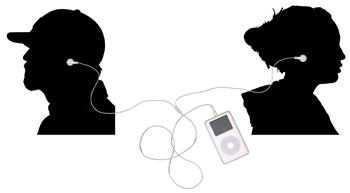
iTune the world out
Ironically, iTunes may be isolating us into an i-robotic society.
Some students at Utah State University are feeling frustrated because of they feel like they are being shut out by electronic media.
Society today is full of people who value music and love the constant hum of the background music of the grocery store.
These people have occupied ears. Rebecca McOmber, a sophomore studying English, said, “I can’t go anywhere without my iPod – it’s my baby.”
A recent survey of 50 USU students shows that iPods are not just a new craze, but to students, they are a new way of life. When asked “Do you have an iPod or portable music player? 26 of the 50 students reportedly had iPods or other music sources like MP3s that they listen to daily.
Despite problems with Apple’s new nano cracking, according to a Reuter’s report, iPods have not dipped in popularity. Many of the students who reported no said it would only be a matter of time before they would be in on it. A iPod would take priority as their next big purchase.
Many students spoke of an overall sharp social downfall that took place since their iPod purchase.
Cory Freeman, a junior studying physical therapy said, “I don’t like having my iPod with me when I’m in social situations like walking around campus, because I don’t want to isolate myself from the world.”
Freeman isn’t alone in his worries of isolation. USU’s professor of sociology, Reed Geertsen, said, “Our whole sense of who we are and how we fit into society is sustained on frequent social interaction.”
Sociologists agree that strong relationships are a necessity to the survival of societies.
Jonathan Doti, a graduate student studying clinical psychology, said iPods send out a “blatant physical message of ‘don’t bother me.'”
Technology has led to a false sense of connection and “Technology does connect us – synthetically that is,”Doti said.
iPod’s are not the only thing isolating us, it is the compilation of cell phones, Internet, instant messaging and texting. Herbert J. Gans, Columbia University sociologist, fears we are becoming “electronic shut-ins.”
“There is a callousness being created about how we interact with each other,” Doti said regarding listeners. Such callousness can lead to other obstructions in our lives.
“Not only are we drowning out the world, we are drowning out ourselves. You become the words of the songs you listen to,” Bradley Anderson, an undeclared junior, said.
Sociological risks aside, there are also physical dangers inherent to extensive use of iPods.
USU audiologist professor, John E. Ribera, said hair cells in the ear need a break from the vibrations.
According to Ribera, intense noise – loud or not – will cause permanent damage to hearing.
As with any technological advance, there are pros and cons.
iPods, if used correctly, can be positive in many ways. Music has been proven time and time again to have uplifting influences in one’s life. Psychologists say listening to music while studying can help to retain information, focus on a subject and ignite our creative minds.
With headphones now doubling as ear plugs, the society may be in trouble. People shoud be aware of the message being sent out.