
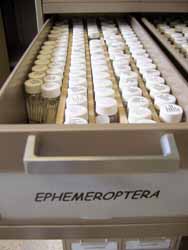
Jeepers creepers: A bug lab at USU
Counting mudsnails can be dirty business, but someone’s got to do it.
And that’s where the folks down at Utah State University’s bug lab take over.
“The bug lab started in June of 1992,” said lab assistant Dan Zamecnik. “There were just five of us at the start, and we learned the different bugs as we were sorting them, so it took a while to learn all the different kinds of bugs, how to sort them correctly.”
Located on the south side of the horseshoe in Biology and Natural Resources, Room 160, USU’s bug lab is little known outside of its own department, but Mark Vinson, a research professor in the aquatic watershed and earth resources department and head of the bug lab, said the lab is going great and is busier than ever.
“Water is more important now than at anytime in the history of the earth,” Vinson said. “People have realized that it’s important to have clean water and to have enough water, and one of the ways you can tell that is to look at the things that live in the water.”
And that’s just what they do. Spending hours hunched over microscopes examining samples of aquatic invertebrates, the technicians in the lab provide statistical data to help determine most of the water policy in the Western United States.
“We are very well-known in agencies around the state of Utah,” Vinson said. “But we’re not ever going to be the Wal-Mart of bug labs. We’re more like the Tiffanys of bug labs. We do basic research monitoring, which is done to answer specific questions.”
For instance, the lab has been working on a project for about 10 years that determines how the operation of Flaming Gorge Dam affects the critters that live in the Green River. The Bureau of Reclamations has used the information to adjust how they operate the dam to make life better for the creatures that live down the stream and to provide better water quality and better water conditions.
The list of research projects is quite long and includes, among others, a high emphasis on aquatic invasive nuisance species, such as the New Zealand Mudsnail.
“There are many exotic species from other countries that have found their way into the United States,” Vinson said. “We look at what impact they’re having on the adapted eco-system.”
But being an invasive species isn’t an easy job.
“To be an invasive species you have to have a high reproductive rate and live in a place where most things don’t like to eat you. Then you can take over a natural habitat and push out the native species,” Vinson said.
The lab, which has processed more than 20,000 samples since its inception, monitors all aquatic invertebrates, which includes much more than just insects.
“The species we monitor range in size from smaller than a pinhead to larger than a softball,” Vinson said. “While clams are basically the biggest things we monitor, we deal with everything aquatic.”
The day-to-day operations involve many different people each doing specific jobs. It all begins with the field technicians who gather the samples and send them to the bug lab where sorters, such as lab technician Brooke Bushman, take over.
“I’m the first person that comes in contact with the sample,” Bushman said. “Because of the number of animals in a sample, we do a statistical split to determine the make-up of the sample.”
Next, the animals are identified taxonomically by taxonomists such as Erin Thompson.
“We identify insects down to their species hopefully, but at least as far as we can go,” she said. “Our data then goes to Mark, and he sends a report to whoever sent the samples.”
The data from the reports is then used to help many government agencies and private departments determine their water policy.
For guys like Vinson, who has been “working with water and invertebrates” since he was old enough to stuff them in his pockets,” the bug lab is a way of life. For others it’s just a job. Whatever the reason for being there, working in the bug lab can be an interesting experience.
“For the most part, we just learn on the job,” Thompson said. “Right at first the job is hard, but I think other perks are great, like finding new bugs you haven’t seen before and going out in the field to do your own research. There are also a lot of great people in here, and the atmosphere is very laid back.”
For students who might be interested, Vinson also offers an aquatic invertebrate class (AWER 5550) every spring.
“Students can also get involved with the local Autobahn chapter, local Trout Unlimited chapter, or Cache Valley Anglers,” Vinson said. “But the most important thing students can do is to see how they deal with water in their life. Don’t pollute it and don’t waste it. Brush your teeth without the water running.”
-mattgo@cc.usu.edu
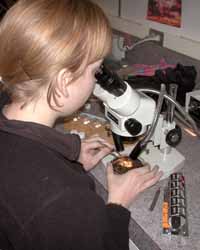
Amber Baumbartner sorts different bugs out of a water sample. The bug lab recieves samples from different water sources. It is the lab teacher´s job to extract the different species from the sample. From this they can tell how healthy the water is from the number and kinds of organisms in the water. (Photo by Jamie Crane)