
Journalism and Communication professor takes residence in freshman housing hall
Editor’s note: The following is the first in a three-part series.
His day began before the sun had risen over the northern Wasatch Range. That same sun now sinks behind the Wellsvilles, marking the end of a long day with brilliant shades of pink and yellow.
Utah State University professor Ted Pease hulks his six-foot-three frame into a shiny red SUV and drives around the corner to Davis Hall, the old brick apartment building where he’s been living for the past seven months. He parks next to the beat-up vehicles belonging to recently graduated high school students who call this building home.
Around the back is apartment 101. Pease pulls a plastic key card from his wallet, waits for the click, and steps inside.
The room is dark and lonely.
Eventually he’ll join his wife, Brenda Cooper, in northern California. But for now, the 57-year-old head of the USU’s department of journalism and communication is living in a dorm building otherwise reserved for freshman.
Early into this arrangement, Pease would sometimes call his wife to tell her he was done with his day and headed home.
And she would always correct him.
“You’re not going home until you come here,” she said.
So now, Pease says: “I’m going dorm.”
Before the dorm
Until a year ago, Pease and Cooper owned a 5,000-square-foot home on a secluded, 12-acre sanctuary in Petersboro, a 325-person hamlet just west of Logan.
After living there for nearly 18 years and with Cooper nearing retirement, the couple decided it was time to move on.
“We sold the house when we could get out, because the market had been so lousy,” Pease said. “We tried to house sit for a while but that didn’t work out. We didn’t have any place to put all our stuff and we were afraid of breaking everyone else’s stuff.”
With two dogs and an elderly cat, the couple had a difficult time finding somewhere to live. But perseverance paid off and they eventually found a little house in Providence whose owner agreed to rent to the couple and their three furry companions.
One icy day in the spring of 2012, Cooper came home to find a foreclosure notice taped to the front door. The house was scheduled to be auctioned April 1.
Cooper was shocked. They lived for the next several weeks not knowing how long they had to stay. The four-month semester was barely half over.
“Really, it’s not an exaggeration to say that from the time we sold the house in December 2011 to the end of the semester last year in May, we went through rental hell,” Cooper said.
Fifteen years earlier, after an academic conference in San Francisco, Pease and Cooper took a drive up the rugged California coastline and found themselves in Trinidad, one of California’s smallest incorporated cities with a population of about 400 residents.
From the moment they saw it, they knew they were home.
Seven years later, they bought a small vacation home in Trinidad, and in the intervening years they’d travel there for winter breaks, summer vacations and long weekends.
They always figured they would retire there.
Just not so soon.
But following the foreclosure nightmare, Cooper decided she was done living in other people’s space.
“I had no intention of retiring this year – that wasn’t the plan at all,” Cooper said. “We were just pushed to do it a little sooner than expected because of the situation we ran into after we sold our home.”
As the prospect of retirement slowly became a reality, she was enticed by the temperate winters and crashing waves of the California coast.
But Pease, who was overseeing a transition that included an almost total changeover of the department’s faculty, wasn’t in a position to leave.
“We knew that it would be difficult to do this as a long-distance relationship, but it seemed like the best practical way to deal with it,” Cooper said. “We don’t like living apart and I’m not sure if we were to go back a few months if we would make the same decision, but that’s where we are right now.”
Over the summer, Cooper negotiated an early retirement and moved to Trinidad. Pease remained in Logan, and his search for a place to live continued.
“I could have rented a townhouse or something, but I said, ‘Brainstorm – hey, there are dorms, maybe they have faculty residence or something.'”
They did.
A mix of about 15 staff, faculty, visiting scholars and graduate students at Utah State take advantage of the convenient option to live near campus in the dorms. However, they live in family housing – mostly Aggie Village. Very few, if any, live in single-student housing.
Except one professor.
When Pease first told his wife he was going to live in an on-campus freshman dorm, she laughed.
“It’s not something that I could have done,” she said. “I like my privacy and I like having that sense of space for my own.”
But Pease figured he’d be fine.
It was, after all, just a temporary place to stay until it was time to go home.
Room 101
When Pease first moved his belongings to Davis, he was greeted by a little rainbow cutout on the door. Under the rainbow was a small cloud made of paper with his name scribbled on it in blue Sharpie. The resident assistant – an undergraduate who acts as a leader in university housing – had made one for all the new residents of the dorm.
As Pease pushed open the heavy gray door and stepped inside, one of the first things he noticed was a couch and loveseat that were really “dangerous-looking.”
But he had already made his decision. So, he prepared to accept his fate of living with a hair-strewn, SpaghettiO-stained couch.
Davis Hall area coordinator Shannon Jolley took pity on the professor and provided him with a new couch. She also agreed to remove the bunk beds to make room for Pease’s personal bed and belongings.
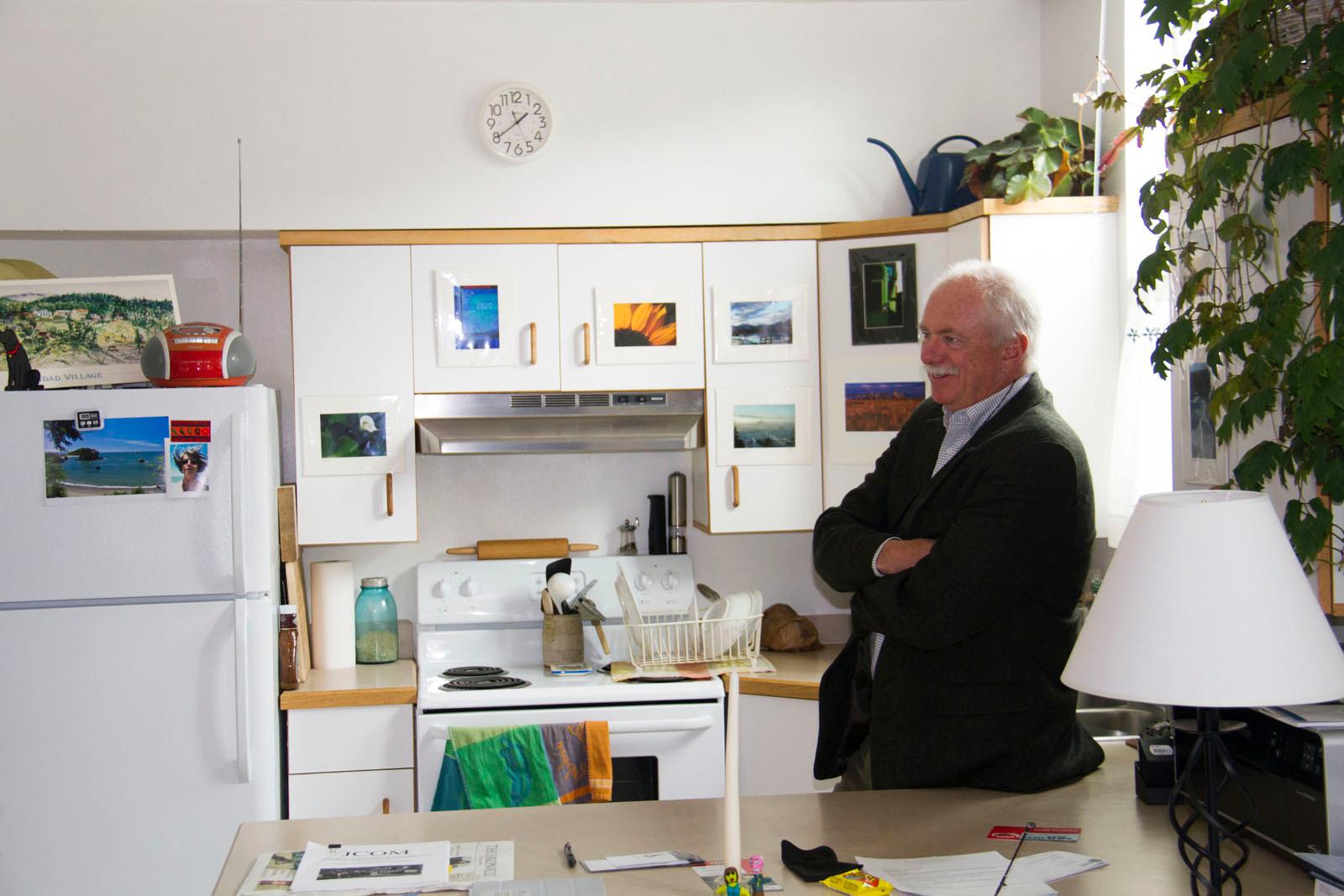
In an attempt to escape the drab confinement of the apartment, the veteran photographer covered the whitewashed walls in photos. A potted plant sits in the corner behind a forest-green overstuffed loveseat. Some may call it quaint, b
ut Pease disagrees.
“A 1960s cinderblock dorm is not quaint – it’s tiny,” he said. “But it’s functional.”
The usual arrangement allows six students to live in each apartment.
“They must be really small people,” Pease said, shrugging his wide shoulders. “It would take me four days and then I would strangle my roommates. It’s only like 900 square-feet. I know because I paced it off one day. I was just curious.”
It was a claustrophobic transition from his 5,000-square-foot home.
“I do find that I don’t hang around the house as much as I used to when it was my house,” Pease said.
Rather than relaxing on the common-room couch with a room full of 18-year-olds, Pease plays tennis and golf on the weekends. He travels to see Cooper in Trinidad as much as his schedule permits.
“I don’t stay home very much,” he said, before abruptly stopping to correct himself. “I don’t stay dorm very much.”
– sarah.menlove@gmail.com
Editor’s note: Sarah Menlove is a JCOM student at USU.