
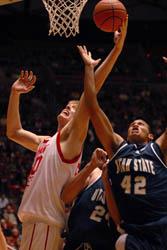
‘Just like football’ – Ags go cold at Huntsman Center, suffer worst loss to Utes since 1999
The only good showing from Utah State Wednesday night at the Huntsman Center was in the stands.
A rowdy sea of Aggie blue took over three sections of the upper bowl, making noise for most of the game.
The same couldn’t be said for the men in blue on the court.
Utah State was handed a 24-point beating-72-48-by the University of Utah, breaking the first two-game winning streak of the year and pushing the Aggies back to .500 at 5-5.
“We’ve come down here and played well and we’ve come down here and got hammered, and that’s what happened tonight,” USU head coach Stew Morrill said. “They just beat us in every phase of the game … We couldn’t guard them. We couldn’t score. We got out-rebounded. They’re a lot better basketball team than we are right now. It’s not even close.”
From the start, it never looked good for the Aggies. The Utes came out on fire, scoring the first 11 points of the game on four makes-three 3-pointers and a dunk-and they never looked back. Utah pushed that run to 19-4 before the Utah State offense woke up and went on a 7-3 mini run in the middle of the first half.
Except for a few little runs during the game, the Aggie offense was almost nonexistent. It took until the 9:45 mark in the first half for Utah State to reach double digits on a three from junior guard Desmond Stephens.
“We were behind the eight ball all night,” Morrill said. “We showed a couple glimpses where it looked like we might get in the game, but they were short lived.”
The Aggie offense was just as anemic at the end of the game, as they only scored four points on two Brayden Bell jumpers in the last eight minutes. Overall, USU shot 37 percent from the field on 17-of-46 shooting. Mistakes on the offensive end, including 13 turnovers and a few ill-advised 3-point shots killed some of the Aggie runs, as they only recorded two points off 10 Ute turnovers.
Utah also kept senior guard Jaycee Carroll under wraps. Carroll, who didn’t get a lot of touches throughout the game, finished with 11 points on 4-of-7 shooting and 1-of-3 from beyond the arc. Morrill said they ran the whole play book at the Utes to get Carroll the ball, but USU’s inability to screen and execute kept the ball out of the hands of the Aggies’ biggest threat.
“We didn’t play Utah State basketball at all – it’s about that simple,” Carroll said. “(Utah) executed their game plan almost-well, we scored 44 points-almost to perfection, I guess.”
Things weren’t much better on the defensive end for the Aggies.
Utah State allowed the Utes to shoot 53.7 percent from the field on 29-of-54 shooting and 50 percent from behind the arc-that number could have been much worse, because Utah was burning the nets to the tune of 77.8 percent, 7-of-9, on 3-pointers in the first half.
It wasn’t just the Utes’ outside game that killed the Aggies. Utah’s 7-foot-1-inch junior center Luke Nevill dominated the paint, picking up 20 points and 14 rebounds against smaller USU defenders. The Aggies threw different looks at Nevil, with redshirt freshman Tai Wesley and junior center Gary Wilkinson taking turns on the big Aussie.
“He’s about 8 feet tall,” Morrill said about the difficulties in guarding Nevil. “He’s skilled. He’s strong. They throw him the ball way up high. You name it.”
Nevil’s presence in the paint also affected the USU offense. He only recorded two blocks, but seemed to worry Aggies entering the key. Despite Nevil, the Aggies were able to score 18 points in the paint, including a couple good post moves from Wesley with the Utah center on his back.
Wesley was one of the few bright spots for the Aggies, posting nine points and three boards in 29 minutes. Wilkinson also ended up with a double-double, leading USU with 12 points and 10 rebounds.
“I was really disappointed in our competitiveness,” Morrill said. “We had guys who just didn’t compete. We had some no-shows … It’s understandable with young guys, it’s not understandable with older guys, and junior college guys are older guys.”
Some veteran Aggies didn’t show up much on the stats sheet. Senior forward Stephen DuCharme only put in two points in 15 minutes of play on 1-of-4 shooting. Senior guard Kris Clark also struggled, recording three points on one 3-pointer, six assists and two turnovers.
Wesley showed some of the only competitive fire for the Aggies after taking a charge against Utah guard Lawrence Borha with 3:50 left in the first half. With Wesley still on the floor after the offensive foul, Borha stepped over the Aggie forward, who took umbridge with the act or something Borha said. Wesley leaped up and stood toe-to-toe with Borha, exchanging words, earning both players technical fouls.
After the exchange, Utah State went into the half down 38-23-a difference that could be explained by an 18-point difference on 3-point baskets. Utah would finish the game with a 9-4 advantage from behind the 3-point line, including three from guard Tyler Kepkay and forward Shaun Green and two from sophomore forward Kim Tillie. A Frenchman, Tillie was a perfect 7-of-7 shooting from the field for 16 points.
Wednesday’s loss broke a trend of one and two-point games between the in-state rivals over the last two years, and it exemplified the Aggies’ road woes this season.
“There’s no good reason,” Carroll said about USU’s inability to win on the road. “It’s the simplest thing in the world. It’s the same game. It’s the same offense, the same defense. I don’t know what it is, besides maybe guys don’t focus when they get away from Logan and their minds start drifting or they get leg weary or something.”
The loss leaves USU winless at other teams’ gyms so far this season. The Aggies are 1-5 away from the Spectrum, with the only win coming on a neutral court against the University of Iowa at the South Padre Island Invitational.
Utah State has another chance to pick up their first road win Saturday as they head west to play Cal State Bakersfield at 8:30 p.m.
“When you’re a good basketball team, you win at home and compete on the road and have a chance to win,” Morrill said. “The Spectrum doesn’t make that much difference. We’ve had a lot of very good basketball teams that have won at home, eight-straight post-season teams that have won at home. So we had good teams that won at home and then went on the road and won some.
“If you’re an average team, you win some home games, but you don’t win on the road. If you’re less than average, you lose at home and on the road. Take that for what you may. At best, we’re average right now, and I wouldn’t even call us that.”
-da.bake@aggiemail.usu.edu