
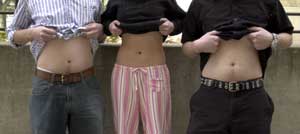
Keeping track of the Growing Waistline
It may look like a hot tub, but the tank located in the HPER Building is not used for relaxation. Measuring body fat percentage could hardly be considered relaxing.
Hydrostatic weighing, or weighing a body under water, is considered the “gold standard” when it comes to weighing body fat percentage, Lindsey Lovell, student director of the Employee Wellness Center, said.
Lovell, a graduate student in exercise science, said, “We take that weight and put it into some equations that have been developed to determine the percentage of your body fat,” she said.
Hydrostatic weighing is based on the principle that when the “body is immersed in water, it is buoyed by a counterforce equal to the weight of the water displaced,” according to ACSM’s Guidelines for Exercise Testing and Prescription. “Bone and muscle tissue are denser than water, but fat tissue is less dense.”
Someone with more fat-free mass will weigh more in water than someone with more fat mass, she said, which will reveal the actual percentage of the body that is fat.
ACSM’s Guidelines for Exercise Testing and Prescription said hydrostatic weighing is the standard for measuring body composition, but it requires a lot of equipment.
At Utah State University, all of the equipment for hydrostatic weighing is available for students and employees who want to know their body composition.
Lovell said she was the one who made hydrostatic weighing available to students.
“I was interested in my body fat. So that’s why I started the thing for students,” Lovell said. “Mostly it’s just for students to know. It’s a good way to track their progress if they implement it.”
Lovell said people use hydrostatic weighing for various reasons, but usually because they want to track their progress or just because they are interested in knowing what their body fat percentage is.
“Some people like to challenge themselves and set goals,” Lovell said.
“I’ve always wanted to know how much body fat I had,” Meredith Cragun, as senior in elementary education, said.
“Because by knowing how much body fat I have, I can know how much I need to lose,” she said.
Lovell said it is better to use body fat as a measurement because weight isn’t necessarily an accurate measurement. She said weight will increase when more muscle is gained, so body fat is a better representation.
Before using hydrostatic weighing, Cragun said she had used another body fat indicator, the skin fold test.
“It was not a pleasant experience. They actually pinched me,” she said. “I didn’t feel it was accurate. I’ve heard this hydrostatic thing is accurate.”
Cragun said she will be getting her body fat hydrostatically tested soon.
“The decision was a New Year’s resolution to be fit and toned,” she said. “This will be the start of my measuring and I feel this will help me. It will give me the encouragement and the motivation to finally succeed in my New Year’s resolution.”
When getting their composition done, people should realize that everyone is different, Lovell said. They should track their progress over time, instead of making it a one-time thing, she said.
Lovell said there are five components of health: cardiorespiratory fitness, muscular strength, muscular endurance, flexibility and body composition. When these are combined, they can evaluate a person’s general health, she said.
It is important to have complete health, Lovell said, and body fat is a good way to measure that. She also said it is easy to get the amount of exercise that is recommended to be healthy.
“If you do any amount of exercise – even if you just walked up and down the hill to campus every day,” she said, “you’d be getting the minimum amount of exercise that you need.”
Lovell said students can get their body fat weighed at anytime for $25, but they offer it once a semester for $5. It was offered this semester in January. She said to schedule an appointment, call the Wellness Center at 770-9844.
-hollyadams@cc.usu.edu