
Lab uses poison for good
During his “Caught on Campus” interview for the Utah Statesman, Jake Jensen, a sophomore majoring in exercise science, mentioned his fear of the Poisonous Plant Research Laboratory.
“It is close to where we work out and I don’t trust a poisonous plants lab,” he said. “What do you do with a poisonous plant lab besides poison things?”
When asked what she thought the PPRL does, Kelli Mitchell, a junior majoring in composite teaching-biological science, said “I have no idea. I’m pretty sure it’s dangerous and exciting.”
Other students are also unsure about the role of the PPRL in research and at Utah State University.
“Researches poisonous plants. It’s really big, [so] they must be doing something cool, right?” Emily Warnock, a senior majoring in biology, said.
The United States Department of Agriculture ARS Poisonous Plant Research Lab was founded in 1954 on the USU campus. The federally owned lab studies the effects of poisonous plants on range animals including cows, sheep, goats and horses.
The lab is the only one like it in the country and the bill to complete the building tipped off at $8.5 million dollars.
The lab is a one-of-a-kind institution, the only like it in the world. The PPRL, as well as its staff, are internationally recognized for their research work. Lynne James, director of the PPRL, said other labs in South Africa and Australia used to be in place, but poor economics forced them to shut down.
James gave an example of work that began many years ago, but still continues today.
In the 1950s, Idaho began recording losses in sheep herds because of birth defects in lambs. Through the efforts of scientists and the newly established lab, it was discovered sheep grazing on “Veratrum californicum” – commonly known as skunk cabbage – during their 14th day of gestation gave birth to severely disfigured offspring.
James said the lab then could help ranchers and farmers lay out grazing patterns so sheep could avoid grazing on the plant during gestation, and the resulting losses would be significantly less.
“[We are] dealing with something that has a great impact.” James said about the research being conducted at the lab.
In cooperation with Harvard University and the University of Michigan, using goats as models, in utero surgical techniques are being developed to close cleft palates in the fetus, he said. This is also being developed for use in humans.
“[They] can fix a cleft palate with one surgery, not 10 or 12,” James explained. “You can’t tell the difference between a goat that had the cleft palate and one that was normal.”
James explained that with new technologies, the physical effects or scarring and also psychological stresses would be eliminated. “It becomes a humanitarian [issue].”
The “spin-off” of research on skunk cabbage, as James called it, resulted from the toxin that caused the damage, cyclopamine, being isolated from the plant. This compound is what causes the “cyclops effect” in the lambs. Because it acts as an inhibitor for cells, they stop dividing, which causes the birth defects.
The effects of cyclopamine have been pursued further and may have medical applications in the curing or inhibiting the process of pancreatic and prostate cancers.
This impact becomes even more apparent with the growing list of examples he gave.
Lupine is a plant located in the foothills and grows all over, James said. It is a poison in the sense that if animals, such as cows, eat it too fast, they die. If only a small amount is ingested, for a limited time it acts as an anesthetic to calves within the womb, he said.
James gave two impact examples this toxin has upon the calf. The knee in the right front leg is malformed and instead of the joint allowing the calf to walk forward, “they can only hop like a rabbit,” he said.
The other consequence is that the tongue of the forming calf doesn’t move, instead, it lies in the roof of the mouth and results in a cleft palate, he said.
As in the research with the grazing of the sheep, a grazing pattern for cattle was developed so this problem could be avoided. James said the toxin was also isolated from the plant, which allowed for continued research.
“We’re here to solve problems of livestock poisoning by plants and the rest you get for free. The scientists at the laboratory receive many calls from poison control centers regarding poisoning in people. Thus, the laboratory renders a valuable service to the human population as well as to the livestock industry,” he said.
James also said he uses the research done by the lab to give lectures to high school-age students brought to the lab by their teachers.
By explaining the various harmful toxins and their effects on the parents and offspring, James said he has been able to use these powerful examples as an anti-drug tool.
“What most people think of poisons [is] as something you eat and die,” James said. He then explained there are several different ways in which poisons act and he emphasized in most of his examples that it was the young or offspring of the individual that was harmed by the toxins, not the mother who initially ingested it.
The research being done on poisonous plants has global importance, James said. In 1978, James proposed that a workshop be held for researchers of poisonous plants, an idea which later developed into the International Symposium of Poisonous Plants.
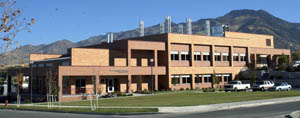
The laboratory is located in Logan along 1400 North and from 1050 East to 1200 North. The new main building holds state-of-the-art equipment and technologies, including video conference capabilities. In addition to the new building, other buildings are being built and older ones are being refurbished.
The employees of the lab all hold some status at USU and Dr. James is a full adjunct professor. “I got my three degrees here. I guess you could say I’m an Aggie fan,” he said.
The lab includes scientists of several differing disciplines so extensive research can be accomplished. he said. “Not only is it a unique lab, but a very productive lab,” he said.
James also said that one of the goals the lab is striving for is for students to know and understand what work is done at the facility.
“We don’t just poison animals,” he said, referring to Jensen’s interview. He said if Jensen would come in, “I’ll show him what we do.”
-eliseras@cc.usu.edu
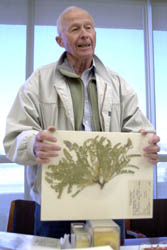
Dr.Lynn James, director of the PPRL holds up an example of loco weed, a plant that affects livestock around the world.