
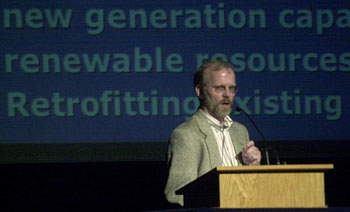
Last Lecture focuses on future
Geology professor Jim Evans believes in issues, not problems.
“We don’t have problems, we have issues that give you opportunities of things that you can learn and move forward,” Evans said. “If we think they’re problems, then we get all bummed out. If we think they’re issues, then we have something to deal with.”
Evans, who graduated from the University of Michigan with a degree in geology and engineering, spoke to students Thursday afternoon about “Utah 2050: Oil, water and milk in a land of plenty [of people],” as part of the annual “Last Lecture” put on by the Honors program and gives the selected professor to lecture as it if was his or her last public speech.
“This is my opportunity to say the last statement,” Evans said. “The last opportunity if I were wiped from the face of the Earth in 37 minutes from now. I thought I was going to say something really profound.
“Then I realized I’m not capable of saying profound things, and so it would be 45 minutes of pure torture for you to watch me flounder while I try to do something profound.”
So, Evans decided to speak about something he knew at least a little bit about: Utah – and what it could be like in the future.
In 45 years, Evans said the population of Utah will double according to an article that appeared in the “Salt Lake Tribune” in January of 2005.
The projections by the state government agency used in the article said that Utah is going to have 5.5 million people in 2050.
Right now Evans said Utah has about 2.2 to 2.3 million people.
“Most of you will be alive [in 2050],” Evans said to students. “You’ll be at the peak of your adulthood, most of you probably want to live in Utah and yet we’re going to have double the population in 45 years.”
Evans moved to Utah in 1987 after receiving his master’s and doctorate degrees from Texas A&M. At that time he said driving from Salt Lake to Logan used to be “fairly gentle, country driving” north of Ogden. Now, he said he has found ibuprofin to be essential when he drives the freeway because of almost continuous traffic.
Most of the growth, Evans said, will occur in the “metroplex” areas of Utah and in St. George.
Evans defines metroplex as what will be the area from Richmond, Cache Valley, to Nephi, Utah County. He said it could be a continuous string of cities with few open spaces.
He also said there will be a lot of growth in Southern Utah. By 2050, St. George could have as many as 600,00 people living there.
“We’re going to be packing ourselves into this space,” he said.
Some of the warning signs of this growth are apparent today, Evans said, even in Cache Valley.
“We live in a closed valley,” he said. “We get snow, it gets cold, there are lots of cows and we drive cars.”
Put all those together and Cache Valley residents can see some “gloomy winters.”
Evans said there are two ways to deal with it. The first, ignore it. The second, he said, be proactive.
The biggest concern Cache Valley residents should have today, Evans said, is saving and regulating land.
“The days of the large lot with a large house on it … are essentially gone for Logan,” Evans quoted Jay Nielsen, Logan city community development director.
Evans said he sees many positive aspects to this “issue.”
He said Cache Valley is full of college-educated people who can create solution, increase awareness of issues and bring a huge range of talents to solving the problems.
“USU has much of the intellectual fire power to contribute and educate,” he said.
Each year professors are nominated to speak as the last lecturer by Honors students. The students pick a professor who has had and impact on those in his or her class.
Evans was selected to speak by a committee of Honors students chaired by Katherine Shakespeare, who said Evans impressed the committee. She said he came to the student interview fully prepared.
Evans came to the interview with an illustrated handout in hand, Shakespeare said, and several days later the students were still thinking about some of the concerns he raised for the future of Utah.
“Dr. Evans’ passion for teaching and the positive effect he’s had on so many students and individuals also influenced our decision,” Shakespeare said.
Junior Brittany Webb also thought Evans was a stand-out professor. She had Evans as a teacher and was so impressed by him that she returned the next year to be his teacher assistant.
“Dr. Evans’ classes are definitely not of the typical lecture-and-take-notes variety,” Webb said. “[He] makes his classes fun places to be, and that is what makes learning fun.”
-emilieholmes@cc.usu.edu
-aedmunds@cc.usu.edu