
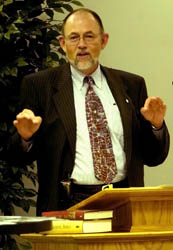
Lecture explains ‘Da Vinci Code’
A history-based discussion on the fact and fiction of Dan Brown’s novel, “The Da Vinci Code” drew more than 100 listeners Friday.
In conjunction with Homecoming week, the College of Humanities, Arts and Social Sciences sponsored the discussion led by Norm Jones, head of the history department. The lecture was free to the public and many individuals who had read Brown’s book came to the lecture.
The book has gained popularity for several reasons, Jones said.
“It has come to us in a point in time of interest in religion and spiritual issues, a certain amount of suspicion about organized religions – certainly the Catholic Church – has had its problems in the United States,” Jones said.
Jones said the book incorporates flaws and historical inaccuracies, however, Brown presents the theories in a way where they could be perceived as believable.
The book presents the quest for the Holy Grail and explains the grail is not an object, rather a descendent of Jesus Christ, Jones said.
“Statistical odds, we all contain that genetic material,” Jones said about the theory.
The lecture focused on the history of the Bible, the conservative religious group Opus Dei, the Templar Knights and the Priory of Sion.
Jones said Brown incorporated specific biblical and non-biblical references to support his theory of the role of the sacred feminine and the conspiracy that the Catholic Church is hiding secrets.
“Brown, of course, does not make any claim that he is telling the truth,” Jones said.
Tim and Lynnie Foster, residents of Logan, attended the lecture. Tim said they have both read the book and were interested to find out what was historically factual and what was fiction.
“I thought it was very interesting to find out how much of that the author just used to make it better,” Lynnie said.
One argument Brown makes in the book is the marriage of Mary Magdalen to Jesus Christ, Jones said, however, this is highly improbable. If Jesus were married to Mary Magdalen, “it would have been mentioned and would have been celebrated,” Jones said.
The book incorporates symbols and cryptic messages in a fast-paced plot, Jones said, which allows Brown’s theories to appear plausible. The history of the Priory of Sion – the secret group that is charged to protect the Holy Grail – is presented as truth in the book, Jones said.
There was a Priory of Sion, Jones said. However the group lasted for 80 years and then was absorbed into the Templar Knights – the order started in 1112 A.D. charged with protecting the Holy Land (Jerusalem) – Jones said.
The book insinuates that the Priory of Sion lasted until the present with such historical figures leading the group as Sir Isaac Newton and Leonardo da Vinci, Jones said, which is not accurate.
Brown’s book does accurately portray self mortification that the conservative Catholic organization, Opus Dei, uses for purification purposes, Jones said. However, the group is portrayed as an evil organization, which is not the case, he said.
“Mortification of the flesh is necessary to control the evil,” Jones said about the ritual beliefs of Opus Dei. “It is hardly an evil organization.”
The Catholic Church has made public statements about Brown’s book, Jones said. The Catholic Church distributed a brochure about “where the novel takes leave of the truth, and their right on,” Jones said.
“I don’t think they’re feeling terribly threatened by [the book],” he said.
Jones said he did not think the book was particularly well written and the end seemed to fall apart.
However, Tim thought the book was fun to read.
“Whether it was fact of fiction, it was a good murder mystery,” Lynnie said.
-kcashton@cc.usu.edu