
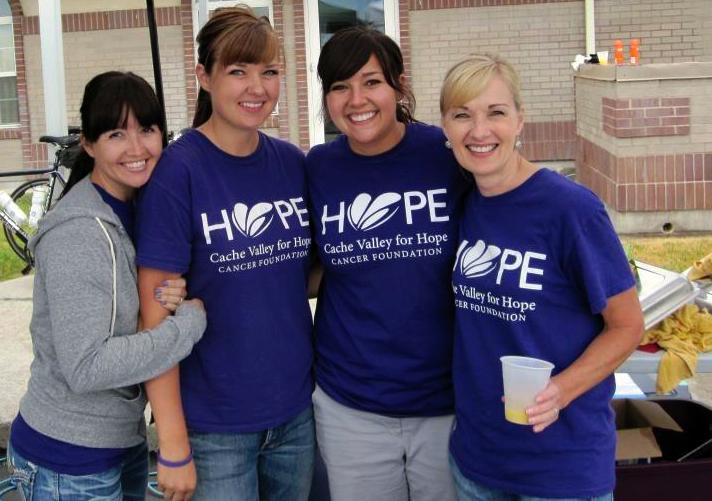
Local group eases burdens of cancer
Cache Valley resident Roger Welsh was diagnosed with cancer on April 13, 2010. After nine weeks of chemotherapy and a few surgeries, Welsh overcame the disease. However, his exposure to the trials of others in the valley suffering from cancer during his bout with the illness was a catalyst in his founding of the non-profit cancer foundation Cache Valley for Hope in April 2011.
“I was in the cancer center five hours a day, five days a week,” Welsh said. “I saw a lot of different people that would come in and I listened to what their problems were. Most of them weren’t worried so much about medical bills as they were about daily, monthly bills like mortgages and car payments.”
While Welsh was undergoing treatment, he and his family formed a team for the annual Cache Valley Relay for Life. The goal was for each team to raise $1,000 for the American Cancer Society. Welsh and his family were the number-one team in 2011 and raised $8,000 of the total $78,000, but Welsh had an underlying concern.
“Where was the money going?” he said. “I knew it was going somewhere good for research and things, but I couldn’t see how it was going to help the people in the community in the ways I saw they were having issues. I thought, ‘We need to try and form something that focuses solely on the people in Cache Valley.'”
Cache Valley for Hope’s purpose is to make donating easy for people in various financial circumstances. With its automatic deposit system, donors can set up how much is automatically donated each month, even if it’s a few dollars. Currently, there are about 250 donors donating money automatically. People also have the option to donate any amount at any given time without setting up an automatic deposit system. Welsh said the donations are dispersed articulately between those in the valley in need.
“If you know somebody who has cancer, you can go online to our website and nominate them,” he said. “I take that information and send them an analysis form that they fill out to give me an idea are where they are financially. We then meet as a board of directors with the information and vote to decide if the particular individual is qualified for our service.”
The cancer patients who qualify for financial aid are not paid directly.
“I put the money toward their mortgage or car payment, for example,” Welsh said. “This way we can see exactly where it’s going.”
Cache Valley for Hope now has a team of 10 unpaid directors who volunteer their personal time to keep it going. Tyler Vanderbeek and his wife Laura, also a cancer survivor, are both directors of the foundation. Vanderbeek said putting in the time for CVFH on top of his family life and job can be difficult.
“There have been certain moments it’s been a little bit more stressful than others, but I know it’s a huge benefit for those in the valley going through cancer,” he said. “After going through it ourselves with my wife, we know what it’s like. It’s definitely worth the sacrifice to see the help we are giving these people.”
The Vanderbeeks show their gratitude for the way people in their neighborhood helped them in their time of need by reaching out to others in the valley.
“It’s a way we can give back to the community,” Vanderbeek said. “We know what it’s like firsthand physically, mentally, emotionally and financially, even with insurance. It’s a huge relief for them and they can focus on recovering instead of the bills.”
Vanderbeek said CVFH has a goal to have 10 percent of Cache Valley residents donating $10 monthly.
“Ten percent of the valley ends up being around 10,000 people,” he said. “If they are all donating, that could go a long way.”
Cache Valley resident John Van Duren is undergoing cancer treatment and expressed his appreciation for the organization.
“All I know is I would have lost my house and wouldn’t have the fuel to drive to and from my home and hospital for treatments without Cache Valley for Hope,” he said.
Van Duren, unable to work, said CVFH has been a tremendous help ever since they first contacted him and said he had been nominated.
“The people donating and in the foundation are so generous and so dedicated,” Van Duren said. “I am just so grateful they called me that day. I want more people in the valley to know all about such a great thing.”
Van Duren wasn’t alone in his desire to tell others about CVFH. Krissy Kartchner, whose daughter Kelsey has a form of cancer called bilateral retinoblastoma, said she and her family never pass up an opportunity to get the word out about the organization.
“I share events on my Facebook page and talk about the get-togethers we’ve enjoyed,” Kartchner said. “My husband has displayed the CVFH pamphlets on his desk at work.”
With the majority of Kelsey’s care in Philadelphia, Kartchner said things would be more difficult without help from Cache Valley for Hope.
“The worry about airplanes, taxis, hotels and food seem less overwhelming knowing that the daily finances are lightened through CVFH’s support,” she said. “I do the doctors visits with Kelsey and my husband Jason stays home with our children and is in charge of the finances. He is able to have the financial stress eased so he can offer comfort and encouragement while we are traveling for treatment.”
The locality of the organization has been a blessing for Kartchner and her family.
“You can see the genuine love and compassion of the board members for the families during these trying times,” she said. “Roger checks with us through texts on how doctor appointments have gone and sends emails of support and offers help. You can’t get through cancer alone. You need a network of support that boosts you up in times of need, whether emotionally or financially.”
– brooke.larsen@aggiemail.usu.edu