
Looking into the world of Friesian Horses
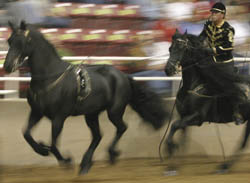
For most Utahns, a well-trained horse is a phenomena belonging to the barrel racing and pole bending events at the county rodeo. But from Thursday through Saturday, Oct. 14-16, that conception gave way to the drama, elegance and style characterized by the Friesian Extravaganza horse show. The show took place in Ogden at the Golden Spike Arena.
Long manes and tales touched the ground of the arena as the night was started with a musical number from the Phantom of the Opera, performed on horseback. As the disfigured Phantom raced around the arena he sang about his love for his student Christine. By the end of the song Christine had fallen for the Phantom and they paraded out of the arena together.
This dramatic performance was followed by antique horse drawn carriages and a stunning dressage performance by a champion Friesian. The Friesian’s naturally fluid movements and flashy gaits make it the horse of choice for classical dressage, which is an ancient riding skill where the rider “tunes” into the horse, allowing them to move as one through technical maneuvers.
The ancient skill fits well for such an ancient horse.
The Friesian breed of horse is more than 2000 years old and was relatively isolated in a small province in the northwestern Netherlands, called Friesland for most of that time. An area rich in agriculture, Frieslander’s used the horse to work the land until the invention of farm machinery. The horse breed was also utilized as a war horse by Friesian soldiers fighting with the Norman armies, and later used by knights during the Middle Ages. With the mechanization of farms, tragic World Wars and cross-breeding, the purebred Friesian was on the brink of extinction. They were saved by a group of dedicated breeders in Friesland. In 1913, there were only three studbook stallions left in the world. Now there are 40 approved stallions in Holland and America.
Only a few decades since the Friesians neared extinction, these distinctive horses enjoy a celebrity life style unrivaled by any other breed. Friesians are often used in movies to help create a historical or mystical illusion of time.
The Friesian Extravaganza displayed this illusion during the costume parade. Medieval knights and ladies on their black beauties pranced around the arena to the theme song of the 1985 hit movie, “Lady Hawk,” starring Mathew Broderick, Rutger Hauer, Michelle Pfeiffer and directed by Richard Donner.
The movie featured a Friesian named “Goliath,” whose real name is Othello. He participates in the role of the faithful steed of the knight Navarre. According to legend, Navarre and his lady Isabell were cursed by the evil bishop who cast a spell on them. By day, Navarre was a man and by night, he was a wolf. His love turned into a woman at night and a hawk by day. The Friesian’s modern day popularity in North America can be linked to the movie “Lady Hawk”.
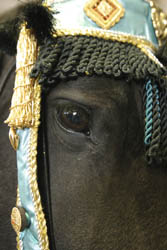
The Friesian Extravaganza was unlike any horse show ever performed in Utah. These horses with all their history and dramatic flare for the spotlight entranced the entire audience. Looking into their luminous dark eyes one can almost hear the sound of swords clashing and battles raging in a distant land.
Friesian horses are one of the most unique breeds to have performed at the Golden Spike Arena and probably the last.
Becky Blankenship is a photographer for the Utah Statesman. Comments can be e-mailed to
photos@statesman.usu.edu
(Photo by Becky Blankenship)