
Making a world of difference
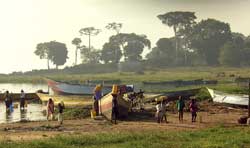
During the winter break, USU’s Engineers Without Borders traveled to Uganda to assess the quality of water and the topography around two boarding schools in order to improve their water systems.
“We hope our project will help decrease illnesses that are there, like typhoid fever, worms and dysentery,” said Josh Hirschi, leader of the Bira, Uganda, project and a junior majoring in environmental engineering.
Those who traveled to Uganda were USU students Hirschi; John Sapp, president of Engineers Without Borders and a junior majoring in environmental engineering; Ryan Davies, a junior majoring in civil engineering and Hailey Ferrara, a sophomore in environmental engineering.
Club adviser and professor of civil engineering William Grenney, who traveled with the students, said, “They have real dedication to the program. They didn’t come back until 11 p.m. on Christmas Eve and they left the second day of finals.
The students visited the villages of Bira and Masaka where they evaluated the conditions of the water surrounding boarding schools. The schools have 300-400 students attending each, Sapp said. Grenney said the schools are self-sustaining, meaning they grow their own food and raise cattle.
In Masaka, the group stayed in someone’s home. Grenney said, “There were no screens on the windows. We stayed in one small room with bunk beds. There were malaria-bearing mosquitoes, cockroaches and lizards.
They also stayed in Kampala, the capital of Uganda. While there, they met with engineering students attending Makerere University and worked with them to test their findings from the schools.
Ferrara said, “We had to take water samples to be tested there because we couldn’t do it on site or bring it back with us. We couldn’t take the required equipment with us.”
Using the data collected in December, students are currently working to determine the ground-water level in Masaka, Sapp said. The group plans on finding locations to build new wells for the two schools.
Students are also working to find alternatives for water collection and distribution within the schools, Sapp said. Based on techniques learned in their engineering classes, students are designing pumps, storage containers and a water distribution system. They are hoping the systems they design are sustainable and durable so that years from now, the schools will still be benefiting from their project, Sapp said.
Engineers Without Borders plans to return to Uganda in August for two or three weeks to implement their plans. Sapp said he hopes to send a team of six students and a professional mentor.
Sapp said, “It’s not like we went and that is it. We will continue with this project. We will send down another team to put it together and make it work.”
Hirschi said, “One thing this trip did for me was to apply engineering outside the classroom and see it help people.”
The group described Uganda as very lush and said the country is fortunate in that they have water all year long, even in the dry seasons. However, the water is unprotected from the element and animals, Sapp said.
Davies said, “They are very poor. The children’s clothing was mostly always torn and ragged. Many babies were naked and being carried on their brother or sister’s back.
Ferrara said AIDS has wiped out the middle-age group. There are mostly elderly people and teenagers living in the area and children are usually raised by older siblings, she said.
“As we drove through the city, you could get a sense of hopelessness because of how many children live in the streets,” Davies said. “You want to help them and you could help them for a minute, but you couldn’t do anything in the long term. But we are bettering their situation by getting water to them. That will help in the long term.
Engineers Without Borders is a chapter organization that began at USU a year and a half ago. The group also has projects in Tibet and Peru. They have been involved with local service projects like Habitat for Humanity.
For more information about Engineers Without Borders, visit their Web site, www.engineering.usu.edu/clubs/ewb, or contact Sapp at ewbusu@cc.usu.edu. -ariek@cc.usu.edu