
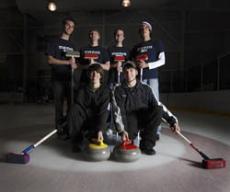
Making an Icy Impact: USU curling
Funny, little men with brooms.
For many, this is the image they bring up when they hear of the sport called curling.
People might laugh at the thought of it, call it a glorified shuffle board or share other such remarks. What they probably don’t realize is the amount of skill, physical work and strategy that is involved in this seemingly simple game.
To be fair, rather than comparing it to shuffle board, it would be more appropriate to compare it to playing chess while running laps on a giant sheet of ice.
Another thought that might pass through the mind of someone hearing about curling is as something they do in North Dakota, where they don’t have anything better to do but play on the ice.
Wrong again. While curling might be big in those Northeastern states, it also has quite a strong following here in Cache Valley. If you don’t believe this, just head down to the Ellen Eccles Ice Arena on a Monday night.
There you will find up to 50 students who have taken the curling class as well as USU’s very own curling teams. Yes, USU has more than one curling team.
While the nation was infected with March Madness, the curling teams competed in their own version of a national championship.
Both teams competed in the College Nationals in Chicago. One of USU’s two teams took the bronze medal, which would signify that the team that did best in its sport this year wasn’t basketball – it was curling.
The third-place team consisted of Eddie Ruby, Mike Bruckner, Neil Womack and Charles Taggart.
However, the curling team is still just a club and not an official sport yet. They have been competing for about three years, many of the members of the team getting interested in the sport just after the Salt Lake 2002 Winter Olympics.
The original four members, who started the club three years ago, are still together and curling here at USU.
The team is made up by Stephen Houghton, Jeff Carr, Erik Kaltschmidt, and Matt Johnson. The team said that at first, curling was not as popular as it now is.
“When we first started the class it seemed like it was hard to fill up the ice,” Houghton said. “But this year the classes are pretty full. They even had to cut a few people because it was overflowing. It is definitely growing in popularity.”
While the sport is growing in Logan, the team members still get a few strange remarks from others who find out what they do.
“They’ll laugh about it at first (and say), ‘You really do that?,'” Ruby said. “But then they are like, ‘That’s pretty cool.'”
With regards to hearing curling stereotypes, Bruckner said, “You get used to it. People are usually curious about it.”
The team was quick to say there is really only one way to learn what it takes to be a curler, and that is to go out and curl.
In curling, the object of the game is to have as many of your team’s stones as close to the center, or button, as possible. In order to get them there, players must slide them the length of the ice, but still manage to stop them in a 2-foot circle. However, while one player slides the stone, the others don’t just sit around and watch. They have to do the real work.
While the stone is sliding the down the ice, a player stands in the circle where the stone hopefully ends up. This player is known as the skip, and he shouts commands for the two sweepers. The two sweepers run along side the stone, which is difficult by itself, and when the skip yells sweep, they sweep as fast as they can in front of the stone.
Sweeping in front of the stone creates friction with the ice which helps smooth it out and ultimately make the stone slide farther. Sometimes when a stone doesn’t have enough juice to make it all the way, all four players will sweep, giving the stone some extra feet of distance.
And the sport takes more than physical ability.
“It’s a team sport. There is a lot of strategy,” Carr said. “Curling is all strategy. It doesn’t take a whole lot of athletic ability, but it is all strategy.”
Players can knock the other team’s stones out of the center, leave a stone short on purpose to guard their inside stones, or curl their stone around the other team’s to sneak in the side door for the point.
The team members were quick to mention that curling is a sport for everyone. There are some fees to being part of the club since they have to rent the ice each time they play, but everyone is invited to come out.
The club, however, does not have to buy its own stones, which cost about $3,000 for a set of 16.
It is a challenging, fun and friendly sport, members of the team said. Each of the club members has his own reasons, though, for playing this sport.
“It’s fun because no one else knows about it,” Kaltschmidt said. “It’s our own little world.”
“It’s more relaxed of a sport,” Johnson said. “After playing high school football and basketball, which were always intense, it’s nice to be able to show up here and just have a good time.”
So the next time someone tries to mock curling, remember to tell them that it is more difficult than they think, and, before they knock it, they should come out and try it.
-wwm@cc.usu.edu