
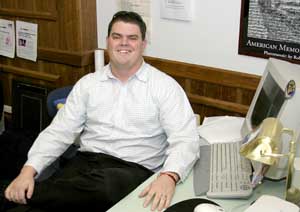
Many find being a student is more than just that
At 4:30 every other morning, Gabriel White wakes up to listen to people scream about their cell phones.
He drives to Convergys, a call center sub-contracted by Sprint PCS. In the customer assistance department, White is a “specialist” who “signs onto the phones” – call center terminology for wearing a headset and maintaining a constant stream of inbound calls – to listen to complete strangers shout and swear about their cell-phone coverage, service and billing. He spends six hours at a time dealing with an onslaught of angry customers. This ritual is repeated Mondays, Wednesdays and Fridays. On Fridays he puts in an eight-hour day.
After work, he goes to school to attend the first of four classes. His 12 credits make him a full-time student. He is scheduled as an adviser for an average of two hours a day in the Humanities, Arts and Social Sciences senatorial office of Associated Students of Utah State University. As HASS senator, he meets with Dean Gary Kiger every month, the HASS council every other week, the ASUSU council every week, and the other college senators every week.
White’s ASUSU responsibilities and his part-time job at Convergys (with overtime) combine for more than 40 hours of work per week.
He spent most of summer and early fall studying for the Law School Admissions Test. In August, White studied for the LSAT for five or six hours per week. He studied four or five hours on some days in September. Near the end of September, he participated in two or three eight-hour study sessions.
Due to his busy schedule with ASUSU, White couldn’t participate in the celebrated LSAT preparation course taught by philosophy professors Richard Sherlock and Chuck Johnson.
“I just got a [LSAT practice] book and beat the hell out of it,” White said.
White finally took the LSAT on Oct. 4, and didn’t get his score until the end of October.
And to top it all off, he’s married.
His hectic schedule may sound abnormally busy, but this demanding and eventful routine is getting to be more common among college students.
“Out of 700 or 800 students this year, the majority of my clients have stress related to [being too busy,]” said Mary E. Doty, director of the counseling center at USU.
Doty, who holds a doctorate in psychology, and her counseling team see hundreds of students every year who have emotional and mental problems. But she said most of their problems are compounded by jam-packed schedules.
“They get overwhelmed,” Doty said. “Years ago, there wasn’t the same level of pressure and competition.”
The competition is so tough that many students postpone their entrance into the job market by applying for graduate schools.
“[Students are saying] ‘If I want to make a decent salary, I have to get an advanced degree,'” Doty said, echoing the sentiments of many college student, nowadays.
Getting into law school, especially a “Tier One” like the University of Utah S.J. Quinney College of Law (ranked 40th nationally, according to the “U.S. News and World Report” Web page www.usnews.com/usnews/edu/grad/rankings/law/brief/lawrank_brief.phpt), is more competitive than it has ever been.
In USU’s professional and graduate school fair on Oct. 15, Reyes Aguilar, Jr., associate dean for admissions and financial aid at the University of Utah’s law school, said in the 1970s studying for the LSAT wasn’t as serious as it is now. Now, if a particular student tells him that he or she was just too busy to put a lot of time into studying, that student drops low on his consideration list.
Luckily, White put in the hundreds of hours necessary to be prepared for the test. He even studied 30 to 45 minutes a day this summer in Peru, where he joined his wife, Wendy, on an anthropology trip.
White’s LSAT study time had to fit into the time he spends hitting the books for classes. And that time wasn’t easy to come by since he is dual majoring in political science and economics.
One advantage of working through school is that it teaches students that life could be just as busy after school, and they are better prepared to face that fact, White said.
“In the real world, you’ve got family, you’ve got work, you’ve got continuing education, you’ve got fun things to do, you’ve got friends, you’ve got religious responsibilities,” he said.
Those religious duties for White spring from his membership in The Church of Jesus Christ of Latter-day Saints, Utah’s predominant religion. LDS leadership encourages young adults not only to fulfill marriage and family responsibilities, but also to get an education.
Despite the ecclesiastical admonitions to marry young and be self-reliant, Doty said students in Utah colleges are no different than students around the nation.
In her conversations with counselors in other states, as well as her personal experience outside Utah, the pressures and demands that lead to emotional issues are the same nationwide.
Students can feel overworked without being workaholics. White said he’s not a workaholic, but when he really enjoys something, it becomes an obsession.
“Working as an intern, I took my work to lunch [and] read through papers at home late at night,” White said. “I jumped out of bed every morning.”
Despite his demanding routine, White has found many benefits to working through school. He has learned to allot proper time for different areas of his life.
“It’s helped me learn to balance my time,” White said.
Although White finds that he works hard during school, he has never fallen victim to one of the growing trends among student workers: that they, ironically, often become ineligible for student grants.
In an Aug. 8, 2003, article in “The Chronicle of Higher Education,” Stephen Burd wrote, “Financial-aid experts believe that thousands of low- and moderate-income students fall victim to the ‘student-work penalty’ each year, losing their financial aid because they earn too much, putting in long hours at off-campus jobs, forcing many of them to take time off from college or drop out.”
So, not only do many students spend would-be study time working, but many of them become ineligible for grants while fellow students can spend extra time studying and get paid by the government for it.
Partly due to an extensive work background, White seems to find the time to work and study.
“I’ve always worked,” White said. “The longest I’ve ever been unemployed at one time, I think, was three weeks, since I was 16.”
White’s first college job was waiting tables at Sizzler. He also worked at Cache Valley Truss, where he learned to build and install trusses until that company went out of business. During the summers, he has found a variety of jobs. He’s worked in a California vineyard owned by some relatives, helped take care of animals in his dad’s company, Pangenic, and he even interned in Sen. Orrin Hatch’s office in Washington, D.C.
Although White is only 24 years old, he is part of the student population who works full-time, the majority of whom are 25 and older. Harry Wessel, in an article in “The Orlando Sentinel,” said that about two in five current U.S. college students are at least 25, and most of these are working full-time. As of 2000, 62 percent of these students work full time, according to the U.S. Department of Education.
So, White isn’t all that different from other students. College students are getting busier and busier, filling up their schedules with more and more items in order to stay competitive and meet the various demands of life.
-marklaroc@cc.usu.edu