
Many students colorblind to no drive days
Bear River Health Department’s red, yellow and green day air quality program displayed on Utah State University’s WebMail login page has undergone changes recently.
“We ran into a few glitches in our system,” said Mike Weibel, public information officer for Bear River Health Department. “We recognized a few more variables in determining red, yellow and green days than we were originally aware of.”
According to the health department’s Web site, Cache Valley residents are encouraged to stay indoors and keep driving to a minimum during red days and be prepared to follow these recommendations on yellow days.
Weibel said the health department appointed an air quality task force to provide recommendations about the current system for determining Cache Valley’s air pollution.
“Instead of a yellow day always followed by a red day, the task force decided to change the system a little,” Weibel said. “We are now placing more emphasis on yellow days. A yellow day will no longer necessarily be followed by a red day.”
He said the problem was Cache Valley residents were driving more on yellow days in preparation for a cut-back on driving during the red day to follow.
“Why should we wait until a red day to make the needed changes in our behavior?” he said.
The health department works with USU’s meteorologists and engineers to determine the quality of the valley’s air, he said.
“In consultation with our air quality program, USU helps us determine whether we are having a red, yellow or green day using scientific data,” Weibel said.
He said using current technological innovations, the team can determine the amount of air pollution the area can expect days ahead of time.
Paying attention to the color associated with the amount of pollution in the air will be beneficial to everyone, but he is not aware of whether or not Cache Valley residents are paying attention to the recommendations made daily on their behalf, he said.
“Bear River Health Department has made arrangements through Utah Department of Transportation and the city of Logan to put cameras on busy traffic lights in Logan within the next week,” he said. “This will help us determine whether or not residents of the area are paying attention to our color system and following the recommendation to keep driving to a minimum on red burn days.”
Between Jan. 18 and 21 on the valley’s first red day using the reorganized system, the number of passengers on the LTD bus system went up 20 percent, Weibel said.
“Our main target with this system is to cut driving by one-half,” he said.
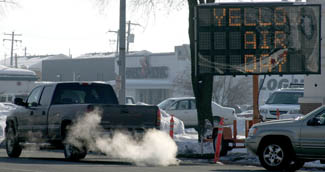
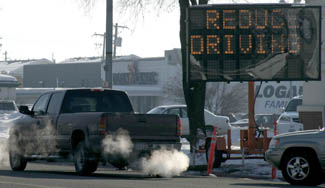
Weibel said there are several ways to be aware of whether the day is considered red, yellow or green. He said the most immediate information can be found on USU’s WebMail login page, as well as Bear River Health Department’s Web site and electronic signs on both ends of Main Street.
Holly Okubo, a junior majoring in interior design, said she pays little attention to the air pollution posting on WebMail’s login page.
“I don’t really take what color of day it is into consideration,” she said. “I will drive no matter what if I have somewhere I need to go. I guess I just don’t really think about it.”
She said she doesn’t believe the red, yellow and green day postings are necessary or needed for students.
“I can tell when there is inversion because of the fog in the air, so I don’t really need a little stoplight on a Web site to tell me what’s going on in the atmosphere,” she said.
Brad Hart, a junior majoring in speech communication echoed the general consensus of USU students.
“I don’t pay any attention to the air quality posting. If it’s red, I’m still going to drive,” he said. “Plus, when I’m logging into WebMail, I’m usually in a hurry so I don’t really have time to consider what type of day it is.”
Weibel said he is looking into other ways of informing Cache Valley residents about the quality of our air and ways to help mitigate the problem. He said he is looking into red, yellow and green flags to fly in the city, as well as information cards about what residents should do during the different levels of inversion.
-Lexiek@cc.usu.edu
(Photo by John Zsiray)