
Meditation group brings religions together
The Amrita Sangha for Integral Spirituality is a meditation group that meets every Wednesday evening, led by Associate Professor of English Michael Sowder. The Amrita Sangha has become Sowder’s core focus since he founded it last November.
“The Cache Valley Sangha group is more focused on Buddhism, and in this group we try to draw on the world’s different traditions,” he said.
In the main room where the meditators meet, against one wall is an altar. It’s a wooden table about four feet tall with scarves draped across the length. At the front of the altar are five candles, each of a different shape and size, and behind which are framed pictures.
Within each frame sits a deity, or teacher, of various faiths. There is the Dalai Lama with a Catholic Priest; a picture of Jesus Christ sits next to Buddha. Also upon the altar is a statue of Hindu God Shiva, the destroyer.
“We have an eclectic, universal approach to meditation and spirituality. No one has to be a buddhist to meditate,” Sowder said.
While an ascribed religion may not play a key role in Sowder’s view of meditation, he, along with many of the other members, have had histories with other religions before beginning to meditate.
“I was raised Catholic,” he said. “I had 12 years of Catholic education and I began meditation 35 years ago in a yoga studio for ten years and then I migrated to a Buddhist tradition, but now I’m back in a kind of yoga meditation.”
Meditation takes some practice to get down, but Sangha group member who goes by the spiritual name Mirabai has been practicing meditation for 25 years in the United States as well as Japan.
“When I began, I thought, ‘This is weird,'” she said. “But I’ve given years to degrees, so I thought I could give four years to this.”
Mirabai did just that, and spent longer time with the practice. When she was pregnant with her second child she moved to Japan to teach English, despite her misgivings, and there said she saw the connections between all things.
“There was another woman about the same months along as I was who lived just across from me,” she said. “And we couldn’t communicate, but we both practiced the same form of meditation.”
There are many forms of meditation but at its core, meditation has been practiced for about 5,000 years and has many benefits, both spiritual and physical, Sowder said.
“All the things meditators have been touting as benefits for centuries are now starting to be proven by science,” he said. “Meditation is transformative of your physical health and has mental benefits. Many scientists say they have breakthroughs when meditating.”
Sowder said meditation is supposed to reduce blood pressure, stress and tension, is good for your circulatory system, oxygenates your body and is good for your posture. It improves concentration, willpower and focus, he said.
“Those who meditate report greater feelings of well being, you’re just more joyful,” he said.
Bernadene Ryan, a masters student in folklore, said she believes this meditation group along with the three others offered at different times in the week is a valuable resource in a university town.
“It’s important to be able to slow down, calm down,and understand where feelings are coming from,” she said. “It’s important for students, who become so stressed, to be able to let go, to not be attached, to realize that I am not a stressed person, I am a person who has stress.”
When the Sangha group meets each week, the members greet new and returning guests with a smile and a greeting. The typical meeting begins with gathering in the main room for announcements, singing and sometimes chanting, and a focusing. Next, the leader for the evening will have a dharma, or talk about some spiritual philosophy before the group moves into a 20 to 30 minute silent or guided meditation.
“Focus on your breath, or on your mantra,” Mirabai said to the group.
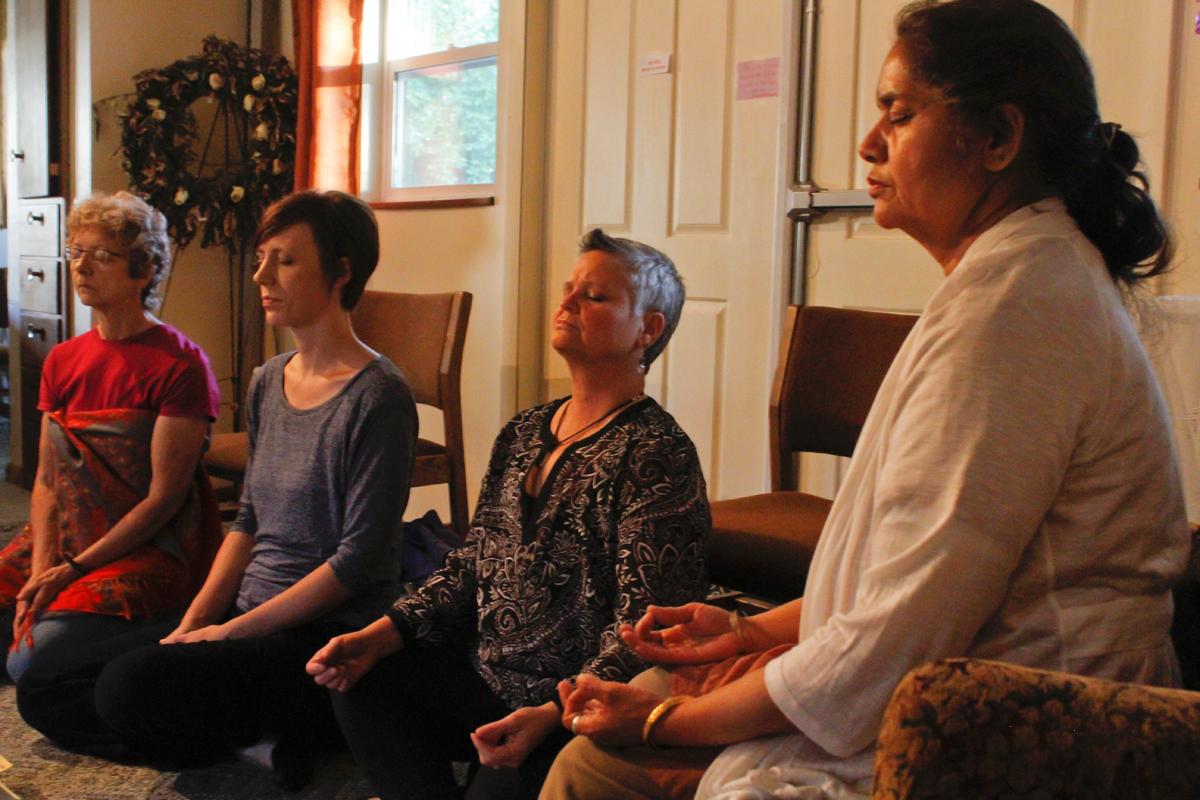
Around the room, men and women of varying ages and ethnicities sit with their hands on their knees or in their laps, with their eyes closed or open and heads bowed or faced toward the heavens. The lights are dimmed, and a gong sounds three times, as breathing deepens and the room goes quiet.
Throughout the meditation time, people shift to more comfortable positions. Breathing deepens, then becomes more shallow as thoughts shift from a focus on breathing to whatever is happening inside the mind.
“We follow breath because it happens in the moment,” Sowder said. “Our mind is a lake with ripples, the past, present and future all there. We recognize those thoughts and go back to our breath, because we want to be in the present.”
At the appointed time, the bell tolls again and the group rejoins their minds for a communal sharing time.
Sangha literally means “a spiritual community,” and it is in this spirit of community and connection that the group meets each week, to become connected and grounded. Ryan said the group is a way for her to reconnect to the world.
“I meditate on my own, but when you’re not part of the mainstream religious groups of society then you can feel like an outsider,” she said. “You need support. I’m not sure I would have lasted this long here if I didn’t have the connection to the community through this Sangha group.”
Ryan began her Utah Sangha experience in spring 2010 when she moved to Logan from Canada for school and first was involved with the Cache Valley Sangha, which meets on Monday nights. She transferred to the Amrita Sangha group for the smaller, closer community.
“I like it because it’s a spiritual, non-judgemental, non-lecturing group, and I feel accepted here,” she said.
– april.ashland@aggiemail.usu.edu