

Merrill-Cazier Library commemorates 20 years of education on Logan campus
Twenty years ago, the Merrill-Cazier Library opened its doors to the Utah State University Aggies. Today’s executive team is completely made up of faculty members who have been there since the doors first opened in 2005: dean of university libraries Jennifer Duncan, associate dean and department head for collections and discovery Liz Woolcott, associate dean and department head for public services Britt Fagerheim and director of library information technology Todd Hugie. Working their way up, each has seen the vast variety of changes made.
“At the time, they were very focused on making the library a beautiful space where people can come together, collaborate, learn, study, grow,” Duncan said. “The focus of this building is on the people.”
The updated library has a devotion to its outreach and support.
“The essential point of the library is that we support student success,” Duncan said.
The three associate dean positions cover the essentials of what makes up the library: collections, public services and technologies.
“I’ve been a student, I’ve been professional staff, I’ve been faculty and now I am in administration,” Woolcott said. “From a collections perspective, we really heavily invested in electronic resources, so between the time we opened the door and now, we’ve moved a lot of our purchasing into electronic resources so it’s open to all campuses and students, even if they don’t have a primary campus to go to every day. We need to make sure that all of our resources are available to anybody who needs it.”
On the bottom floor of the library is USU Special Collections & Archives, which is open to every student for their research. Students may also look on its website to see the online sources available to them at library.usu.edu/archives.
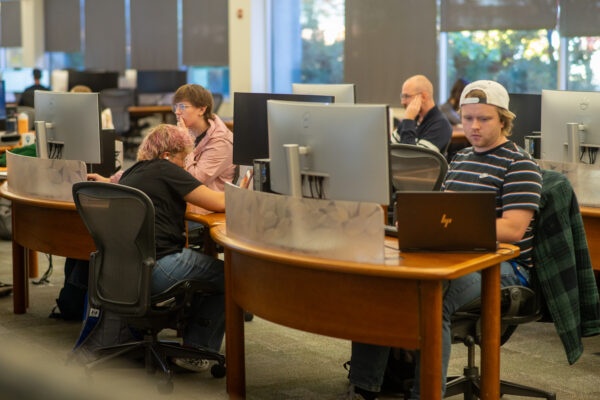
People sit at computers on the first floor of the Merrill-Cazier Library in Logan, Utah on Oct. 21, 2025. (Dane Johnson//The Utah Statesman)
“Over the past 20 years, we’ve really continually shifted spaces in the library as needs of students changed, as the coursework changed, as faculty research has changed. We’ve adapted the building, really, to match what the needs are on campus,” Fagerheim said.
Fagerheim is over the public service resources in the library.
“We have a faculty librarian who works specifically within the Innovation Hub, and that’s a position that I wouldn’t have even envisioned when the library opened,” Fagerheim said. “Twenty years ago, most of the research assignments were writing papers, and now we have a very burgeoning digital scholarship initiative.”
The Innovation Hub has been open for over a year now and is located in room 158 in the south atrium of the library.
“At that time — 20 years ago — we were coming into the world of the internet, where our resources were becoming electronic. It was really driven by print books, print journals — you needed to come into the library to do your research — all of those things,” Duncan said. “Over these 20 years, we see the library, really, kind of as a duality between our physical building and the online environment we provide. We have a front door: the one students come into our building and use. We also have a website. Our website’s a totally different ‘front door.’”
The library opened at a time before everyone had a phone or computer. Apple released the first iPod in 2001, Myspace launched in 2003, Facebook was introduced in 2004 and the first iPhone was released in 2008. In 20 years, these technologies rapidly grew.
“This technology age has moved so fast compared to the industrial revolution and other revolutions that have happened. We needed the support from our upper administration, which fully supported the library and the move in this direction,” Hugie said.
According to the executive team of librarians, the library is only growing more electronically, and the spaces are growing more for student collaboration and in-person resource utilization.
“I would encourage students — if they hear the messages that libraries are becoming outdated, that that’s not true. Libraries aren’t going away, and we’re becoming more and more important in this technology world,” Hugie said. “I would encourage them to come and use our resources. We spend millions of dollars a year just in the library providing resources and research information for our students. If I were a student today, I would spend some of my time and my education learning about libraries and how they can help me in my career and how they can help me learn and be a better citizen.”
According to Duncan, as the library continues, the staff is looking forward to the changes in technology and seeing just how much a library can grow with the people.