
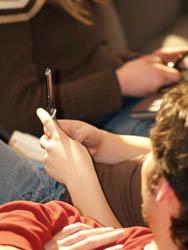
Millenial generation redefining priorities
A “60 Minutes” program aired November 11, 2007, stated children lacking the opportunity to screw up combined with over-adoring parents has created a new generation of people with the simple priority of: they come first.
This segment titled “The Millennials are Coming” stated that the Millennial generation, also know as Gen Y and the Thumb generation, is made up of roughly 80 million people, all born between 1980 and 1995. The Millennials are flooding the job market and rapidly taking over from the baby boomers who are beginning to retire.
According to the “60 Minutes” segment, Millennials have a new outlook on life. Unlike Gen X, Millennials will plan their work days around a commitment they’ve already made.
“Family and friends are the new priorities, while blind careerism is beginning to fade.”
Morley Safer, the “60 Minutes” correspondent explained fewer middle class Millennials are willing to do dirty jobs such as mowing lawns, because those jobs don’t get kids into Harvard. Today is all about hopping between jobs until a person finds the one they want, he said.
“No longer is it bad to have four jobs on your resume in a year, whereas for the baby boomers or even Gen X, that was terrible,” said Jason Dorsey, author of two “how to” books for Millennials.
Marian Salzman, an ad agency executive at J. Walter Thompson and interviewee for “60 Minutes,” explained that some Millennials are the greatest generation. Many are extremely resourceful and hard working, while others are completely incorrigible, she said.
“I believe that Millennials actually think of themselves like merchandise on eBay. ‘If you don’t want me, Mr. Employer, I’ll go sell myself down the street.'”
According to Wall Street Journal columnist Jeffery Zaslow, who was interviewed for “60 Minutes,” the finger of blame should be pointed at the most famous next door neighbor, Mr. Rogers.
“What happened is Mr. Rogers went around telling all the little kids they were special, which is great but parents ran with it,” Zaslow said. “And we said, ‘You, Junior, are special, and you are special,’ and for doing what? We didn’t really explain that.”
While some sources blame Mr. Rogers, others, such as Eddie Berry, a USU professor of demography, speculate that the defining moment for Gen Y, which explains their unwavering emphasis on relationships, was 9/11.
“After that, kids would look up at the sky and wonder which plane was going to hit them,” Berry said. “Millennials live with terrorism in a way that other generations did not.”
Although Millennials are growing up in a time of terrorism, they, like the baby boomers, were a result of economic good times. The parents of Millennials had more available to them and were able to spoil their children, Berry said.
As a result of being spoiled, the Millennial generation received numerous Barbies, Power Rangers and Ninja Turtles from their parents. All of which, in Berry’s opinion, had a lot to do with the Millennial generation’s ability to form relationships with one another.
“Part of what we know about the Millennial generation is that they’re very socially tied to each other,” Berry said. “Think of MySpace, think of Facebook, think about how tightly connected everyone is by instant messaging.”
Berry speculates this ability to contact anyone with the click of a button, as well as the 9/11 attacks, are the main reason’s Millennials find more satisfaction in friends and family over spending heavy hours at work.
What employers are saying they see most often of the Millennial generation is their interest in quality of life in their work environment, their desire to have work life balanced with other areas in their lives, that they want to maintain a level of self esteem, and that they want respect, Berry said.
“I think our generation really values the sense of praise and self worth,” said Blake Ure, a 23-year-old junior and American studies major at USU. “We like to be in-contact with people constantly or we feel detached from society.”
Although it is true that the Millennial generation does put a lot of emphasis on friends and family, Ure said, it is too broad to say that all Millennials have an “I come first, and you can shove it if you don’t like it” personality.
It is true however, that the Millennial generation doesn’t always do things in what the previous generations would consider a conventional method, Ure said.
The world is changing dramatically, Ure said. Not only between Gen X and the Millennial generation, but between individuals born only a decade apart.
“My brother was born in ’92 and the things that I reminisce about like night games, by the time his generation got to that, it was the era of the psycho parent who said ‘You can’t go outside after five because a child molester might grab you.'”
All of these factors have created a generation that longs to be close to one another, Ure said. Although some people, such as those interviewed by Morley Safer for “60 Minutes,” might believe that the Millennial generation has their priorities backwards, Ure feels that the previous generation will always see their successors in this light, and that the Millennial generation is doing just fine.
-greg.boyles@aggiemail.usu.edu