

Mountain West vs. Pac-12: What the media deals mean for Utah State
Utah State University is preparing for a major shift in its athletic history. The Aggies will join the Pac-12 Conference in 2026, leaving the Mountain West Conference after years of steady growth and success. The move anticipates more exposure, more games on national TV and potentially higher revenue. However, it also raises questions about whether the benefits will match expectations.
This week, the Mountain West announced a new media rights deal with CBS Sports, FOX Sports, the CW Network and streaming partner Kiswe. The deal will cover more than 150 events each year. It ensures football and men’s basketball games remain widely accessible, but it also guarantees continued coverage for Olympic sports through the streaming platform. For the first time, some events on the Mountain West Network will be placed behind a paywall, a shift from the free streaming the conference previously offered.
The Pac-12’s media rights deal, finalized last year, also spans CBS, the CW and USA Network. It will carry roughly 22 football games and 50 men’s basketball games on linear television. Several games will appear on familiar cable and broadcast channels, making them easy for casual viewers to find.
While the conference has not publicly released financial terms, industry estimates suggest Pac-12 schools could earn between $7 million and $10 million per year. That is roughly double what remaining Mountain West schools are expected to receive.
For Utah State, exposure was a major reason behind the move. USU Vice President and Director of Athletics Cam Walker explained what he sees is the importance of being on traditional TV.
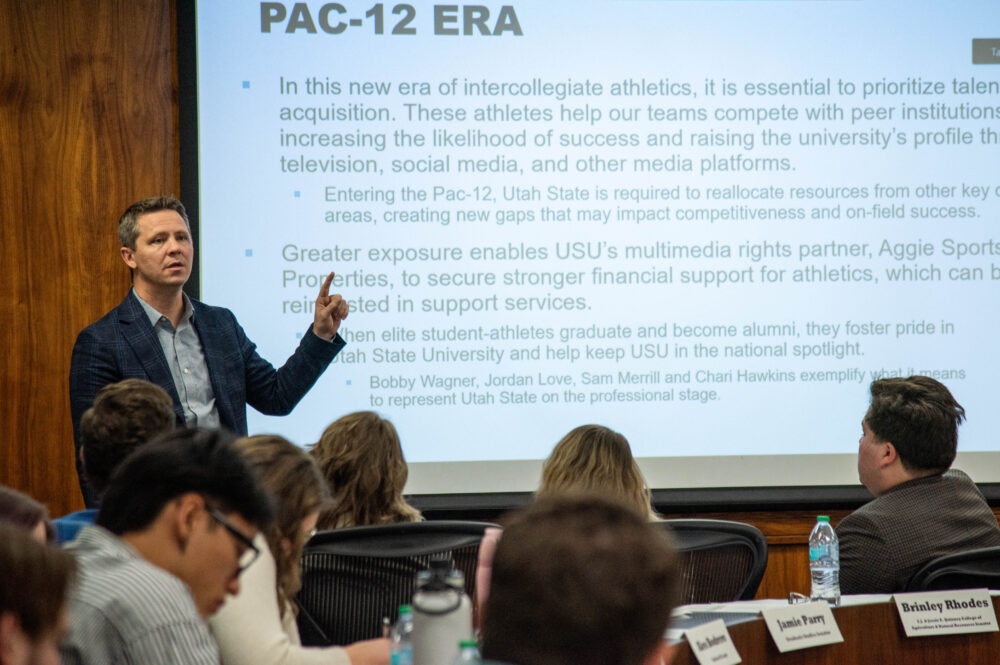
USU Athletics Director, Cameron Walker, talks about the change to the Pac-12 conference to USUSA Fee Board in the Senate Chambers on Jan. 21.
“The Pac-12 is an opportunity for us to move into a great thing,” Walker said. “All of our games moving forward will be on CBS, CBS Sports, USA Network or the CW — so actual channels. Right now, a bunch of our games are on an app that sometimes works.”
Walker’s comments highlight a key advantage of the Pac-12 deal. He said while Utah State already has a loyal base of supporters, national TV exposure allows the school to reach casual and nonlocal fans more effectively. The Mountain West’s streaming service offers access to more events, particularly non-revenue and Olympic sports, but linear television still delivers the largest audience and greatest visibility.
USU President Brad Mortensen said the move is about more than money or TV deals.
“There’s still a bit of legwork to do with working out the media rights deals,” Mortensen said. “At every stop, to me, the most important thing is showing up to represent Utah State and to make sure that our Aggie interests are well represented so that our teams and our student-athletes and our fans and boosters can all feel like we’re doing everything we can to compete for championships in the new Pac.”
The transition does have trade-offs. Some Mountain West games, previously available for free, will now require a subscription to the conference’s streaming platform. In the Pac-12, fans may need multiple subscriptions to watch all events. Coverage for sports outside football and men’s basketball is still yet to be determined. Athletic departments across the country are learning to navigate this tension between exposure and access in the modern sports media landscape.
Coaches see the opportunities as worth the challenges. In a recent interview with The Utah Statesman, USU Women’s Basketball head coach Wesley Brooks joked about the late 9 p.m. tipoff for the men’s team on national TV.
“That’s a good problem to have,” Brooks said. “At some point, I want to be on national TV, and I’ll take a 9 p.m. tipoff to be on national TV. So, that’s where we want to get our program, too.”
For programs like Utah State, being featured on national television, even at inconvenient times, can help recruiting, raise the school’s profile and energize fans and donors.
The media deals also affect finances. While the Pac-12 deal may not initially meet early revenue expectations, it is projected to deliver more per school than the Mountain West’s new deal. While the Pac-12’s payouts could range from $7 million to $10 million annually per school, the Mountain West’s distributions are likely to stay near $4 million to $5 million. These figures are estimates, as neither conference has fully released official numbers.
The move also comes with legal and logistical complexities. The Mountain West and Pac-12 are working through disputes over exit fees for schools leaving the Mountain West. The litigation stems from scheduling agreements that included financial penalties. Both conferences have agreed to mediate, but the negotiations highlight how complicated realignment has become.
For fans, the change will be noticeable. They will see more Aggie games on broadcast and cable TV, but they may need new subscriptions to watch all games. They will also see new rivals and new conference schedules. For coaches and players, they say the opportunities are significant: national exposure, stronger recruiting and a chance to compete in a higher-profile league.
Ultimately, the transition from the Mountain West to the Pac-12 represents more than a change in conference affiliation but rather a recalibration of Utah State Athletics. Media deals, revenue and scheduling are measurable, but the true test will be whether the move increases visibility, strengthens programs and helps the Aggies compete at a higher level. It will only be a few short months before administrators, coaches, athletes and fans will see how these changes unfold.