
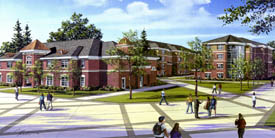
Multi-million dollar student living
A new multi-million dollar living/learning community will house more than 500 students in a six-building complex behind the Taggart Student Center.
Construction of the new housing facilities to be finished in 2006, is part of the campus master plan to upgrade Utah State University and make the college more competitive, Steven Jenson, director of housing and food services, said. New housing will aid in attracting and retaining students, Jenson said.
In response to Hall’s goal for the university to become a Tier II school, on-campus housing needs to increase, Whitney Milligan, assistant director of Residence Halls/Residence Life, said.
“Residential campus does play a very important part in the culture here at Utah State,” Jenson said, ” and we want to be able to provide the very best in living/learning accommodations, which will help to support the academic mission of the university.”
The new housing complex will be located west of the TSC in the ravine where the old steam plant was.
“We’ve tried to build on Old Main before, but were not allowed,” John Fitch, project coordinator, said. ” It really exemplifies President Hall’s putting students first.”
The biggest advantage of the new housing will be the effect on the TSC. The new housing will turn the TSC into a ” real student center, with a lot more life in the building,” Jenson said.
“It will re-energize the student center,” Milligan said, ” right now, it doesn’t feel like a student center – it feels like a bunch of offices.”
The new residence halls are being called a living/learning community because “much of the education a student has sometimes happens outside the classroom,” Jenson said. The community center will have a two-story lounge area with wireless Internet access. There will be rooms for possible classes to be held and staff offices for student assistance as well.
“We have good results that show students who live on campus consistently do better academically than those who live off campus, particularly in the first year or two,” Jenson said.
Students living in an apartment are less included in the community, Jenson said. The new housing will include a full kitchen on every two floors.
“Resident life programs focus on a lot of different developments of students. It is very intentional and very focused on providing academic and transitional support,” Milligan, once an resident assistant at USU, said.
“We are trying to help draw the students out of their suites and apartments to get to know lots of people. Research shows the more included students feel the more successful and more likely they are to graduate,” Jenson said.
The community center is scheduled to open in Fall 2005, Jenson said, and three additional buildings are scheduled for completion by March 2006. The remainder of the complex will open in the Fall 2006.
“The location is ideal. I think it will be a major benefit to the university in helping to attract students to the university,” Jenson said. “It will be very effective to putting a new face to the university.”
The new housing facilities will consist of six buildings and a four-level parking terrace. The buildings were broken down into smaller groups, “so it doesn’ t have a big institutional feel to it, we wanted it to have a nice community feel to it,” Jenson said.
“We are doing this for the students,” said Fitch, who also headed the Edith Bowen and steam tunnel project. “The university should be all about the students.”
Resident halls will be four stories and house 96 students per building, Jenson said. There will be some themed housing in the new facility, Jenson said, such as the Leadership House being relocated there.
The design of the building is an important factor that Evergreen Construction is considering, Jenson said. KCB architect tried to be very careful with the design to complement the surrounding structures, such as old main, Jenson said. The ravine next to old main is a great location, Jenson said, and will complement and improve the area.
“We know it is a very sensitive area historically,” Milligan said, “and we needed to make sure whatever goes there won’ t clash with the rest of campus.”
Students have helped in the process of the design, Jenson said. The university used focus groups and took students to Weber State University and the University of Utah to view the housing there.
Currently, some older housing facilities are not in as much demand, Jenson said. Newer facilities, such as Snow Hall, have a higher student preference, he said.
The university is in the process of phasing out the mobile home park, Jenson said, which will close in 2011. Graduate and older students will be moved to the Student Living Center and families will be put back into Aggie Village, Jenson said.
“We’re committed in trying to move the undergraduate students to the core of campus, because we think they will have a much better campus experience,” Jenson said. “You couldn’t ask for a more ideal location.”
As for housing plans for the future, Jenson said, there are plans to upgrade other facilities, with some buildings being removed.
-kcashton@cc.usu.edu