
Natural Resources gets $5 million gift
The third college at USU in as many months to receive a multimillion dollar gift, the College of Natural Resources was presented a $5 million gift from the S.J. and Jessie E. Quinney Foundation, Tuesday afternoon in the Taggart Student Center Ballroom.
Rick Lawson, grandson of S.J. and Jessie E. Quinney and board member of the Quinney Foundation, presented the gift, which will be parceled out in $1 million increments over the next five years. The gift marks yet another donation from the Quinney Foundation, which has donated money steadily to USU for nearly 40 years, Lawson said.
From the first gift of $70,000 USU received at the hands of Joe Quinney in 1970 to the 2008 gift of $5 million, the Quinney Foundation has donated just under $22 million to USU, said USU President Stan Albrecht during a speech at the gift presentation luncheon.
“This gift reflects a very substantial commitment from the S.J. Quinney Foundation,” Albrecht said. “This gift literally does stretch the foundation of natural resources beyond what they might normally choose to do. So, we express our humble appreciation to the trust that has been given to us. At the same time, we would like to acknowledge that today’s gift is just a part of the many, many, many years of support the Quinney Foundation has had with the university and its College of Natural Resources.”
Nearly $2 million of the donation will provide continued funding for the Quinney Scholars program within the CNR, a nationally recognized program that has existed since 1989. The Quinney Scholars program has provided scholarships for 200 undergraduate students and fellowships for 50 doctoral students. With the gift, these scholarships and fellowships will be continued, as well as new fellowships for master’s students will be offered.
About $1.2 million of the gift will continue to support the growth of the S.J. and Jessie E. Natural Resources Quinney Library, which houses more than 60,000 items.
The remaining portion of the donation will fund the CNR program development in areas such as the Aspen Alliance, Utah’s Rivers and Riparian Restoration, Sustainable Living in Utah, Great Basin Restoration and Bioregional planning. Some of the funds will also go to support the CNR Academic Service Center as well as distance education programs.
Nat B. Frazer, dean of the College of Natural Resources, said the money was designated for these areas because of an underlying philosophy Quinney had in donating money.
“Joe Quinney was very interested in people, and he said he wasn’t particularly interested in providing money to things the state ought to be doing anyway,” Frazer said. “And so we feel that the best investment that we can make is in people, and the best people to invest in are students.
“The other thing is that universities are in competition for the better students, so other universities also offer scholarships and benefits. So it’s really the Quinney scholarships and fellowships that enable our college to be nationally competitive and to bring in top-notch graduate students.”
Lawson said his grandfather, Quinney, had a great love for the outdoors and would drive through Logan and point out areas of natural resource interest on the way to Bear Lake, a favorite vacation. Lawson said this love of the outdoors and nature led his grandfather to build up the Alta ski resort, transforming it from a damaged mining area into a resort to be enjoyed by many.
“The other love of my grandfather’s life was skiing and Alta. Grandfather thought Alta should have tickets the local people could afford. I think that was part of the vision he and my grandmother had in the beginning of their financial support they had here,” Lawson said. “They believed this college would be able to further that vision and goal of making available to the people of Utah, and the people of the world, the natural resources that are rightfully theirs.”
Thad Box, a former dean of the College of Natural Resources, said he was dean when Quinney made his first donation to the College of Natural Resources in 1970. He said he met with Quinney at his law office and was surprised when Quinney started talking about duck hunting, fishing and mountains and mining, showing his love for nature. When asked about the money, Box said Quinney told him he did not want the donation to be part of the budget, but said it should be “spent on ideas, people and programs. I want you to use the money we give you to make Utah a better place.”
Honoring the wishes of Quinney, Albrecht said USU is committed to use the money to attract and support outstanding faculty and to build new facilities.
“To the foundation and to the members of the foundation board, this is our commitment to you,” Albrecht said. “We thank you for making us a better university. We thank you most of all for believing us, and we promise you, we will not let you down.
“State support allows USU to be a good university. The support of these family foundations really does help us to become a great university,” Albrecht said.
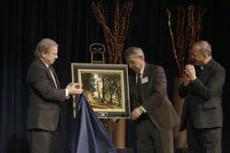
In appreciation of the gift, Albrecht and Frazer presented Lawson and the S.J. and Jessie E. Quinney Foundation a gift of their own – a painting of Old Main as viewed through the trees at the bottom of the hill.
Frazer said the vision of the College of Natural Resources in utilizing this gift is “to continue to excel in bringing in and keeping the best faculty, to continue to excel in recruiting excellent students, and to make a real lasting difference for the people of Utah in terms of preserving and enhancing the quality of life in this state.”
-seth.h@aggiemail.usu.edu