
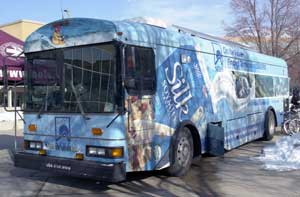
New bus saves gas, runs on veggie oil
When Alex Schirer goes to a Chinese restaurant, he doesn’t order a plate of sweet-and-sour chicken. Instead, he asks for the tub of vegetable oil it was cooked in.
As a driver of the National Outdoor Leadership School’s only vegetable oil-powered bus, finding leftover oil from a Chinese restaurant is the best kind of grease Schirer can get.
“We can’t go to any restaurant; not all restaurants have good grease,” said NOLS Marketing Events Coordinator Lara McCluskey. “Asian and Mexican restaurants tend to have good grease.”
The oil is recycled and used as fuel to run the 36-foot bus, which has been on the road for the past 490 days touring the United States – all in the name of alternative energy.
As part of the tour, the bus and three NOLS members paid a visit to students at Utah State University Wednesday to promote their three-part mission of technical outdoor skills, leadership and environmental awareness.
“A lot of people are interested in it because it’s not something you see everyday,” Schirer said.
The bus has a separate fuel line for vegetable oil, which they collect from various restaurants along the road that have leftover grease, McCluskey said.
“It’s totally free,” she said.
Most restaurants pay to have pay to have their leftover vegetable oil removed, so instead, NOLS takes it away without charging them, Schirer said.
“A lot of people at restaurants are skeptical of what we’re doing sometimes when we ask if we can have their leftover oil,” Schirer said.
To be used as fuel, it is heated to between 100 and 150 degrees and then filtered and poured into the extra fuel line. Unlike biodiesel fuel, which is a combination of about 80 percent petroleum diesel fuel and 20 percent vegetable oil, NOLS uses pure vegetable oil to run its bus. They only use diesel fuel to start the bus’ engine, McCluskey said.
Anyone who owns a vehicle with a diesel engine can convert it to run completely on vegetable oil. It costs about $1,500 to buy and install a second fuel line and doesn’t require any alterations on the engine itself, McCluskey said.
“It’s out there enough that it turns heads,” said Matthew Copeland, NOLS marketing manager. “If they can run a bus on veggie oil, maybe they can do other things with alternative energy.”
In general, vegetable oil gets about the same amount of mileage as regular gas-powered cars, McCluskey said.
The NOLS bus also includes six solar panels on its roof that produce energy. That energy is stored in batteries in the bus, which can be used for computers, phone chargers and a DVD player inside.
“What they’re trying to accomplish is something that is very in line with the goal of [USU’s] Outdoor Recreation Center to show alternative ways of transportation,” said John Louviere, ORC program administrator, who organized the event.
Aside from showcasing the bus, the NOLS members held various presentations, such as rock climbing and leadership workshops throughout the day. The bus tour is a marketing tool to encourage students to enroll in classes at NOLS. The school is based out of Lander, Wyo., and provides college credit in wilderness education that can be transferred to more than 400 colleges across the country, Schirer said.
“This is very interesting,” said Drauzio Ranger, a senior majoring in biology. “I think it’s a good idea to teach people to preserve nature and to recycle stuff.”
Ranger said he is interested in taking classes from NOLS because he was a cave guide in Brazil before he came to USU.
The NOLS bus has visited most states from coast to coast and recently returned from visiting Wesleyan, Kan. Their next stop is at the University of Utah, Schirer said. All of their visits to various universities and businesses is free.
For more information about NOLS, visit www.nols.edu.
-mmackay@cc.usu.edu