
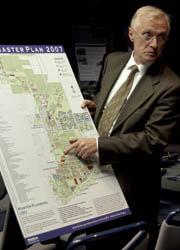
New campus master plan outlined
USU revealed its five-year campus master plan aiming to preserve the university’s history and appeal and to accommodate the estimated growth in enrollment.
The plan, presented Wednesday, includes the construction of a new College of Agriculture building, an early childhood education and research center and the renovation of some of the oldest buildings on campus.
“The purpose of having a master plan is to ensure some of that growth can occur and some enduring qualities don’t get lost,” said Stanley Kane, director of planning for Facilities. “We want to enhance the campus experience for visitors and users.”
Kane said it is important to maintain the feel of USU’s campus, it’s attractive green space and beautiful vistas even with the construction of new buildings.
The construction of the College of Agriculture and Agriculture Research Service building is the university’s first priority, Kane said. Part of the building will be funded by the state. During the next legislative session, he said the school will ask for $42 million for construction of the building.
Because USU has already received $2.5 million for design, Kane said he is confident the university will be granted the remaining funds needed for construction.
“I am positive once federal government funding begins a project, the remainder of the funding just comes in subsequent years, maybe two to three years,” he said.
The U.S. Department of Agriculture and Agriculture Research Service will also be funding part of the building. Kane said the ARS is confident its can raise $60 million.
The COA/ARS building, to be located on the east side of the Quad, will be about 250,000 square feet and cost approximately $102,000,000, according to a Facilities pamphlet.
An Early Childhood Education and Research Center is also in the works. Kane said the center is expected to be privately funded. He said he is “99 percent sure” the funding will come through. Construction could begin as early as 2008, Kane said.
Also part of the five-year plan, the Utah Science Technology Research Facility will be built on USU’s Innovation Campus. Jordy Guth, staff planner for Facilities Planning, Design and Construction, said the facility will be funded by USTAR, and according to the pamphlet, it will cost about $54,000,000. Guth said they hope to break ground in 2009.
The remodeling of the Animal Science, Biology Natural Resources and Ray B. West buildings is also part of the master plan. Those buildings need basic repairs to ensure structural and student safety, Kane said.
“Buildings like Ray B. West and Animal Science are historically significant buildings on the Quad, and we will preserve their exterior and improve their interior,” Kane said. “BNR has shortcomings, but those shortcomings can be improved without tearing down the building.”
With this master plan, there is a bigger push to build upward, instead of out. Kane said with USU’s space restrictions and expected growth in enrollment, they must plan carefully for the future.
Evan Pool, senior majoring in environment and society, attended Wednesday’s meeting. He said it is important for students to be aware of USU’s future plans.
“It is invaluable to know what’s on the backburner. It is just as important to know what is going on in the here and now,” he said.
Pool said he was excited by the plans presented, especially the sustainable designs and the green building technologies.
Guth said USU has gone to great lengths to conserve energy with innovative systems. She said with sustainable design, the school is minimizing the use of outside energy wherever possible.
Even though USU has created a five-year plan, it is likely to take much longer to implement everything presented in this year’s plan because of funding, Kane said. He said it typically depends on the nuances of politics and money. While USU looks at physical needs, the state looks at growth rates of colleges in Utah and directs funds to the fastest growing schools.
Kane said USU has to be patient and also wait for the “philanthropic spirit to kick in.”
“With the current rate of funding, it could take over 20 years,” Kane said. “The problem is that we get one big project every five years. We tend to go to big buildings and pass the smaller projects.”
The creation and passing of the master plan is a very fluid process that Kane said requires flexibility with funding and administrative decisions.
The master plan goes before the Board of Trustees Oct. 19 for approval. It must also be approved by the Board of Regents, which is meeting later in October.
-arie.k@aggiemail.usu.edu