
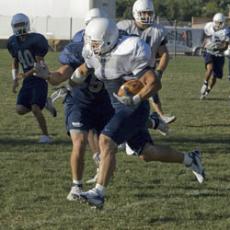
New Look Aggie Offense
Most of the Aggie offense spent the last six months learning a new language.
Not French, not Spanish, or German.
They were learning Dickey.
“The biggest deal has been the terminology, just how we talk, how we communicate,” USU Offensive Coordinator Darrell Dickey said. “… They spent all spring saying, ‘Well, that’s what we used to call this, that’s what we use to call that.'”
The difference in the names of formations, personnel groupings and a myriad other things are the foundation of a new-look Aggie offense that makes its debut at Romney Stadium Aug. 30 vs. University of Nevada-Las Vegas.
Dickey said the Aggies will look to establish an inside and outside running game – using a tailback as the main ballcarrier – set up more play action passes and, most importantly, keep defenses off balance by mixing the run and pass. That also means using what Dickey calls “fun plays,” which include reverses, halfback passes and other trickery.
“As much as our guys can handle and actually go out on the field and execute, the better off we’ll be,” he said. “Because the less things you can do, the more predictable you’ll be.”
But with all the changes, there remain some things Utah State fans will recognize.
“It wasn’t just come and tear everything apart and start completely over,” Dickey said. “There was some carryover from what they did last year to this year.”
Fans will still recognize some quarterback runs, the shotgun formation and other hallmarks of recent Aggie offenses.
Head Coach Brent Guy said he estimates the offense will be about 50 percent new and 50 percent old, but that percentage goes up or down by position.
For skill players – quarterbacks, wide receivers and running backs – much has changed, up to 70 percent new terminology in some cases, Guy said.
For offensive linemen, none of their calls changed. In fact, they had to teach Dickey their language.
“Instead of 15 guys learning new terminology, I just decided to learn how they talked,” Dickey said.
Although a change in offense can be a daunting task, Guy and Dickey said they are pleased with how well the players are picking everything up.
“When we got through spring, we had 60 or 70 percent more in than Coach Dickey thought we could get in, in spring,” Guy said. “So we’re way ahead of the game as far as the amount of things we can do in our game plan.”
The speed of the transition could be explained by a change in Utah State’s off-season philosophy. This meant using walk-throughs as a way to spend more time on the mental game and play execution, Guy said.
Or maybe the quick transition has to do with players having experience with the process of learning a new offense.
Utah State has had a plethora of different offensive schemes in the last four years, including Mick Dennehy’s pass-heavy approach and an offense that relied on quarterback runs. Some seniors, like wide receiver Kevin Robinson and starting quarterback Leon Jackson III, have been through it all.
“It’s not been that hard learning a new offense,” Jackson said. “I’ve had four different offensive coordinators. After you get to about two or three and you start understanding that football is football and you’re seeing that it’s the same stuff just with different ways of running it and with different names.”
Although some of the older players might be used to this transition, Dickey was aware how hard the situation can be for old players and a new coach.
“Sometimes guys are set in their ways, and I told them, ‘Guys, I’m not set in my ways,'” he said. “… We kind of had to accept each other.”
The acceptance shows when seniors on offense are asked about Dickey.
“He’s a really good coach,” Pace Jorgensen, senior guard, said. “He melds really good with the players.”
Aaron Lesue, the Aggies’ starting tailback, said Dickey is doing an “awesome job” because he’s very intelligent, knows the game and is passing that on to the players.
There is also excitement among players about Dickey and the new offense.
“It’s going to be fun,” Robinson said. “You never know what he’s going to throw out there.”
Dickey isn’t immune to the excitement bug, either.
“I’ve seen that we have enough talent to play football with anyone on our schedule,” he said. “… We obviously have a long way to go and a lot of work to do, but based on what I’ve seen, I like our chances.”
Offense by position
Quarterback:
After a spring and summer filled with speculation, Utah State announced Wednesday that Leon Jackson III will start at quarterback when the Aggies open their season against UNLV Aug. 30 at Romney Stadium.
Jackson started nine games in 2005 and the first five of last season before being replaced by freshman Riley Nelson. But after Nelson left on an LDS Church mission, Jackson found himself in a three-way race for the starting job with junior college transfer Sean Setzer and sophomore Jase McCormick.
Although Jackson will be the first on under center for Utah State this season, it’s not likely he will be the only one.
“If we end up being a one QB team, that’s fine with me,” Offensive Coordinator Darrell Dickey said. “If we end up being a one QB team where one guy gets a series or two each game, that’s fine with me. That’s probably how we’re going to start the season, and then make decisions about circumstances after that point.”
Running Backs:
Utah State is used to losing the previous year’s leading rusher – it’s happened two seasons in a row.
This year, the Aggies look to replace the departed Marcus Cross with a stable of different backs.
Senior Aaron Lesue will be the first to carry the ball for the Aggies. Lesue and true freshman Curtis Marsh will get the bulk of the carries early on, Dickey said. People can also look for redshirt freshmen Derrvin Speight and Jacob Actkinson – who will also see time at fullback – and freshman Robert Turbin to get some carries.
Although there could be a lot of backs involved in the Aggie offense this season, Head Coach Brent Guy wouldn’t call it a running-back-by-committee approach, but more like an opportunity to put each guy in the best position to make plays.
Whatever you call it, the competition may not be a bad thing.
“We have more than one back that can get in there and do the job, and it’s a competition and that pushes us,” Lesue said.
Wide Receiver/Tight End:
If the receiving corps was the cast of a movie, Kevin Robinson would be the leading man.
The senior led the Aggies with 36 receptions for 582 yards and five touchdowns in 2006.
But that’s not to say he doesn’t have a strong supporting cast.
“The receiving corps is strong as ever,” Robinson said. “We’re all talented, we can go out and make plays. It’s just whoever gets the ball at the time.”
This cast includes Otis Nelson – the Aggies’ second leading receiver last season – and returning lettermen Xavier Bowman, Nnamdi Gwacham and Omar Sawyer. Utah State will also be strengthened by the addition of Tarell Richards, who was recently granted another year of eligibility by the NCAA.
At tight end, the Aggies also return experience. Seniors Jimmy Bohm and Will Fausel and junior Rob Myers all logged playing time last season. Myers led the group with 10 catches for 125 yards in 2006.
O-Line:
With junior center Ryan Tonnemacher and senior guards Pace Jorgensen and Shawn Murphy returning, Utah State should be strong up the middle.
“It’s the first time in a while that we’ve had five guys playing well together (at offensive line),” Jorgensen said. “We have three really solid people in the middle. They’re both really athletic guys too.”
Tonnemacher, who is making the switch from guard to center this season, was named to the 2007 Rimington Trophy Watch List. The Rimington Trophy is given annually to college football’s best center.
Jorgensen isn’t on any watch lists, but the starting rig
ht guard enters the season with 27 career starts, which is the most on the team.
Murphy will move to left guard this season after starting all 12 games at left tackle in ’06.
Rounding out the o-line are probable starters Derek Hoke and freshman Spencer Johnson at the tackles. Hoke, a junior, has started five games in the last two seasons.
– da.bake@aggiemail.usu.edu