
New technology aids ridership count accuracy
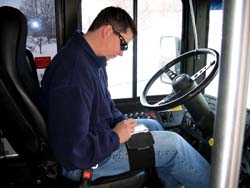
Ridership counts for the Aggie Shuttle are more accurate now that drivers have technology on their side – or rather, in their lap.
Using 12 Dell handheld computers purchased with a $150,000 grant from Clean Cities of Utah and the Department of Energy, shuttle drivers are able to keep track of the number of students boarding buses. Utah State University is one of the first schools in the country to implement this technology.
“Prior to this, we did the ridership counts at two different weeks per semester,” said Lisa Leishman, director of Parking and Transportation Services. “What we reported to the administration was those two numbers, the average daily ridership based on two weeks’ analysis.”
The old style of recording ridership required drivers to use pencil and paper. With the computers, passenger statistics are recorded based on day, time, route and bus stop, said Justin Rees, an intern with Parking and Transportation Services.
“[With the old style] the driver would have to make the stop, grab the clipboard, write down the rider count and put the clipboard down,” Rees said.
Now, the handheld computer is attached with Velcro to a strap around the driver’s leg.
Drivers pick up the device corresponding with their bus each day and begin by doing a vehicle inspection with software on the handheld. On the bus, the drivers use an Excel-based spreadsheet to input the number of passengers on their route, Rees said.
With the daily vehicle inspections (DVIs), Aggie Shuttle supervisor Alden Erickson is able to cut down on paperwork by having all the inspections put directly into the computer. Erickson said he keeps records of DVIs for five years and has filing cabinets full of them.
With the development of additional software, Erickson said, the handhelds could be used for communication with shuttle drivers, storing training and emergency information, as well as time-clock management.
“All of my drivers are students, they’re going to class, it makes it convenient for one of them to hop on the bus and the other driver to hop off,” Erickson said. “We want to keep the buses on route as much as
possible.”
With the current system, drivers have to travel to the Transportation Services Building to clock in for their shift before beginning their route. By using the handhelds as a time clock, Erickson said, efficiency could be increased.
Efficiency of the entire shuttle route is the goal with the handhelds. Leishman said when changes are considered for routes in the summer, the information gathered from the handhelds will be used to decide which bus stops are being under-utilized, and which stops need more attention from buses.
The handhelds were used throughout January and recorded more than 145,000 passengers riding on the system’s five routes. Paper counts were used daily during the fall semester, when drivers recorded more than 511,000 riders.
With the new technology, Erickson said, the accuracy should improve.
“This is more precise, you don’t have to worry about handwriting issues,” he said. “These are some real raw data that you can bring up there.”
Erickson and Leishman said they could present their needs better to the administration with more accurate data.
The handhelds are held in metal cases and all are equipped with screen protectors to prolong the life of the devices, Rees said. One handheld has been set aside as a backup, 10 are used on buses and Erickson uses one in his office.
Erickson said Rees participated in the writing and research of the grant. The idea for the handhelds and their use was also Rees’ idea.
Rees said he contacted other universities such as Utah, UC Davis, Boise State and George Washington University to see if they had similar systems used on their buses. All of them said they did not.
“They all think it’s a great idea,” Erickson said. “They’re just waiting for it to get perfected so they can use it themselves.”
-str@cc.usu.edu
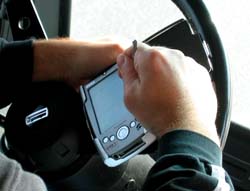
Tony Tinger, a shuttle driver on the 8th East route, uses a handheld computer mounted on the steering wheel. (Photo by K’Leena Murphy)