
October Skies
Most students are familiar with the feelings associated with making a big presentation in front of a big class about a project that they’ve been working on for a long time.
For the students from Utah State University’s Get Away Special (GAS) team, these feelings were increased by the fact that they weren’t presenting to their professor and peers, but rather some of the highest ranking officials at NASA.
For those students, it was definitely a learning experience.
“I’ve learned to fight back the tears when smoke rises up out of your project on a board room table in front of everybody at NASA headquarters,” said Tim Nielsen, a senior majoring in computer engineering.
The GAS team has been a part of USU for more than 25 years. Originally, it set out to develop experiments to send into space with NASA using the Get Away Special system. But, with the tragedy of Feb. 1, 2003 involving the space shuttle Columbia, all space research came to a halt.
After the Challenger accident, all work at the GAS team stopped for three years.
Rather than risk such a long period of inactivity and students waning interest, Andrew Auman, a senior majoring in physics and the student coordinator over the GAS team, began searching for a new goal for the team.
After news came to the team through a former student that is currently working at NASA, that the GAS program was in danger of being canceled, the GAS team then decided to develop their own way for students of all ages from kindergarten through the undergraduates do experiments in space.
What they came up with is the ISO-CRATE (International space station Student Outreach Container Research Available To Educators).
The ISO-CRATE is a shoe-box sized device designed to contain and measure results for long term experiments in a weightless environment.
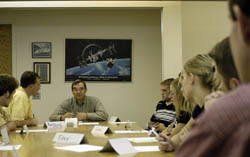
After spending a summer getting the project designed and assembled, eight members of the GAS team were invited to Washington, D.C., to present the ISO-CRATE to a committee of research and education officials at NASA headquarters.
“It’s been good because we’ve had to learn how real engineers work,” Auman said.
The committee was so impressed with the project, in spite of a slight malfunction with the camera, NASA expressed interest to take the project nationwide.
The GAS team has a long history at USU.
It all began 28 years ago at a NASA meeting for the announcement of the Get Away Special, a new form of technology that would open doors for many different space research projects aboard the then new space shuttle.
Gilbert Moore, a former USU professor, was so excited by the possibilities presented by the new project that he interrupted the speaker to announce that he would like to purchase the first opportunity to send a payload of experiments into space.
He then proceeded to write a check from his own account.
At that time, Moore was an executive for Morton Thiokol, a big name in the aerospace industry, so nobody thought too much about the move. What surprised everybody in the space research world is that he then donated the payload to his former employer, Utah State University.
With the help of his friend and former colleague, professor Rex McGil, the newly formed GAS team was able to send the world’s first GAS payload, the G-001 into space on June 27th 1982.
Since then, USU has sent more experiments into space than any other educational institution with the second closest, Penn State, sending only one- fourth the experiments.
Members of the GAS team have learned more from their experiences in the program than just science and engineering.
“It makes everything that we’ve studied real. It’s not just monotonous homework,” said Lee Gardener, a senior majoring in electrical engineering.
“We’re not just looking up answers in the back of the book,” said Rebecca Mitchell, a sophomore majoring in chemistry.
“Sometimes, there are no answers.”
Now that the ISO-CRATE has been presented, the GAS team can turn its attention to matters in Cache Valley.
Historically, a big part of the GAS team has been working with local schools to develop student experiments.
Dolly Creger, a bio-engineering junior, is a student ambassador to high schools and has helped students of all ages put together projects ranging from popping pop corn in space to tests on the effects of radiation on crystals in space.
Jeff Duce, a junior majoring in mechanical engineering and current member of the GAS team, did an experiment with boiling water in space when he was in high school.
Duce said Young students who take advantage of such opportunities can go on to continue research in higher education programs.
-steveshinney@cc.usu.edu