
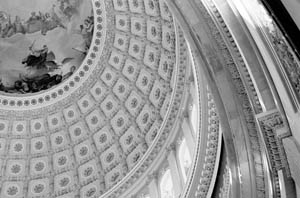
Our nation’s capital has more to see than monuments
The District of Columbia, or as most people know it Washington, D.C., the capital city of the United States of America seems like an ideal location for a President’s Day vacation. The convening point for all government in the United States it just fits with the patriotic commemoration of our past presidents.
Hopping off the Metro into the downtown area involving the monuments, Smithsonians and government buildings, a couple of days were filled trying to see them all: A day at the National Gallery daydreaming in the Van Gohs and Monets and then a visit to the National Archives where the original Constitution and Declaration of Independence are kept.
Another day visiting the monuments and paying respects to the great leaders of the United States A little out of the way from the other monuments the Jefferson Memorial made for a nice walking destination past the Holocaust Museum, and on through the cherry trees, unfortunately it was too early for blossoms. Up the steps of the Lincoln Memorial with a pause to stand on the engraved spot where Martin Luther King Jr. stood to deliver his “I Have A Dream” speech to thousands surrounding the reflecting pool and filling the park. Fitting it should be at the foot of the gigantic statue of the president who waged a war against slavery.
Across the Mall, reflecting in the pool was the pinnacling Washington Monument. It was unaccessible due to construction and remodeling of the grounds.
Down the Mall, the Lincoln and Washington monuments draw a line to the U.S. Capitol building, the site of President George W. Bush’s renewed Inauguration just a month earlier and the building where the government performs its duties. A tour of the Capitol was next on the list, prearranged through a Senator’s Office.
Meeting at the senator’s office an intern wrote me a nametag (with the senator’s office number, instead of my name) and led me down through the underground tunnel connecting offices to chambers. The tour led up through the kitchen area past the corner stone marker, and into a columned circular room with an exquisite chandelier, which was supposedly rescued from a church in the Czech Republic. Then through and into the old Supreme Court Chamber where the first Supreme Court cases were held.
In the back is a clock made by Simon Willard in 1837 which one justice set five minutes fast to encourage punctuality. The tour led back under the chandelier and into “the crypt.” This is the center of Washington, D.C., marked by a white star tile with a chandelier above. Also here are the 40 doric columns which provide the support for the massive dome copied after the one at St. Peter’s in the Vatican.
The tour went up another turning stair case and led to a room not usually on the tour list, the old Senate Chamber. This is where the Senate first met and senators like Daniel Webster and Henry Clay debated. This room was the highlight of the tour with its massive eagle made of gold representing the “strength and unity of the young republic.” This chamber is usually closed, reserved for special Senate committee meetings like those discussing homeland security, and the Monica Lewinsky hearings.
The old Senate Chamber is open only when the Senate isn’t in session. It’s kind of a trade off.
Tours are only allowed into the present Senate Chambers while Senate is in session. The tour went from there through a hall of statues given from each state into the massive chamber beneath the dome. Its size makes the numbers of people spread out and draws your eyes to the light streaming in through the windows and to the fresco of the apothesis of George Washington – a scene of George Washington being lifted into the heavens. This was the end of the tour, so we wound our way back down past the chandelier from the Czech Republic and back through the underground tunnel to the senator’s office.
The tour was fascinating and seemed like an inside view of the workings of our government, even though no one was there. It was a reminder that the reason behind the monuments came from the debates and legislation. Maybe, some day again there will be great legislation worth monumenting.
Michael Sharp is a junior majoring in German and photography and is the assistant photo editor for the Utah Statesman. Comments may be sent to michaelsharp@cc.usu.edu.
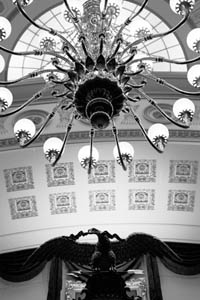
The Golden Eagle representing the strength and unity of The Union is the central piece of the the Old Senate Chambers. (Photo by Michael Sharp)
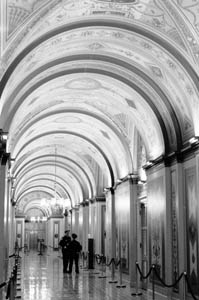
Security guards converse beneath the elaborately painted arches of one of the Capitol Building´s hallways. (Photo by Michael Sharp)
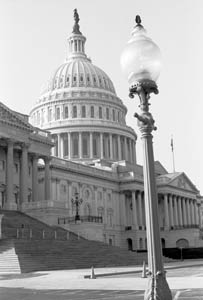
The dome of the U.S. Capitol towers to the sky with a statue of Lady Liberty. (Photo by Michael Sharp)