
Pando: How one tree makes a forest
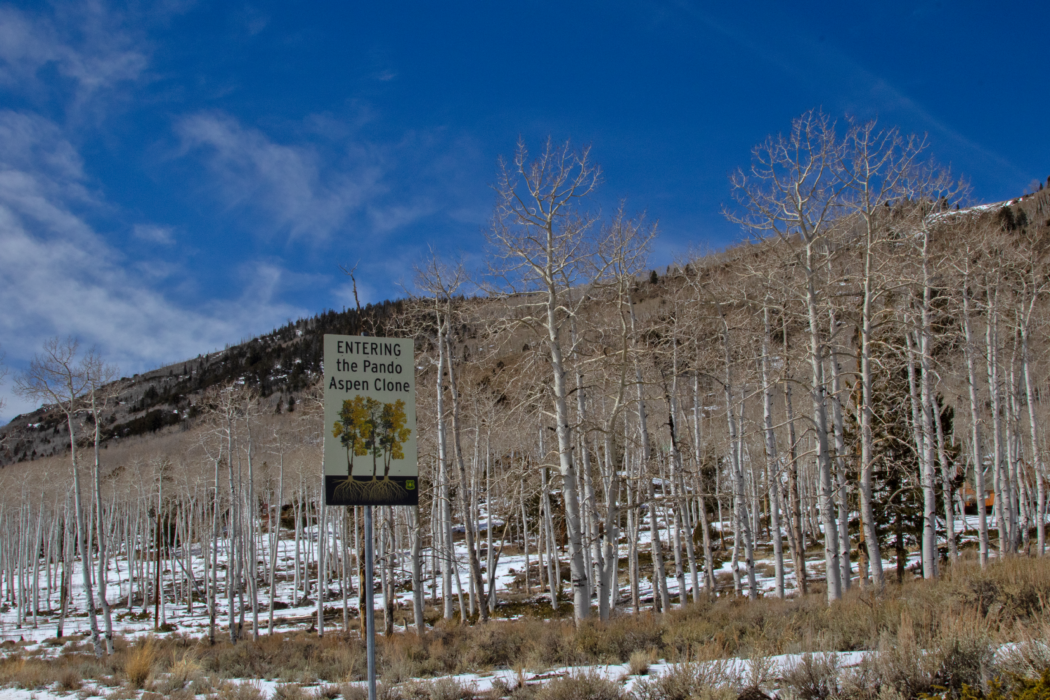
All trees start out as a single seed, but not all trees become Pando, a quaking aspen clone in Utah’s Fishlake National Forest. Over thousands of years, it has grown to span over 106 acres with an estimated 47,000 genetically identical trees.
“It’s been around a long time — certainly centuries if not millennia,” said Paul Rogers, ecologist and director of the Western Aspen Alliance.
According to the United States Forest Service, when the Pando clone was discovered, scientists named it a Latin word that means “I spread.” Pando is an aspen clone that originated from a single seed and spreads by sending up new shoots from the expanding root system.
“Pando is believed to be the largest, most dense organism ever found at nearly 13 million pounds,” according to the Forest Service. First recognized by researchers in the 1970s, it has more recently been proven by geneticists.
Aspens are known for their clonal growth, meaning what appears as a forest of trees is, in fact, a single interconnected organism.
“What we think of as a tree is really kind of a branch,” Rogers said. “The part sticking above ground is only a small part of this larger organism, which is this vastly connected root system.”
Pando’s size and resilience make it a symbol of nature’s endurance. Yet, despite its longevity, the giant clone is in decline.
“If something’s been around for thousands of years and in the last 50 or 75 years, it starts dying off rapidly, clearly, that points the finger back at how we as human beings are interacting with it,” Rogers said.
The primary threat to Pando’s survival comes from an overabundance of deer due to the eradication of natural predators to regulate their populations. When unchecked, deer feast on the young aspen shoots, preventing regeneration.
According to the non-profit Friends of Pando, “The problem with deer, and elk is their preference for eating the stems of new growth and sometimes nibbling on old growth. These action hinders Pando’s ability to keep energy production and regeneration in balance as the new growth either dies, or is unproductive throwing energy production out of balance. When deer or elk eat at the bark of mature trees, they can leave scars which create pathways for diseases and other animals to destroy healthy branches.”
While cattle grazing has also impacted the ecosystem, Rogers emphasized deer pose the greatest challenge.
“All the young ones keep getting eaten, and then you have this giant gap — the tall ones and nothing in between,” Rogers said. “It’s like if you walked into town where everyone was 85 years old. That’s not a very sustainable demography.”
Fencing has been implemented in certain areas to protect the clone, leading to promising regrowth. However, fencing is a temporary solution that fails to address the core issue.
“I call it Pando triage,” Rogers said. “It’s like getting a patient breathing again. But then what? The real issue remains. There are too many animals.”

Fenced-off area of the Pando aspen clone in Fishlake National Forest as seen on March 16, 2025.
Aspens are a keystone species in many forest ecosystems. According to the Forest Service, “aspen communities are found associated with a diverse range of vegetation, from semi-arid shrublands to wet, spruce-fir forest… The aspen ecosystem is rich in number and species of animals, especially in comparison to associated coniferous forest types.” This means their health has a cascading effect on the plants and animals around them.
Natural fire suppression is another issue for Pando’s regeneration. Aspens have a unique reproductive strategy largely dependent on disturbances like fires. When mature stems are damaged or destroyed, the root system sends up new shoots, rejuvenating the forest.
“Aspens are built for resilience but only if we allow the natural processes to occur,” Rogers said. “Without those disruptions, Pando becomes vulnerable.”
Efforts to restore balance in the ecosystem will require cooperation among federal agencies, state wildlife managers and local communities.
“In some way, we need to limit the number of animals that live in that area, but that’s a hard thing to do,” Rogers said. “Ideally, we want the system to run on its own. That’s what our target should be.”
Rogers proposed a variety of measures from selective deer culling to exploring the reintroduction of predators. Though controversial, such measures are essential to maintain Pando’s long-term health.
“Ignoring the core problem for a quick and expeditious fix now often makes the problem bigger down the line,” Rogers warned. “Like climate change or some of the other big issues, we’re pushing it on to somebody in the future, and that doesn’t seem ethical to me.”
Fortunately, Pando has become a focal point for scientific research. Ecologists like Rogers are studying the impacts of different management strategies to determine the most effective long-term solutions. By monitoring the growth of fenced and unfenced areas, researchers can gather crucial data to inform future conservation efforts.
“Science gives us the tools to understand what works and what doesn’t, but it’s up to policymakers and the public to put that knowledge into action,” Rogers said.
Public engagement is also vital. Rogers encouraged visitors to experience Pando firsthand and connect with the landscape. His involvement in the recent PBS documentary on Pando highlighted the importance of storytelling in fostering appreciation and understanding.
“We do really care about these places, and if we can impart even a little bit of that to people, then hopefully you can make some positive improvement,” Rogers said. “We’re looking to make those connections so that people care about places because ultimately it affects us, right?”
Educational initiatives, guided tours and interpretive signage are all part of ongoing efforts to raise awareness about Pando’s plight. By fostering a greater understanding of its ecological role, conservationists hope to inspire broader support for preservation efforts.
Ultimately, Pando’s future depends on a collective effort. Whether through policy changes, public advocacy or conscious land management, the choices made today will determine if this trembling giant continues to endure for centuries to come.
For more information on how to visit Pando and support its conservation, visit the Forest Service website or consider contributing to local preservation efforts.
 Courtesy of Paul Rogers