
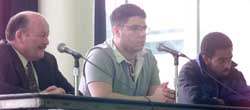
Panel discusses Middle Eastern Islamic issues
Students and faculty met Friday in the Taggart Student Center International Lounge to debate issues surrounding Islamic civilization in the Middle East and how those issues affect the global community.
The discussion was led by James Thomas, a professor in Utah State University’s department of plant, soils and biometeorology. Thomas gained his experience in this field by serving as special adviser to the president of the Arab American University at Jenin, Palestine and as the former associate dean of international programs of the College of Agriculture at USU.
“It is important to talk about what is happening in this land, the Middle East, and what we are going to do about it,” Thomas said, as he explained how Islamic civilization impacts world affairs, with more than one billion Muslims worldwide and 200 million of them living in the Middle East.
Thomas opened the discussion by briefly explaining the history of the Muslim people.
“They were builders and innovators, not just conquerors,” Thomas said. “Islam has produced some of the world’s greatest thinkers.”
Thomas also told of how Islamic civilization made significant contributions during the middle ages in the arenas of science, math, and
technology.
One of the first items discussed was the issue of terrorism and Islamic Fundamentalists. Thomas said a large number of these Islamic Fundamentalists had “hijacked Islam,” and were using it to meet their own political agendas.
“Too often Muslims are connected with violence and terrorism because of this,” Thomas said.
He explained that Islam did not start as a religion of violence and control, but as a group of people striving to follow the teachings of Muhammad ibn Abd Allah, known to Muslims as the Prophet Muhammad.
Thomas said terrorism happens because people are dissatisfied with the status quo, and when they try to protest they are met with force by the governments who don’t want to give up power.
“They go to the streets and get rejected, so then they go to their basements. And what can you do in a basement – build bombs,” Thomas said.
He said that because of this process, the way to remedy the problem would be to allow freedom of discussion in Middle Eastern countries, so that the people could air their grievances vocally instead of having to express their dissatisfaction with violence.
He added that another factor leading to terrorism is that Middle Eastern countries in general are not exploiting their most valuable resource – their people.
“They need to invest in their young people,” Thomas said, explaining that perpetrators of many terrorist acts could have stayed in their countries and used their planning and technological skills to make considerable contributions to the betterment of those countries, if they had been supported by their local governments.
The question was also brought up of whether or not democracy could be the solution to problems in the Middle East.
“My feeling is that [democracy] is the best solution, but it will take some time,” Thomas said.
Mekki, a graduate student from Algeria studying microbiology asked, “If we set up a democracy, what will we do if an Islamic Fundamentalist gets into power?”
He said we need to consider that maybe democracy isn’t the only or best solution.
The issue of education and equality for women was also brought up.
“It is a cultural question,” said Youssef Filali, a sophomore from Morocco majoring in electrical engineering.
He explained that in many countries in the Middle East, cultural norms dictate that the women stay home and lead a more traditional lifestyle, but many do it out of choice, not because they are forced.
“Women all over the Middle East are free to do whatever they want,” Filali said. “We have women who are ministers in our government.”
However, Thomas later said, in some Middle Eastern countries women really don’t have a choice. Filali said that in these countries people are trying to fix the situation.
“It doesn’t take two days to fix it,” he said. “It takes years and years.”
Thomas also said that because of the increasing trend toward globalization, changes will eventually come to the Middle East, because the people will make the change and require their governments to change as well.
“There are no frontiers any more,” said Bill Furlong, professor of political science at USU. “Change is out there, and it’s going to come.”
-sjeppesen@cc.usu.edu