
Peace Corps recruiter comes to USU
When Jonathan Bringewatt tries to recruit students to spend two years in a foreign country, he’s not talking about an LDS mission.
Bringewatt, a Peace Corps recruitment coordinator, came to Utah State University Wednesday to spread the good word about good work – volunteer service.
“It’s a wonderful experience, but also probably the hardest experience I’ve ever had,” Bringewatt said of his two-year stint in Morocco.
A Denver native, Bringewatt visits all the Utah colleges and universities sharing his experience in the Peace Corps. His wife, Becky, and he had graduated from college and were working odd jobs in the mid-’90s. They realized they had forgotten about this idea they had in college “to go experience another part of the world.” The Bringewatts applied in 1998, and lived in eastern Morocco from 1999 to 2001.
“We joined the Peace Corps in order to get out of our own backyard, and have whole other perspective on human existence,” said Bringewatt, who learned a Moroccan dialect of Arabic.
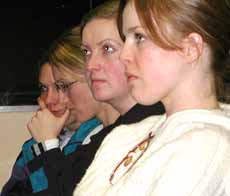
During a slide show and video presentation, Bringewatt explained to the group of 16 students in the University Inn that the Peace Corps, established in 1961 by President John F. Kennedy, is about experiencing another culture and seeing things from a new perspective.
“In addition to your volunteer rose, it’s just as important to get involved in that cultural exchange,” Bringewatt said.
Peace Corps workers can serve in five main areas: education and youth and community development, health and HIV/AIDS education, business development and information technology, environmental work and agriculture. Bringewatt said the area that requires the least expertise is education and community development. That’s why 38 percent of volunteers work in that area.
Bringewatt also said an applicant cannot choose where to serve, although he or she may have “regional preferences.” There are now 71 countries in which laborers live, according to www.peacecorps.gov.
The Peace Corps only works in countries it has been invited to. Safety is an issue, too.
“We’ve pulled out of Haiti, of course,” Bringewatt said.
The idea of joining is intriguing to students for many reasons.
“I’ve been wanting to do a big service thing for a long time,” said Mark Dean, a watershed science senior. “It will give me some experience, and when I get back, I’ll be able to find employment pretty easily with this volunteership under my belt.”
Bringewatt noted that one perk of corps service is a guarantee of “noncompetitive eligibility for federal employment.” It doesn’t ensure a job, but it gives Peace Corps veterans a good shot at jobs available only to government workers.
Rob Ortega, a senior in psychology, has already started the application process for next summer.
“I just kind of wanted to go out and see what it’s like outside of the country, see what it’s like in another country without a McDonald’s and Wal-Mart,” he said.
He also said he wants to meet people, experience something new and learn a language. He knows some Spanish, but would like to master it.
Bringewatt said only 9 percent of volunteers are married, but he and his wife went together. Brenna Pearson, a freshman studying social work, hopes to do the same.
Pearson’s engaged, and she said she and her fianc would be more likely to go if it wasn’t so long.
Bringewatt said the program is for 27 months, and it’s not really negotiable. The first part is mostly for language training with other volunteers, and the rest of the time, “you might be the only American in town.”
“After three months, you are officially sworn in as a Peace Corps volunteer,” he said, adding that the final 24 months are all spent in generally the same area.
Where that area is, is mostly left up to an applicant’s language proficiency, skill level and company need, Bringewatt said.
Also, most jobs within the corps require a four-year college degree. Even master’s degrees are required for some high-level teaching and business programs. But, once a volunteer gets in the field, all expenses are paid.
But not everyone is eligible. Bringewatt said volunteers must be 18, a U.S. citizen and have a sense of adventure. He said the hardest part is probably the commitment to live for two years without all of the amenities to which Americans are accustomed. Bringewatt said a volunteer may have to wash clothes by hand, bathe in a washbucket and eat some unusual foods.
“I was able to even eat interesting organs,” he said.
Although people don’t go to make much money, a living allowance is provided. At the end of service, volunteers receive a $6,000 stipend. Bringewatt welcomed the money, admitting he couldn’t have saved that amount in two years working a 9-to-5 job.
The recruitment at USU has been successful; Aggies have served in 16 countries over the years. Bringewatt said there are four students who are working overseas right now, and six more have been nominated for 2004 departures.
The campus representative for the Peace Corps is Clint Collins, a graduate student in vocational rehabilitation. He can be reached at peacecorps@cc.usu.edu and for information, visit www.peacecorps.gov.
-marklaroc@cc.usu.edu