
Pennsylvanian professor gives polygamy lecture
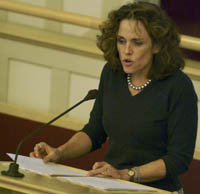
Sarah Barringer Gordon, a renowned legal historian who has studied the legal history of polygamy in The Church of Jesus Christ of Latter-day Saints, spoke about her findings and the challenges of her research Friday at the 11th-annual Leonard J. Arrington Mormon History Lecture.
Gordon, a professor of law at the University of Pennsylvania, has centered her research on polygamy-related court documents from territorial Utah. She said one of the biggest challenges in her research has been the huge amount of information she’s had to pore over.
“I thought it was a mountain before I came to Cache Valley and saw these enormous mountains,” Gordon said. “So now I say it’s a hill of material.”
Gordon said that of 2,657 criminal cases prosecuted in territorial Utah from 1871-1896, 95 percent were polygamy related, a category in which she groups not only charges of polygamy and bigamy, but also incest, adultery, fornication and unlawful cohabitation. She said the high rate of polygamy prosecutions did not yield very good conviction rates, but were vigorously pursued anyway.
“In particular, they disagreed about the role of women,” Gordon said. “It was not simply about economics. It was a wide-range attempt to articulate the institution of marriage. It was a story of institutions trying to elbow out competing forces.”
In her research, Gordon said she found lots of evidence of segregation of charges. Instead of prosecuting a man for polygamy, which was a felony, prosecutors often charged him with one count of unlawful cohabitation for each wife because it was much easier to get a conviction. Unlawful cohabitation was only a misdemeanor.
“But if one could convict any man of several counts, it gets closer to a felony,” Gordon said.
Gordon said that the polygamy question is relevant in modern times because it is a symbol from the past that parallels separation of church and state issues today.
“Issues of church and state are all over politics and they show no sign of leaving anytime soon,” Gordon said. “As I keep telling my colleagues in Philadelphia, we can all learn a lot from Utah.”
The lecture, which was held in the Logan LDS Tabernacle, was appropriately placed, according to Arrington Lecture Board member Gary Anderson, who introduced Gordon.
“There’s a room behind us, up above, where polygamists used to hide,” Anderson said. “When U.S. marshals were out and about, it was a place of refuge.”
Gordon questioned the popularly held belief that polygamy was prosecuted entirely for economic reasons to take down the power of the LDS church.
“My own research on the subject convinces me that most people were not, in fact, that cynical,” Gordon said. “What [prosecutors] would do, however, is connect the practice of polygamy with power. You just don’t see the levels of cynical power grabbing if polygamy was just an excuse. But I do think that many people severely opposed it, so they thought they could gain some advantage and still be doing good.”
In conjunction with the lecture, the Arrington Lecture Board is sponsoring an essay contest for all Utah college students. Students who attended the lecture may enter the contest, employing issues raised by Gordon into research of their own. Three winners will receive $250.
Gordon encouraged the audience to always keep trying in research, even when information is hard to find.
“If you look carefully, there is a great deal of information to be gleaned from even a sparse record,” she said. She said good research requires respect for the past, insight and generosity.
Gordon also praised her friend and co-researcher Catherine Dane, who she said has been a great help to the project.
“Research of these records demands collaboration and cooperation,” she said.
-jenbeasley@cc.usu.edu
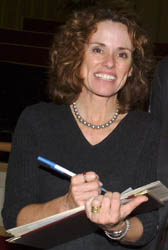
Sara Barringer Gordon signs papers after her lecture on polygamy in Utah last Thursday in the Logan Tabernacle.