
Preserving memories and dead animals
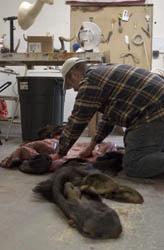
“It’s a busy time of year, during hunting season,” said Daniel Wegener, owner and operator or Logan’s Drop Tine Taxidermy. For many people, having their harvest, another term for their kill, mounted is a regular part of hunting season. Wegener says, “[it is] a way to preserve your trophy and memories of time with your family and friends.” It can help the hunter always remember that special kill of theirs, a “great one, a first one, or a pretty one.”
Mounting is a complex process that has been refined and improved immensely as technology has changed over the years, said Wegener. The process varies depending on the type and size of animal and the type of mount being done-whether it is just the head and antlers, as is most common with large game, or the whole animal.
According to Wegener, the work of taxidermy is done primarily on the skins of the animals, although some bones may also be used. The skin is salted, pickled, and tanned to ready it for mounting. Then, it is placed on a form, which comes in many different shapes and sizes. Additional detail is added using clay moldings and airbrushing to simulate muscles and texture. Finally, glass eyes are added and many pins and nails are used to keep the skin in place and, if needed, mount it to a plaque or wall.
Although this similar process is used with all taxidermy, Wegener says that every project is unique and “everything has a hitch in it,” some problem to work around. He describes the work as a “big art project” that requires an “underappreciated” attention to detail and skill. “Some people are happy just to have [a mount with] a huge rack [of antlers or horns], but it is the detail in the face” that defines the quality of the work.
Technological innovations have allowed taxidermists “endless possibilities” in working with animals and perfecting lifelike details, said Wegener. Now, molds can be made the fit animals exceptionally well in a variety of poses, where in the past skins were forced to fit around a limited number of inflexible molds.
These new technologies have even allowed for the development of crypto-taxidermy, where mounts are created of animals that are fictitious or do not exist anymore, such as a werewolf or dodo bird, using the skins of real animals.
Many animal rights advocates are ardently against taxidermy. Jason Hardy, Wildlife Coordinator for the Utah Animal Rights Coalition says that taxidermy can be dangerous because it is often done by amateurs and because of the environmentally harmful chemicals involved in the processes. Mostly, however, Hardy said that taxidermy “glorifies unnecessary killing.”
However, Corrie Wallace, a Wildlife Science Major at USU and former USU Wildlife Society President and Current Vice President, said that mounts of animals can be educational – allowing students to see the fur and bone structure of animals that can’t be viewed otherwise. Additionally, Wallace says that mounting allows people to “enjoy the beauty of the animal for a long time.” Wegener agrees, saying that he became a taxidermist because he “wanted to be around wildlife” for a career.
Many different animals can be mounted.However, the process should begin as soon as possible after the animal has been killed, according to Jim Campbell, owner of Campbell Taxidermy in Wellsville.
At Drop Tine Taxidermy, the price varies greatly depending on the size and type of animal, ranging from $150 for small ducks to $3,500 for a full moose.