
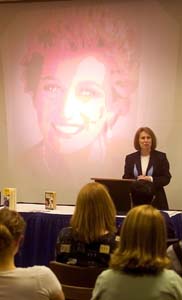
Princess Diana: We’re still talking about her
You would think it would die away – discussing the life and death of Princess Diana.
But it hasn’t.
This was the issue presented in “Princess Diana and the Touch of the Past” by Caroline McCracken-Flesher, an associate professor of English from the University of Wyoming in the Eccles Conference Center Tuesday.
“Is the past the past, and should it be?” McCracken-Flesher asked at the beginning the lecture. And perhaps a more answerable question is, “Can it be?”
With the amount of press, from books to television, the answer, she said, is: Princess Diana is our present, our past, ourselves.
McCracken-Flesher feels there are similarities of Princess Diana’s relationship to the medieval kinship.
“Diana Windsor has seemed the most modern of princesses, bopping along palace corridors, tripping through Kensington in Gucci pumps, dancing onstage with Wayne Sleep or leaning toward an AIDS patient,” McCracken-Flesher said. “But in touching the sick, engaging our sympathies, catching our attention for her tawdry affairs and bodily excesses and becoming a national sacrifice through premature death, she represents the medieval as well as the modern.”
McCracken-Flesher said Princess Diana’s death relates back to ancient religious ideas still in operation today.
Before Christianity reached northern Europe, many cultures maintained the idea of a sacrificial monarch. The monarch’s body expressed the health of society, so if things weren’t going well, he was ready and supposedly willing to sacrifice. Then when Christianity came, it connected with a myth of a Christic King, in which he bears the sins of his people. His talents may be considered godly and his death is a renewing sacrifice.
McCracken-Flesher said Diana died because of society’s insatiable need to see images of her, although not all Britons saw her as a sacrificed Christ.
“[Yet] the seas of tributes around her home at Kensington Palace made her death a public and spiritual communion embodied in flowers,” she said.
Princess Diana’s death confirmed her, in British myth, as the King gone to return in time of need, the archetypal sacrificial king.
McCracken-Flesher also related how everyone felt they could relate to Princess Diana when she was alive: She wasn’t just the Queen of England, she was the queen of people’s hearts.
“Princess Diana brought a connection to us,” she said. “Princess Diana was Cinderella, an anorexic girl, a divorcee, a single parent.”
She took away the stigma after admitting to being anorexic, McCracken-Flesher said. And her death united the world with all the people that felt connected to her.
“All the flowers [at Kensington Palace] represented all the people she identified with,” she said.
Although, McCracken-Flesher said she never met Princess Diana she was an uninvited guest at her wedding.
McCracken-Flesher has two books coming out including, “Possible Scotlands: Walter Scott” and “The Story of Tomorrow” and “Diana: the Postmodern Princess and the Narratives of History,” which she is co-editing. She is also editing a book on the cultural backgrounds to the new Scottish Parliament.
McCracken-Flesher received her doctorate from Brown University, has a master’s from Edinburgh and studied two years at Oxford.
-acbailey@cc.usu.edu