
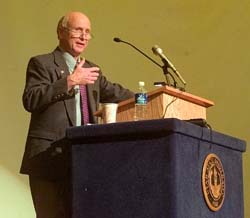
Professor gives ‘Last Lecture;’ discusses controversial topics
Called “knowledgeable,” “witty” and “overwhelmingly qualified” by students who nominated him, political science professor WIlliam Furlong was chosen to give the annual “Last Lecture” Thursday.
The lecture, sponsored by the Honors Department, is designed to give a professor a chance to speak about what he or she wants to – as if it were the last time speaking on campus – but hasn’t necessarily had the chance.
“I’m giving this lecture as if it were my final lecture,” Furlong said. “As if I’d go home after this and garden for the rest of my life.”
The political science professor and Pi Sigma Alpha (political science honor society) adviser was chosen from a group of professors nominated by Honors students a few months ago, Honors secretary Kay Gamble said.
“This was totally student-initiated and decided,” she said.
Three Honors students were chosen to interview the professors nominated and chose one to speak at this year’s 29th annual lecture, Gamble said. Furlong apparently met all qualifications and impressed the students enough for them to pick him.
The author of numerous books about foreign policy with Latin America spoke about freedom of speech, religion in the classroom and classifying professors by their ideology.
“I have gained a real appreciation for the First Amendment,” Furlong said.
After spending time in Central and South America, in countries that don’t have the same rights citizens of the United States do, Furlong said not only is free speech important, but open-mindedness and civility are as well.
“Today’s society has lost much of its civility,” he said. “That’s put a damper on free speech.”
The speech was titled, “Academic freedom and political correctness: Teaching controversial topics constructively.”
“I don’t usually pick on my classes with this kind of stuff,” he said after the lecture. “I think I opened up some issues that need to open up.”
Furlong stressed that both teachers and students need to be open-minded.
“We, as teachers, should be as open-minded as we expect students to be,” he said. “It’s unfortunate that papers are sometimes graded based on ideology.”
Also unfortunate, he said, is the recent increase in Web sites around the nation that evaluate professors based on how liberal or conservative they are. Furlong indicated that the reason for so many liberal professors is perhaps a reflection of studies that show those with higher degrees are more liberal than those without. Conservative students in the political science program, he said, usually go on to law school, not to get master’s and doctorate degrees to teach.
Furlong cited his experience with those in Central and South America who have totally different ideological beliefs than he as examples that those who disagree politically can get along otherwise.
“Our difference in ideology did not really prevent communicating,” he said. “If you disagree on things, agree to at least communicate.”
After emphasizing a need to listen and try to understand others, Furlong ended his speech encouraging teachers to put teaching before their research.
“Teaching has been marginalized,” he said. “It’s a disservice for students for faculty members to not be concerned with teaching.”
Gamble said after listening to his lecture, she could “see why people in the political science department like him.”
Students who nominated Furlong to speak wrote a paragraph about why he would be a good choice, Gamble said. Some of the anonymous information said he has “the best interplay with students during class discussions I’ve ever seen,” “communicates with students well” and “although he does interject his own opinions he makes [students] think and encourages us to make our own decisions.”
Gamble said she could see because of his experience in his field why he is such a good teacher.
“It was a wonderful last lecture,” she said.
-emilieholmes@cc.usu.edu