
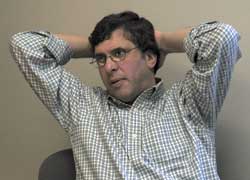
Professor Profiles: The importance of history
Perhaps history repeats itself.
Or maybe historians merely repeat each other.
But either way, for many people, the present would seem meaningless without knowledge of the past.
For Leonard Rosenband, a professor of French and European economic history, that meaning comes from a study of documents and historical records, which he says open up worlds dramatically and distinctly different than our own.
“Without [the study of history], the world would be two-dimensional and flat, which in and of itself would not be terribly satisfying,” Rosenband said. “We learn from the past about how limited our grasp of current circumstances really is. Our deep arrogance about our own capacity may blind us to our own limits and thinking about the past – the choices people made in the past and the limits and the opportunities and their optimism and their pessimism and the universe they inhabited – should remind us that they thought they, too were masters of their world and, like us, they, too found their mastery more limited than they had anticipated.”
Rosenband came to Utah State University in 1983 in the midst of the lasting consequences of the oil crisis of 1973-’74, which took about a 15-year toll on the academic job market, because there weren’t any other jobs.
He said he chose to stay, despite offers from another university, because he likes the mountains and the teaching.
“[At USU], I was able to produce the scholarship that I wanted to produce,” Rosenband said.
That scholarship includes a 20-year research and writing project that resulted in the book “Papermaking in Eighteenth Century France: Management, Labor, and the Revolution at the Montgolfier Mill, 1761-1805,” which recently completed translation into French. Rosenband said he expects to receive a copy of the translated work within the next week or two.
“I oversaw the translation of every word and haggled with the translators over every phrase,” Rosenband said. “But it is complete and I’m pleased about that. It is not a commonplace thing for a scholar to have his work translated and to appear in such a distinguished series.”
Currently, Rosenband is working on another book comparing French and English papermaking from 1650 to 1850.
“Papermaking was a good industry to study if you’re interested in early industrialization, because it was both capital-intensive and labor-intensive and, as a consequence, there was something at stake when labor relations went sour,” Rosenband said. “[The book is] largely a way of thinking about the Industrial Revolution.”
In addition to his scholarship, Rosenband teaches a number of courses, including a breadth humanities course on modern Western civilizations.
“I like the students,” Rosenband said. “I had one student who was so brilliant that he leaves me in the dust in our weekly conversations and I’ve had some students that couldn’t read “STOP” on the sign, and I’ve had everything in between. One of the joys of teaching here is helping those who don’t think very much of themselves learn that they have more potential than they imagine. The students have more potential than they believe. They need to believe in themselves more than they do.”
As a self-described economic historian, Rosenband said he believes that his field will progress as the questions historians ask about the past change in relation to new evidence and contemporary pressures.
“I think historians practice an art, a craft, which has its own procedures, and I think those [procedures] will stay largely in tact. I think the future of what we do will always be influenced by issues that surround us,” Rosenband said. “The questions come and go, but the techniques are more consistent.”
Rosenband says he views history from hybrid convergences and divergences, examining the ways in which economic life is lived and experienced.
“Most of my work turns on moving away from the Cold War approach that frames most of the industrial history since WWII. My approach to economic history is framed by all of [the economic theorists]. It’s not just Smith or, for that matter, Weber, Ricardo or Marx. What I try to do is look for an interplay of all the elements,” Rosenband said.
Though his academic life depends on the amount and accuracy of historical documents, Rosenband said he believes there are a great number of things that records can never tell us.
“It would be wonderful [to visit the past],” Rosenband said. “It would be wonderful to see Robespierre’s face when he’s talking about virtue and terror, or Jefferson’s face when he’s talking about the enterprise of personal rights and property rights. It’s one thing to say in a document that something smells; it’s another thing to smell it yourself. The documents give us a glimpse, a snapshot of life in the past, but to actually be there would be to allow us a whole sense of sensory experiences that are simply beyond our navigation from the documents that we have.”
There are a number of reasons students ought to be interested in the study of history, Rosenband said. For example, the study prepares them for life outside the walls of academia by teaching them to write a coherent, effective essay, which can help students as they work in legal, government and administrative offices.
“[A study of history] should give them an opportunity beyond their expressive skills to analyze and to analyze in a way that’s open-minded,” Rosenband said.
Currently married, with a daughter who is working in the press office for the governor of Illinois, Rosenband said he has enjoyed a number of activities beyond history over the years, including basketball, hiking and listening to jazz music. However, his wife, who is a graduate student at USU working toward a degree in family and marriage therapy, still has to deal with his love of history.
“I certainly don’t leave [my work] here,” Rosenband said. “Does [my wife] find it interesting when I bring it home? Sometimes, and sometimes she finds it obsessive when I bring it home, and sometimes she’s right.”
Born in Brooklyn and raised at the edge of Queens in New York City, Rosenband said he has always been interested in history and has a B.A., M.A. and Ph.D. to prove it.
“It’s been a lifelong devotion,” he said. “I have an elaborate sense of the past born of being Jewish, which gives me a particular vantage. One has to attend to the Holocaust and its meaning. There’s racism and extermination, [and] it also raises questions about where one fits in American society. Am I an American Jew or a Jewish-American? Marx said that we all make our own history, but not precisely in ways that we can govern. And in a funny way, I think that growing up where I did with the ethnic background that I did with the family sensibility that I had, provoked in me a sense of history to the extent that I had to make sense of a world that might be open to me, or might not.”
Though he has been exposed to a narrow-minded spectrum in his teaching and occasionally has been the subject of certain kinds of abuse, Rosenband said that, on the whole, Cache Valley is more complicated than people who don’t live here can begin to realize.
“I heard a statistic on NPR that the four most segregated school systems in the United States are in New York, Illinois, Massachusetts and California – all of which tend to vote more liberally than Cache Valley,” he said. “Yet, when I walk past Hillcrest school on my way home, I notice kids of every color and every ethnicity, and probably every faith, racing along trying to run me down on their little bicycles. That level of successful integration, which is incomplete, but nonetheless real, would probably come as a great shock to people outside of Cache Valley.”
Though working hard to balance his scholarship and teaching, Rosenband gives proper priority to helping students.
“We have a large number of people who need to have their imaginations widened,” he said, “they need to understand things in a more complex and sophisticated manner that comes with the inherent analytical aspect of advanced education.”
-mattgo@cc.usu.edu
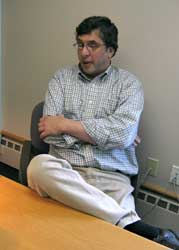
Leonard Rosenband explains how he helped in the translation process for his book about the history of the papermaking industry in France during the 18th century.