
Professor studies mice to understand obesity
With obesity reaching epidemic proportions, Tim Gilbertson is studying fat perception to aid in the war on obesity, the disease of the new millennium.
“Like most scientists,” said Gilbertson, an associate professor of biology. “I am driven by the question.”
The question at hand being how to combat the rising U.S. obesity rate. Gilbertson is studying taste, specifically fat perception, in an attempt to explain the average American’s predisposition to becoming over weight.
Gilbertson is breaking new ground in the science of taste. However, the path of his career has changed much over time. He started out pre-med at the University of California in San Diego majoring in biology and psychology. After some exposure to the medical field, in time Gilbertson chose instead to attend graduate school at the University of California – Davis, studying the nervous system.
There Gilbertson was attracted to the cellular and molecular components of the nervous system, he said, but due to the complexity of the brain found the best avenue of answering neurobiological questions to be through the senses.
Gilbertson’s first faculty position was at Louisiana State University where his department was involved in more nutrition based research. There he became more interested in studying nutrition, more exactly obesity and fat intake. However, after having had a taste of the Intermountain West during his post-doctorate fellowship at Colorado State University, he could no longer silence the beckoning call of the Rockies and fled the humidity of the South.
“One of the things that attracted me to Logan and Utah State was the recreational side of things – to be able to ski and mountain bike and do all of this close to my work,” Gilbertson said.
Gilbertson has been at USU for four years and is currently an associate professor as well as associate department head in the biology department. He also teaches several upper division biology courses. BIOL 5100/6100: Neurobiology, is Gilbertson’s favorite class to teach since it is so central to his research, he said.
Gilbertson’s research is being funded by several agencies with more than $3 million coming from the National Institute of Health, which includes just over a million for research on the mechanisms of peripheral fat detection. Gilbertson plans to renew this five year grant at the end of the year.
Through his research, Gilbertson said his team has identified a number of fat receptors in the taste system along with other organs involved in the recognition of dietary fat. However, his focus is not the taste system itself, he said, but more the mechanisms of cell communication that affect behavior. To investigate this he uses rodents since they exhibit dispositions to obesity similar to those that also affect humans.
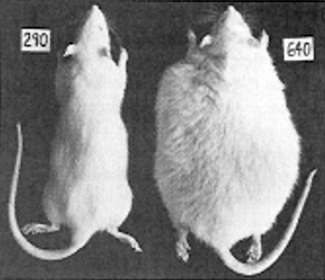
Gilbertson has found that rats and mice are useful for understanding obesity since populations that are prone to obesity are a great model of the typical American. He has found that when given the choice of foods the obesity resistant strain prefers carbohydrates over fats, where as the obesity prone strain prefers fats.
He has found that when both populations are fed the same high-fat diet the obesity resistant strains adjusts its eating habits to maintain a normal weight whereas the obesity prone strain “is a good model for what’s going on in this country, as far as dietary-induced obesity,” he said. “We always call it our ‘typical American.'”
He added that the “typical American” strain seems to be lacking the ability to perceive, and therefore control its caloric intake so it consistently overeats becoming obese.
According to Gilbertson, 70 percent of Americans are overweight and one third are obese. And, as a result of obesity more than 300,000 American’s lives are shortened each year. Gilbertson said that eating a healthy, balanced diet and exercising is the cure for the country’s obesity problem. However, since that pill is a little hard to swallow for most, Gilberson said his research is aimed at understanding how the body perceives fat so that more pharmacological approaches to solving the obesity issue may be developed.
Gilbertson said that the hope is to develop “a more acceptable fat substitutes for the consumer – something that they like as a food additive, so that they are satisfied with eating less fat.” This will allow people to still eat and live how they want with out all the serious effects of obesity, he said.
-chasep@cc.usu.edu

Tim Gilrbertson relates about his research to find out why Americans tend to be overweight. (Photo by Jamie Crane)