
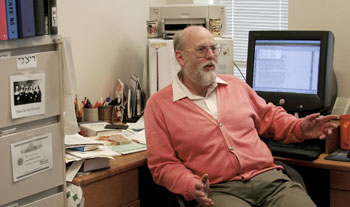
Professor takes an academic perspective on sex and religion in the human race
Being a student for life might not be an intention for most people, but for anthropology professor Richley Crapo, it is why he does what he does.
“Anthropology appeals to me because I realized that it is a field of which you could spend your entire career continuing to be a student and learning new things that you hadn’t known before,” Crapo said.
Crapo has been a part of Utah State University’s anthropology department for more than 35 years. In fact, USU was the first place he came to after finishing his doctorate at the University of Utah.
But, the study anthropology was not his goal in life when he first headed to college.
He began at the California Institute of Technology as a math major and then switched to German where he took a North American Indian class as an elective, which sparked his interest in anthropology.
“Basically, I got converted by taking a class coincidentally just to fill in an elective and it turned out to be much more interesting than math or German would have ever been,” he said.
His interest in Native American cultures continued and he completed his disertation work on the Shoshone Indian culture located in Nevada.
Although he still researches Native American cultures and languages, much of his current work of study involves the anthropology of sex and religion.
His favorite class, which he usually teaches in the spring is the Anthropology of Sex and Gender. “It deals with very political topics – topics that grab people’s emotions,” he said, such as spouse abuse, rape, child abuse, prostitution and pornography. And, he said, it takes a modern look at issue.
“[The class] involves students so much. They don’t sit there quietly like they do in some classes,” he said. “There is a lot of discussion back and forth and they really do read their assignments and come back to class with an opinion on each topic so the discussion could be quite lively.”
With his interests on religion, Crapo has been and continually researches the culture of the Church of Jesus Christ of Latter-day Saints, specifically.
“For at least 20 years, I’ve looked at a lot of LDS culture,” he said. “I’m especially interested in diversity within LDS culture. Every human group, including religious ones where conformity is emphasized, is in fact diverse.”
He said he has been particularly interested in study of the spiritual lives of gay and lesbian Mormons.
“A lot of many LDS people have probably never even stopped to think that there are gay and lesbian members as well as heterosexual members. I was interested in learning more about that phenomenon – what it means to somebody who is LDS or converted to the LDS religion if their sexual orientation doesn’t have the neat fit. There are active members who don’t fit the mold.”
He is currently teaching Mormon Studies this semester in the anthropology department.
“The LDS religion is very interesting in terms of its characteristics. It is a very distinctive Christian tradition that doesn’t either fit the Catholic or Protestant mold. It has features of both,” he said. “There is distinctive beliefs that set it apart from other religions. It is almost like traveling to another country to do research in some ways.”
Crapo is currently on the committee to establish a Religious Studies program at USU, which is slated to go in effect in the Fall of 2007. He said the study of religion is important in an academic setting.
“Human beings are the only religious animal in the world,” he said. “So, I don’t believe anyone can say they understand human beings if they don’t have some basic understanding of the nature of religion, because it is an important part of human experience found in every culture. The majority of human beings are religious. If we don’t understand religion, we are ruling out a very aspect of the human condition.”
He also said an academic understanding of religion will give different insights that cannot be experienced through the religion itself.
-joelfeathers@cc.usu.edu